Group · Sweet foods
Barley sugar
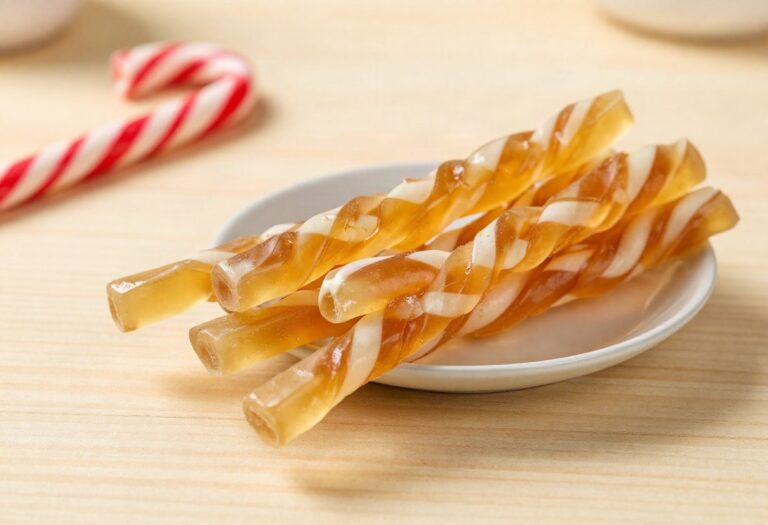
Barley sugar is an old-fashioned sweet, traditionally shaped into twisted sticks or translucent lollipops. Its name comes from the original recipe, in which sugar was boiled with a decoction of barley, giving it that characteristic amber tint. Today it is made mostly of boiled sugar with flavouring (vanilla, fruit, mint), sometimes coloured. It is a hard sweet with no fat or protein, firmly in the sugary foods family. With around 384 kcal per 100 g and nearly 95.3 g of carbohydrate, barley sugar is an occasional pleasure rather than an everyday food. It is enjoyed slowly, for its indulgent and nostalgic side, in moderation as part of a balanced diet.
Macronutrient breakdown
Nutrition table per 100 g
| Calories | 384 kcal |
| Kilojoules | 1630 kJ |
| Protein | 0,2 g |
| Carbohydrate | 95,3 g |
| Fat | 0,2 g |
| Fibre | 1 g |
Micronutrients per 100 g
All measured nutrients, ranked by share of the daily reference intake.
- Total omega-30,1 g4 %
- Copper0,03 mg3 %
- Iron0,3 mg2 %
- Magnesium3 mg1 %
- Manganese0,01 mg1 %
- Phosphorus3 mg0 %
- Calcium3 mg0 %
- Vitamin B10 mg0 %
See the other 7 nutrients
- Potassium5 mg0 %
- Vitamin B20 mg0 %
- Vitamin B60 mg0 %
- Iodine0,3 µg0 %
- Vitamin B50,01 mg0 %
- Zinc0,01 mg0 %
- Vitamin B30,01 mg0 %
Anses Ciqual 2025. Source: Anses, 2025, Ciqual food composition table
Tips
Barley sugar is above all a treat. In terms of nutrition facts, its composition is simple: almost 100% carbohydrate in the form of sugars, no fibre, no protein and a trace of fat. Its glycaemic index is high, as it is pure sugar that dissolves quickly and hits the body all at once. A single lollipop or stick (around 15 to 25 g) already provides 60 to 100 kcal: no need to eat several.
For how to eat barley sugar wisely:
- Keep it for an occasion, a festive snack or a one-off treat, rather than automatic nibbling.
- Let it melt slowly in your mouth to prolong the enjoyment without reaching for another.
- Avoid eating it just before bed, for the sake of your oral hygiene (sticky sugars encourage tooth decay).
- Store it somewhere dry, in airtight wrapping, as it quickly becomes sticky in humid conditions.
If you are watching your weight, bear in mind that barley sugar represents empty calories, that is, energy without micronutrients. To understand this concept better, you can read our article on empty calories and their alternatives. Moderation is the rule: a barley sugar now and then is not a problem in a varied diet, but making it a daily habit can quickly push up your intake of added sugars.
For active people, barley sugar can be useful on occasion: it is a source of fast carbohydrate, easy to carry and to eat during a long, intense effort (endurance race, bike ride) to quickly restart your energy. For recovery, however, it is better to combine carbohydrate with protein: a proper high-protein snack will be far better suited than a simple sweet. Remember to hydrate too, as sugar alone does not cover your needs.
If you like nostalgic sweets, you will find indulgent cousins in the same category, such as fruit jellies or nougat, just as sugary. To compare their contents and make informed choices, explore the whole sugary foods family. The main thing is to enjoy these little pleasures without guilt, but in moderation, favouring quality and occasion over quantity.