Group · Herbs & spices
Vanilla pod
The vanilla pod is the fermented fruit of a climbing orchid, Vanilla planifolia. Each flower is pollinated by hand, and the pod then needs several months of scalding, steaming and drying: it is this work, not the rarity of the plant, that makes it the second most expensive spice in the world after saffron.
In terms of nutrition facts, the page shows 288 kcal per 100 g, with 13 g of carbohydrate, 13 g of fibre, 1.2 g of protein and 0.1 g of fat. A figure with no practical use: a pod weighs two to three grams, you scrape out the seeds and throw away the husk.

Macronutrient breakdown
Nutrition table per 100 g
| Calories | 288 kcal |
| Kilojoules | 1205 kJ |
| Protein | 1,2 g |
| Carbohydrate | 13 g |
| Fat | 0,1 g |
| Fibre | 13 g |
Tips
It lets you use less sugar, and that is its only nutritional effect. The brain reads the aroma of vanilla as a signal of sweetness. A split pod in a custard or rice pudding lets you remove 20 to 30% of the sugar without anyone noticing. On a family dessert, that counts for far more than any nutrient content.
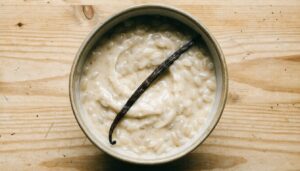
Split, scrape, and keep the husk. The seeds go into the preparation; the husk infuses in the hot milk, then is rinsed, dried and slipped into a jar of sugar or salt. One pod is used twice.
Vanilla, vanillin, flavouring: three different products. Synthetic vanillin reproduces just one molecule out of the two hundred in a pod. It costs a hundred times less and shows in use: it gives a flat note without the length of real vanilla. A label saying « natural vanilla flavouring » does not mean the pod was used.
A supple pod is a good pod. It should wind around your finger without breaking and smell strongly through the packet. Dry and brittle, it has lost most of its character. The white crystals on the surface are not mould but crystallised vanillin: a good sign.
Storage. In an airtight tube at room temperature, never in the fridge, as cold dries it out and encourages mould. It keeps for two years this way.
Sources
Average nutritional values per 100 g, provided for guidance only (spices and condiments are eaten in small amounts; values vary by brand and preparation).