Group · Dairy
Tête de Moine
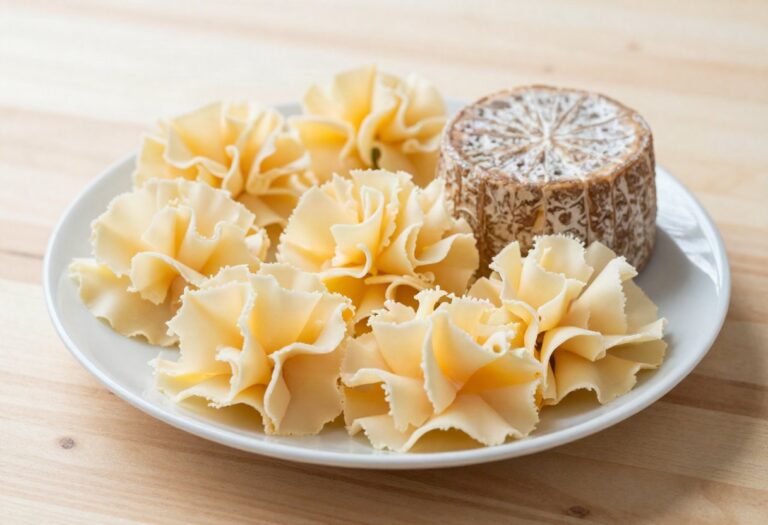
Tête de Moine is a Swiss cheese from the Bernese Jura, born at Bellelay Abbey in the 12th century. Its particularity is not its taste but its geometry: it is not cut but scraped into rosettes with a girolle, which multiplies the surface in contact with the air and releases its aromas.
In terms of nutrition facts: 415 kcal per 100 g, one of the highest in this family, with 34.5 g of fat of which 21.5 g is saturated, and 25.5 g of protein. It carries 2 g of salt per 100 g.
Macronutrient breakdown
Nutrition table per 100 g
| Calories | 415 kcal |
| Kilojoules | 1720 kJ |
| Protein | 25,5 g |
| Carbohydrate | 0,5 g |
| Fat | 34,5 g |
Tips
415 kcal: this is the densest cheese in this selection. Its long maturing and low moisture concentrate everything. A sensible portion is a few rosettes, about 20 g and 83 kcal.
The girolle is not a gimmick. The very thin rosettes melt in the mouth and seem more aromatic than the same quantity in cubes. The practical consequence: you naturally eat less for the same enjoyment.
2 g of salt per 100 g. In the upper average for pressed cheeses. At a drinks party where the rosettes keep coming, the total mounts quickly: see salt.
It dries out very quickly once cut. Keep it wrapped in film on its cut face, at the bottom of the fridge, and scrape at the last moment. A Tête de Moine scraped in advance loses most of its appeal.
Raw milk. Like most Swiss PDO pressed cheeses: not recommended for pregnant women or people with weakened immune systems.