The 20 lowest-calorie cheeses (ranked by kcal per 100 g)
The short answer
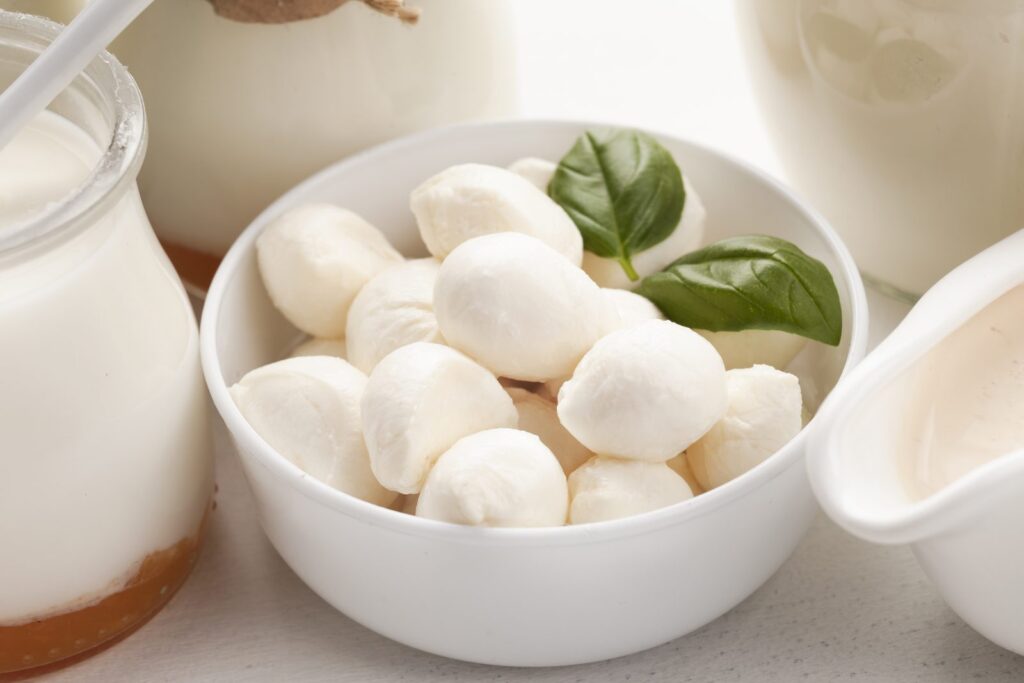
Faisselle (a fresh, drained curd cheese) tops the ranking with 36.8 kcal per 100 g, which is twelve times fewer calories than a dry goat’s cheese at 440 kcal. But the figure per 100 g is not the real yardstick: the portion is. A 30 g slice of Comté comes to 124 kcal, a spoonful of faisselle to 11 kcal, and between the two, salt and calcium matter as much as calories.
The ranking of the 20 lowest-calorie cheeses
Ciqual 2025 values per 100 g, sorted by increasing calories. The entries link to the site’s food pages, each of which gives the full profile.
| Cheese | kcal / 100 g | Fat | Protein | Calcium | Salt |
|---|---|---|---|---|---|
| Faisselle | 36.8 | 0.05 g | 4.43 g | 120 mg | 0.13 g |
| Fromage blanc 0% | 48.4 | 0.28 g | 7.19 g | 150 mg | 0.09 g |
| Fromage blanc | 80 | 2.83 g | 6.87 g | 134 mg | 0.09 g |
| Petit-suisse | 137 | 9.89 g | 9.01 g | 105 mg | 0.075 g |
| Semi-skimmed milk ricotta | 138 | 10.7 g | 7.96 g | 314 mg | 0.27 g |
| Brousse | 142 | 9.36 g | 9.19 g | 260 mg | 0.76 g |
| Cancoillotte | 151 | 10.5 g | 13.6 g | 260 mg | 1.73 g |
| Ricotta | 157 | 10.7 g | 7.96 g | 314 mg | 0.27 g |
| Whole milk ricotta | 174 | 10.7 g | 7.96 g | 314 mg | 0.27 g |
| Fresh goat’s cheese | 194 | 15.2 g | 11.7 g | 170 mg | 1.15 g |
| Fromage frais | 225 | 20.7 g | 6.13 g | 97.7 mg | 0.9 g |
| Mozzarella | 227 | 17.7 g | 16.1 g | 598 mg | 0.6 g |
| Processed cheese | 238 | 17.6 g | 11 g | 543 mg | 1.84 g |
| Burrata | 259 | 23.4 g | 10.6 g | 208 mg | 0.53 g |
| Raw milk Camembert | 267 | 20.3 g | 20.3 g | 380 mg | 1.45 g |
| Rocamadour | 274 | 22.2 g | 17.7 g | 102 mg | 1.14 g |
| Brie de Meaux | 276 | 20.7 g | 21 g | 310 mg | 2.02 g |
| Chaource | 278 | 22.9 g | 17 g | 110 mg | 1.9 g |
| Camembert | 280 | 22.5 g | 19.1 g | 439 mg | 1.45 g |
| Coulommiers | 280 | 23 g | 18.4 g | 382 mg | 1.45 g |
How to read this table without being misled
The top of the ranking is mostly water
Faisselle, fromage blanc, petit-suisse: these are fresh cheeses with a very high water content. Their low calorie density does not come from a lightened recipe but from what they are. It is still a real advantage (you can eat 100 g without thinking about it, whereas Comté is eaten in 30 g portions), but they are not used in the same way.
Salt does not follow calories
This is the trap in the table. Cancoillotte is seventh in the calorie ranking at 151 kcal, and yet it carries 1.73 g of salt per 100 g. A 30 g portion supplies 0.52 g of salt, or 10% of the 5 g a day ceiling set by Anses (the French food safety agency), as much as a portion of Parmesan, which has almost three times the calories. The same goes for Brie de Meaux (2.02 g) and Chaource (1.9 g).
Calcium per calorie is the real criterion
If you eat cheese for the calcium, the ranking changes. Semi-skimmed milk ricotta provides 228 mg of calcium per 100 kcal, mozzarella 263 mg, Camembert only 157 mg. A 30 g portion of mozzarella supplies 179 mg of calcium for 68 kcal: it is the best compromise in the table among cheeses that are not fresh.
Which portion: 30 g or 50 g
A portion of pressed cheese is 30 g, about two fingers thick on a slice of Comté. That is the unit that counts, and it reorders everything.
| For a 30 g portion | Calories | Salt |
|---|---|---|
| Faisselle | 11 kcal | 0.04 g |
| Fromage blanc 0% | 15 kcal | 0.03 g |
| Semi-skimmed milk ricotta | 41 kcal | 0.08 g |
| Cancoillotte | 45 kcal | 0.52 g |
| Mozzarella | 68 kcal | 0.18 g |
| Camembert | 84 kcal | 0.43 g |
| Comté | 124 kcal | 0.25 g |
| Parmesan | 123 kcal | 0.47 g |
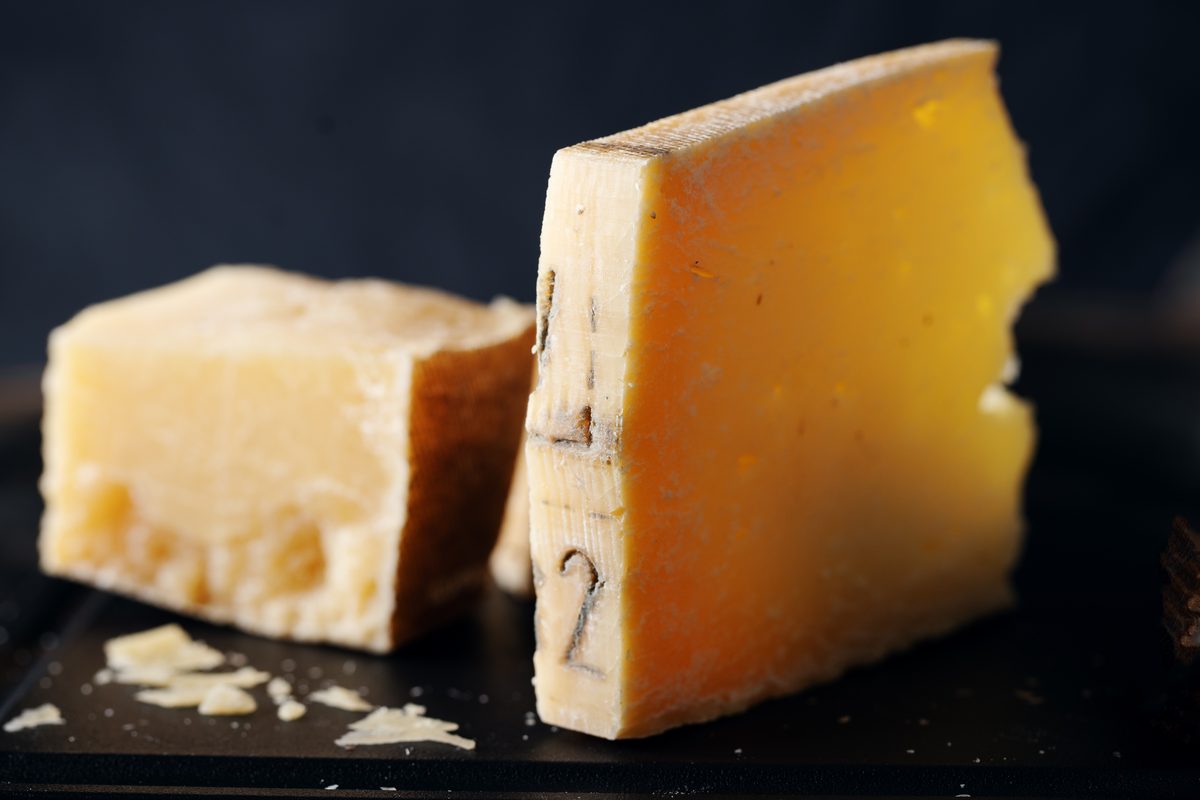
Parmesan is an interesting case. At 411 kcal per 100 g, it looks disqualified. But it is grated, and 10 g is enough to flavour a dish: 41 kcal, 238 mg of calcium per 100 kcal, and a taste that lets you use less. A very high-calorie cheese used as a seasoning can weigh less than a moderate cheese eaten in slices.
The five highest-calorie cheeses
| Cheese | kcal / 100 g | Fat | Salt |
|---|---|---|---|
| Dry goat’s cheese | 440 | 35.6 g | 1.06 g |
| Tête de Moine | 415 | 34.5 g | 2 g |
| Comté | 413 | 33.8 g | 0.84 g |
| Parmesan | 411 | 31 g | 1.57 g |
| Gruyère | 408 | 33.5 g | 1.3 g |
These are dry cheeses, so they are concentrated. Nothing about them is off limits: they simply ask to be weighed once, so you know what 30 g looks like. Comté, incidentally, is the least salty of the five, at 0.84 g.
What to choose according to your goal
To cut calories without cutting pleasure: semi-skimmed milk ricotta, 41 kcal a portion, 228 mg of calcium per 100 kcal, and a texture that holds up in cooking.
For calcium: mozzarella, 598 mg per 100 g. The dairy products family gives the detail of every food page.
For protein: cancoillotte, 13.6 g for 151 kcal, as long as you keep an eye on the salt. Mozzarella follows with 16.1 g.
If you are watching your salt: fromage blanc, petit-suisse and faisselle are all under 0.15 g per 100 g. Every matured cheese is above 0.8 g.
If you are in a calorie deficit: the deficit calculator gives you your margin, and the slimming recipes include these cheeses without banning them.
Cheeseboard favourites, by 30 g portion
The ranking stops at 280 kcal per 100 g. Yet most of the cheeses people actually buy, such as raclette, Emmental, feta or tomme, sit above that. Here is how they come out for a 30 g portion, the one Santé publique France uses in its guidelines.
| Cheese | Calories | Salt | Calcium | Protein |
|---|---|---|---|---|
| Feta | 85 kcal | 0.68 g | 66 mg | 4.4 g |
| Goat’s cheese log | 86 kcal | 0.47 g | 57 mg | 5.5 g |
| Edam | 96 kcal | 0.67 g | 244 mg | 7.6 g |
| Reblochon | 97 kcal | 0.41 g | 141 mg | 6.0 g |
| Munster | 97 kcal | 0.60 g | 105 mg | 6.0 g |
| Pont-l’Évêque | 98 kcal | 0.39 g | 198 mg | 6.7 g |
| Raclette | 103 kcal | 0.51 g | 197 mg | 6.9 g |
| Saint-nectaire | 103 kcal | 0.54 g | 162 mg | 6.9 g |
| Morbier | 106 kcal | 0.42 g | 180 mg | 6.7 g |
| Tomme de Savoie | 108 kcal | 0.39 g | 180 mg | 6.9 g |
| Emmental | 112 kcal | 0.18 g | 293 mg | 8.2 g |
| Cantal | 113 kcal | 0.64 g | 245 mg | 7.4 g |
| Roquefort | 115 kcal | 0.97 g | 198 mg | 5.7 g |
| Cheddar | 120 kcal | 0.53 g | 222 mg | 7.3 g |
| Beaufort | 121 kcal | 0.32 g | 254 mg | 7.8 g |
Three takeaways. First, the gap is small: from 85 to 121 kcal, so 36 kcal between feta and Beaufort. At portion level, the choice of cheese matters far less than the quantity. Second, Emmental is the most balanced cheese in the table: the least salty (0.18 g) and the richest in calcium (293 mg, nearly a third of the 950 mg reference intake for an adult over 25), for 112 kcal. Finally, feta, the lightest, is also one of the saltiest and one of the poorest in calcium: only 66 mg, four times less than Emmental.
Roquefort is the extreme case for salt: nearly 1 g in 30 g, or a fifth of the 5 g a day ceiling. A cheeseboard with several portions of it, plus bread, quickly goes past half of the day’s allowance.
Reduced-fat cheeses, case by case
The Ciqual table contains several pairs of cheeses in a standard and a reduced-fat version. They let you check what the fat reduction really changes.
| Type of cheese (per 100 g) | Calories: standard, reduced-fat | Salt: standard, reduced-fat |
|---|---|---|
| Bloomy-rind soft cheese, Camembert type | 271, 178 kcal | 1.58 g, 1.44 g |
| Washed-rind soft cheese | 311, 200 kcal | 1.57 g, 1.63 g |
| Goat’s cheese log | 285, 183 kcal | 1.58 g, 1.24 g |
| Processed cheese | 238, 134 kcal | 1.84 g, 0.74 g |
| Plain cream cheese for spreading | 225, 133 kcal | 0.90 g, 0.92 g |
| Emmental | 373, 258 kcal | 0.61 g, 1.40 g |
| Tomme | 364, 240 kcal | 1.28 g, 1.84 g |
On calories, the lighter version keeps its promise: between 31 and 44% fewer, depending on the cheese. On salt, there is no rule. Reduced-fat processed cheese contains two and a half times less salt than the standard version, and the reduced-fat goat’s cheese a little less. But reduced-fat Emmental contains 2.3 times more than standard Emmental, and reduced-fat tomme 44% more. That is why the FAQ below advises looking at the salt before the calories: the label settles it, not the word « light ».
A lesser-known effect: when fat is removed, protein is concentrated. Reduced-fat tomme goes from 21.1 to 30.4 g of protein per 100 g, reduced-fat Emmental from 27.3 to 28.6 g. For anyone looking for protein, a well-chosen reduced-fat cheese is more interesting than it seems.
The protein-per-calorie podium
If you want to eat more protein without weighing down your day, the calorie ranking is not enough. You need to look at how many grams of protein you get per 100 kcal.
| Product | kcal / 100 g | Protein / 100 g | Protein per 100 kcal |
|---|---|---|---|
| Plain petit-suisse 0% | 56.5 | 9.7 g | 17.2 g |
| Plain fromage blanc 0% | 48.4 | 7.19 g | 14.9 g |
| Reduced-fat Emmental | 258 | 28.6 g | 11.1 g |
| Plain petit-suisse 4% | 88 | 9.52 g | 10.8 g |
| Plain fromage blanc 2-3% | 75.7 | 7.13 g | 9.4 g |
| Emmental | 373 | 27.3 g | 7.3 g |
| Plain petit-suisse 10% | 137 | 9.01 g | 6.6 g |
| Faisselle 6% | 83.6 | 4.38 g | 5.2 g |
| Plain fromage blanc 7-8% | 116 | 5.44 g | 4.7 g |
| Plain Greek-style yoghurt | 103 | 2.96 g | 2.9 g |
The 0% petit-suisse is the surprise of the table: 17.2 g of protein per 100 kcal, better than 0% fromage blanc. And Greek-style yoghurt, often presented as a « high-protein » product, is actually one of the least interesting: barely 3 g of protein per 100 g, for over 100 kcal. To estimate what you need, our protein needs calculator works it out from your weight and activity.
How much cheese per day
Santé publique France’s recommendations for adults (2019) set two dairy products a day, with a simple equivalence: one portion is 150 ml of milk, 125 g of yoghurt or 30 g of cheese. Their example: a plain yoghurt and a piece of cheese, or grated cheese on pasta. They also ask you to vary the cheeses you eat, because of the risks linked to contaminants, and speak of consumption that is « sufficient but limited ». Butter, crème fraîche and milk desserts do not count as dairy products.
On the real plate, cheese carries a lot of weight. According to Anses’s INCA 3 study, dairy products supply 38% of adults’ calcium, and cheeses are the largest share of that, at 18% on their own. They also provide 5.5% of salt, and dairy products as a whole are the leading source of saturated fatty acids, at 24% of intakes. The detail of quantities and profiles is in our guide to how much cheese per day.
Keep the cheese, lighten the dish
The cheeses at the top of the ranking work well in cooking. Ricotta is the base of spinach and ricotta cannelloni or of courgette, lemon and ricotta pasta. Fromage blanc makes the base of a red berry mousse. And for dishes where cheese is the star, our lighter tartiflette shows that a cheese dish can be lightened without disappearing.
Frequently asked questions
Which is the lowest-calorie cheese?
Faisselle, with 36.8 kcal per 100 g according to Ciqual 2025, ahead of 0% fromage blanc at 48.4 kcal. Among cheeses that are not fresh, it is petit-suisse at 137 kcal.
Can you eat cheese on a diet?
Yes, if you think in portions. Thirty grams of Camembert is 84 kcal, a portion of ricotta 41 kcal: that is not what tips a day over. What matters is the actual quantity, not a ban. The calorie deficit calculator gives you the framework.
Which cheese has the most calcium?
Among those in the table, mozzarella with 598 mg per 100 g. Relative to calories, it stays in the lead with 263 mg per 100 kcal, ahead of semi-skimmed ricotta at 228 mg. Hard cooked-pressed cheeses such as Parmesan go higher in absolute terms, up to 980 mg, but with four times the calories.
Are reduced-fat cheeses worth it?
Look at the salt before the calories. Reduced-fat versions remove fat, and the missing flavour is often made up with salt or additives. A natural fresh cheese such as faisselle or ricotta gets to the same calorie result without processing.
Which cheese is the saltiest?
In this ranking, Brie de Meaux with 2.02 g per 100 g, Tête de Moine with 2 g and Chaource with 1.9 g. Cancoillotte is the surprise: low in calories but 1.73 g of salt. Anses puts the ceiling at 5 g of salt a day, from all sources combined.
Is feta a light cheese?
In calories, yes for a matured cheese: 284 kcal per 100 g, or 85 kcal per 30 g (Ciqual 2025). But it is salty (0.68 g per 30 g) and low in calcium (66 mg), four times less than Emmental. Feta is a good choice for calories, less so for the rest.
Which cheese should you choose for a lighter raclette?
Standard raclette cheese provides 103 kcal and 0.51 g of salt per 30 g slice (Ciqual 2025). The smoked or peppered versions are close, between 345 and 357 kcal per 100 g. The lever is not the choice of variety, it is the number of slices.
Which cheese is the least salty?
Among matured cheeses, Emmental: 0.61 g of salt per 100 g, or 0.18 g per 30 g (Ciqual 2025). Be careful: its reduced-fat version contains 1.40 g per 100 g, more than double. Plain fresh cheeses, fromage blanc and faisselle, stay under 0.15 g.
How many portions of cheese a day?
Santé publique France recommends two dairy products a day for an adult, one portion of cheese being 30 g. Two dairy products means, for example, a yoghurt and a portion of cheese, not two portions of cheese on top of everything else.
Which dairy product gives the most protein for the fewest calories?
Plain 0% petit-suisse: 9.7 g of protein for 56.5 kcal per 100 g, or 17.2 g per 100 kcal (Ciqual 2025). 0% fromage blanc follows with 14.9 g. Plain Greek-style yoghurt provides only 2.9 g per 100 kcal.
Our sources
- Ciqual 2025 table (Anses), « cheeses and similar » subgroup: calories, fat, protein, calcium and salt per 100 g. The site’s 72 cheese food pages carry these values.
- Anses: ceiling of 5 g of salt a day.
- Calories per portion and calcium-to-calorie ratios are calculated from these values.
- Santé publique France, Recommandations relatives à l’alimentation, à l’activité physique et à la sédentarité pour les adultes, 2019: « 2 dairy products a day » guideline, portions.
- Anses, Étude individuelle nationale des consommations alimentaires 3 (INCA 3), April 2017: contributions of food groups to calcium, salt and saturated fatty acids in adults.
- Anses, Les références nutritionnelles en vitamines et minéraux, February 2021: calcium, 950 mg a day after the age of 25.


