Group · Fruit
Sweetened dried cranberries
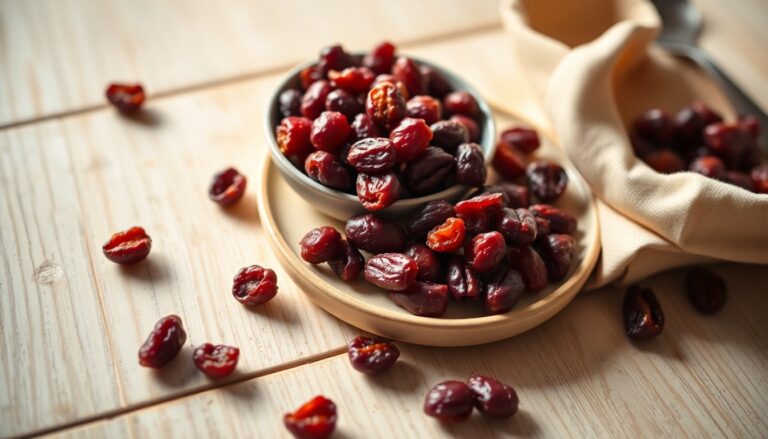
The sweetened dried cranberry is a small red berry native to North America, dehydrated and then coated in sugar to soften its strongly tart natural acidity. You find it in the shops as a dried fruit, in bags or loose, ready to snack on. Crunchy and slightly chewy, it adds a tart note that is welcome in many recipes. Nutritionally, it concentrates the carbohydrates of the fresh fruit and remains an interesting source of fibre. At around 332 kcal per 100 g, it is an energy-dense dried fruit, to be enjoyed in small amounts within a balanced diet. Practical and tasty, it goes as well with sweet dishes as with savoury ones.
Macronutrient breakdown
Nutrition table per 100 g
| Calories | 332 kcal |
| Kilojoules | 1410 kJ |
| Protein | 0,3 g |
| Carbohydrate | 76,4 g |
| Fat | 1 g |
| Fibre | 5,7 g |
Micronutrients per 100 g
All measured nutrients, ranked by share of the daily reference intake.
- Vitamin B60,43 mg31 %
- Vitamin E1,92 mg16 %
- Manganese0,19 mg10 %
- Vitamin K15,09 µg7 %
- Copper0,04 mg4 %
- Vitamin B50,19 mg3 %
- Potassium58 mg3 %
- Total omega-30,05 g2 %
- Vitamin B9dietary folate equivalents2,5 µg
See the other 7 nutrients
- Omega-3 ALA0,03 g2 %
- Omega-6 LA0,12 g1 %
- Iron0,16 mg1 %
- Phosphorus7,5 mg1 %
- Magnesium3,9 mg1 %
- Calcium8 mg1 %
- Vitamin A1,29 µg0 %
Anses Ciqual 2025. Source: Anses, 2025, Ciqual food composition table
Tips
Sweetened dried cranberries are moreish, but their calorie density calls for moderation. A sensible portion is around 20 to 30 g, a small handful, enough to flavour a dish or a snack without weighing down your energy balance. Check the nutritional value on the packet: with more than 76.4 g of carbohydrate per 100 g, largely as added sugars, they have a high glycaemic index. If you are watching your weight, favour lightly sweetened or unsweetened versions and stay alert to quantities.
In the kitchen, they suit a thousand uses. Slip them into a homemade muesli, a porridge, a yoghurt or a mixed salad with walnuts and cheese. They lift savoury dishes wonderfully (poultry, pilaf rice, stuffings) and go nicely with baking. You can rehydrate them for a few minutes in warm water to make them softer. For storage, keep them in an airtight container, away from light and moisture, to preserve their texture.
To vary your berry intake, alternate with other flavour-rich fruits such as blueberries, blackcurrants or redcurrants, which bring freshness and antioxidants with less sugar. You will find more ideas in the fruit family, and for comparing nutrients, the calorie table remains a useful reference.
Tips for active people: dried cranberries are a real concentrate of quick energy thanks to their carbohydrates. A small handful makes a practical snack before an endurance or cardio session, when the body needs immediate fuel. You can also add them to a homemade bar or a mix of dried fruit and nuts (trail mix) for long outings. In the recovery phase, pair them with a source of protein such as Greek yoghurt or fromage blanc to combine glycogen replenishment with protein intake. To go further on eating for exercise, see our guide to nutrition for fitness.
Among its benefits, the cranberry provides fibre (around 5.7 g per 100 g) that contributes to digestive comfort, as well as interesting plant compounds. Keep in mind, however, that the sweetened version differs from the fresh fruit: to get the most from its strengths without too much sugar, include it in moderation on a varied, colourful plate.