Group · Fruit
Redcurrants
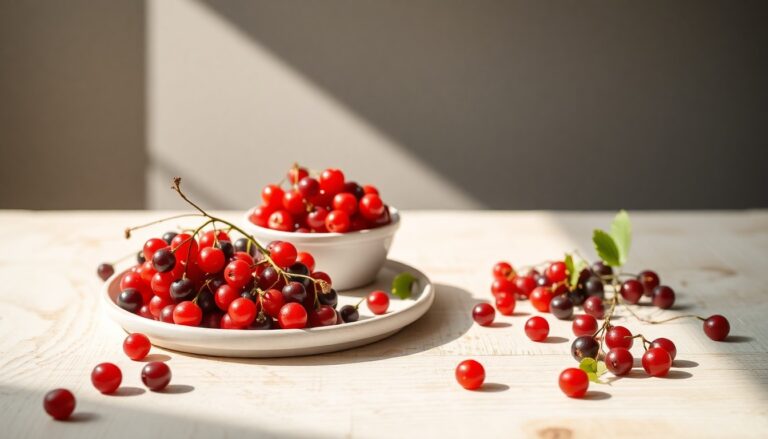
A small, tart berry in translucent red (or sometimes white), the redcurrant is a summer fruit that grows in clusters on bushes called currant bushes. It is harvested mainly from June to August and comes in several varieties, from the sharpest to the sweetest. At just 67.2 kcal per 100 g, redcurrants are among the lower-calorie fruits, while offering a good amount of fibre (4.6 g) and water. Their fresh, lively flavour makes them a great choice in a balanced diet, whether raw, in jelly, as a coulis or in baking. Rich in vitamin C and colourful plant compounds, this berry is as tasty as it is light.
Macronutrient breakdown
Nutrition table per 100 g
| Calories | 67 kcal |
| Kilojoules | 284 kJ |
| Protein | 1,6 g |
| Carbohydrate | 7,1 g |
| Fat | 0,7 g |
| Fibre | 4,6 g |
Micronutrients per 100 g
All measured nutrients, ranked by share of the daily reference intake.
- Vitamin C29,8 mg37 %
- Potassium230 mg12 %
- Vitamin B50,65 mg11 %
- Vitamin E1,19 mg10 %
- Copper0,09 mg9 %
- Omega-3 ALA0,14 g7 %
- Manganese0,13 mg7 %
- Total omega-30,16 g6 %
- Vitamin B9dietary folate equivalents11,8 µg
See the other 11 nutrients
- Phosphorus38 mg5 %
- Calcium38 mg5 %
- Vitamin B10,04 mg4 %
- Magnesium12 mg3 %
- Vitamin K12,06 µg3 %
- Iron0,35 mg3 %
- Omega-6 LA0,22 g2 %
- Vitamin B60,03 mg2 %
- Zinc0,15 mg2 %
- Vitamin B30,18 mg1 %
- Vitamin A2,13 µg0 %
Anses Ciqual 2025. Source: Anses, 2025, Ciqual food composition table
Tips
Redcurrants are best eaten raw and freshly picked, to get the most from their vitamin C and freshness. A portion of around 80 to 100 g is enough to liven up a plain yoghurt, a fromage blanc or a bowl of oat flakes at breakfast. You can also strip them from the stalk with a fork and scatter them over a fruit salad, where they add a welcome tartness next to the sweetness of a peach or a few strawberries.
Varieties and seasonality: there are red, white (sweeter) and cluster currants. Their cousin, the gooseberry, is larger and lends itself well to cooking. The main season runs from late spring to the height of summer, when the berries are at their most fragrant and least expensive.
Key nutrients: redcurrants stand out for their fibre, which helps digestion and fullness, and for their vitamin C. They also contain minerals such as potassium and the antioxidant pigments responsible for their colour. With a moderate glycaemic index and only 7.06 g of carbohydrate per 100 g, they fit well into a weight-loss plan or a balanced diet.
Culinary uses: beyond eating them raw, redcurrants can be made into jelly, a coulis to pour over a dessert, a syrup, or a tart accompaniment to white meats and game. To preserve their delicate nutrients, favour gentle cooking and go easy on added sugar, which would push up the calories.
- Storage: they are fragile and keep for 2 to 3 days in the fridge. You can freeze them on the stalk to use out of season.
- Pairings: they go well with other berries such as blueberries or blackcurrants.
- Weight control: low in calories when plain, but watch out for sweetened preparations (jellies, jams) that multiply the sugars.
For active people: light and rich in water, redcurrants make a refreshing snack after exercise, especially in summer. Mixed into fromage blanc or added to a recovery smoothie, they provide easily absorbed carbohydrates and micronutrients without weighing down digestion. To go further, discover other fruits in the fruit family and compare their nutrients using the site’s nutrition table.