Group · Fruit
Pomegranate
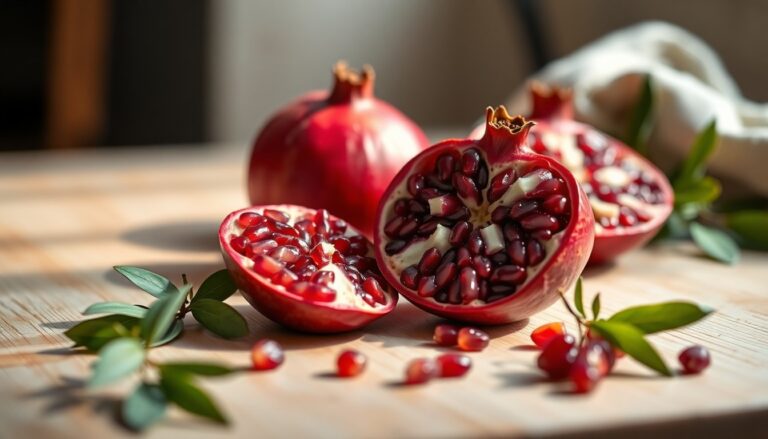
The pomegranate is an autumn and winter fruit, recognisable by its tough red to golden skin and its hundreds of small, juicy seeds called arils. Native to the Near East and the Mediterranean basin, it is eaten fresh, as juice, or sprinkled over savoury and sweet dishes alike. At around 81 kcal per 100 g, it stays reasonable in calories while providing carbohydrate (14.3 g), fibre (2.3 g) and a good amount of colourful plant compounds. Its tart, refreshing flavour makes it a great fruit in a varied, balanced diet. Versatile, the pomegranate suits breakfast as well as salads, desserts and festive recipes.
Macronutrient breakdown
Nutrition table per 100 g
| Calories | 81 kcal |
| Kilojoules | 342 kJ |
| Protein | 1,5 g |
| Carbohydrate | 14,3 g |
| Fat | 1,2 g |
| Fibre | 2,3 g |
Micronutrients per 100 g
All measured nutrients, ranked by share of the daily reference intake.
- Potassium230 mg12 %
- Vitamin C9,02 mg11 %
- Copper0,11 mg11 %
- Vitamin B50,37 mg6 %
- Manganese0,1 mg5 %
- Vitamin B10,05 mg5 %
- Phosphorus27 mg4 %
- Magnesium12 mg3 %
- Vitamin B9dietary folate equivalents8,77 µg
See the other 8 nutrients
- Vitamin B60,03 mg2 %
- Zinc0,22 mg2 %
- Vitamin B30,23 mg1 %
- Iron0,17 mg1 %
- Calcium9,5 mg1 %
- Total omega-30,02 g1 %
- Omega-6 LA0,08 g1 %
- Vitamin A1,01 µg0 %
Anses Ciqual 2025. Source: Anses, 2025, Ciqual food composition table
Tips
To get the most from its nutritional values, the simplest approach is to eat pomegranate fresh. Cut it in half, tap the back with a spoon to release the arils, or pick them out under water to avoid juice splashes. A portion of around 80 to 100 g (half a fruit) is enough to add crunch, freshness and fibre to a meal.
- At breakfast: add arils to a yoghurt, a fromage blanc or porridge for a tart touch.
- In salads: it goes well with baby leaf salads, tabbouleh, or citrus fruits such as orange and grapefruit.
- In savoury dishes: it brightens poultry dishes, tagines and Mediterranean-style grains.
- As juice: tasty, but more concentrated in sugars and lower in fibre than the whole fruit.
In terms of key nutrients, pomegranate provides fibre, which helps digestive comfort and fullness, as well as polyphenols and vitamin C, placing it among the antioxidant-rich foods. Its carbohydrates give it a sweet flavour while keeping a moderate glycaemic index when eaten whole, thanks to the fibre.
For active people: pomegranate is a refreshing snack rich in natural carbohydrates, useful for replenishing energy stores. You can add it to a recovery bowl with protein, for example in a protein snack combining fromage blanc, fruit and nuts. Pomegranate juice, drunk after exercise, also helps with rehydration. To go further on balancing training and diet, discover our guidance on nutrition for fitness.
Weight control: at 81 kcal per 100 g, pomegranate is a moderately calorific fruit, perfectly compatible with a weight-loss goal when eaten fresh and in a sensible portion. Be wary, however, of sweetened shop-bought juices and grenadine syrups, which are much higher in added sugars. Favour the whole fruit, which keeps its fibre and is more filling.
Storage: whole, pomegranate keeps for several weeks in a cool place. Once opened, store the arils in an airtight container in the fridge for 3 to 4 days, or freeze them to add to your recipes later. For more variety, explore other ideas in the fruit family, from berries such as blueberries to exotic fruits.