Group · Herbs & spices
Chilli powder
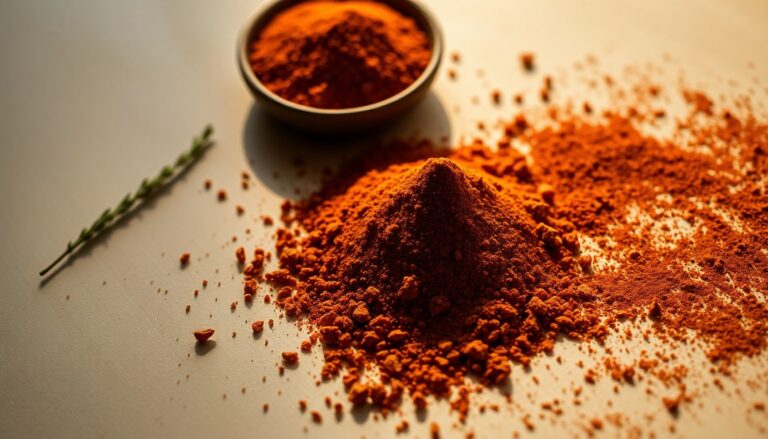
Chilli powder is a spice made by drying and then grinding red chillies, whether mild or hot. Depending on the varieties and blends, its colour ranges from orange-red to dark red, and its heat varies greatly. It is used to lift sauces, marinades, slow-cooked dishes, meat, vegetables and dishes from around the world. Nutritionally, it is used in very small amounts, which makes its 376 kcal per 100 g insignificant at the scale of a portion. It provides fibre (27.2 g per 100 g), a little protein and carbohydrate, and characteristic aromatic compounds. It is a valuable flavour ally for cooking light without sacrificing taste, in a balanced diet.
Macronutrient breakdown
Nutrition table per 100 g
| Calories | 376 kcal |
| Kilojoules | 1560 kJ |
| Protein | 12 g |
| Carbohydrate | 29,4 g |
| Fat | 17,3 g |
| Fibre | 27,2 g |
Micronutrients per 100 g
All measured nutrients, ranked by share of the daily reference intake.
- Vitamin E29,8 mg248 %
- Vitamin B62,45 mg175 %
- Vitamin K180,3 µg107 %
- Potassium2010 mg101 %
- Manganese2 mg100 %
- Vitamin C76,4 mg96 %
- Vitamin B20,92 mg66 %
- Iron7,8 mg56 %
- Vitamin B9dietary folate equivalents106 µg
See the other 7 nutrients
- Vitamin B38,7 mg54 %
- Phosphorus293 mg42 %
- Magnesium152 mg41 %
- Copper0,37 mg37 %
- Vitamin B10,33 mg30 %
- Zinc2,48 mg25 %
- Calcium148 mg19 %
Anses Ciqual 2025. Source: Anses, 2025, Ciqual food composition table
Tips
The strength of chilli powder lies in its ability to transform a dish with a pinch. Because it is used in fractions of a gram, its calories and nutrition facts are anecdotal on the plate: it is an advantage if you are watching your weight, as it intensifies flavour without adding fat or sugar. A good slimming strategy is precisely to replace some of the salt, butter or rich sauces with well-measured spices.
In the kitchen, chilli powder works with many pairings:
- Slow-cooked dishes and chilli con carne: combine it with cumin and paprika for a balanced spicy base.
- Meat and fish: add it to a marinade with oil, garlic powder and a squeeze of lemon.
- Roasted vegetables and soups: a pinch at the end of cooking wakes up the flavours without masking the ingredients.
To preserve its aroma, add it during or towards the end of cooking: strong, prolonged heat can make it bitter. Store it away from light, heat and damp, in an airtight jar. Chilli powder keeps its intensity for around a year; after that, it gradually loses its heat and fragrance.
In terms of nutrients, its interest comes mainly from its fibre and its natural pigments. Capsaicin, the molecule responsible for the heat, gives that characteristic sensation of warmth. Always start with small amounts: you can always add more, but never take it out. If you have a sensitive stomach, go easy on the amounts and see how you tolerate it.
For active people, chilli powder is an excellent way to vary the flavours of meals rich in protein and carbohydrate without adding to the calorie count. It makes the sometimes monotonous dishes of a cutting phase or a fitness nutrition plan more appetising. Do not overdo it before intense exercise, though, to avoid any digestive discomfort, and make sure you stay well hydrated.
You can explore other lively flavours in the Herbs & Spices family, or compare the content of your foods using the calorie table. In the kitchen, chilli powder remains one of the simplest ways to eat tasty food while keeping control of your portions.