Group · Fruit
Asian pear
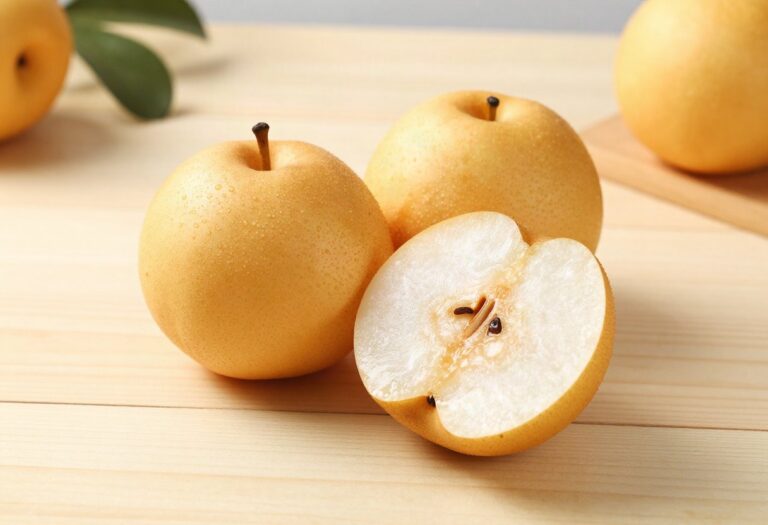
The Asian pear, also called nashi or apple pear, is a crunchy, juicy fruit that looks like an apple with its round shape but has the sweet, fragrant flavour of a pear. Native to East Asia, it comes in several varieties with golden, bronze or pale yellow skin, sometimes slightly gritty. Its white, firm flesh, full of water, makes it very thirst-quenching. With only 42 kcal per 100 g, it fits easily into a balanced diet. Rich in water and fibre and low in fat, the Asian pear offers pleasant everyday freshness, ideal as a light snack or at the end of a meal for a touch of natural sweetness.
Macronutrient breakdown
Nutrition table per 100 g
| Calories | 42 kcal |
| Kilojoules | 176 kJ |
| Protein | 0,5 g |
| Carbohydrate | 10,7 g |
| Fat | 0,3 g |
| Fibre | 3,6 g |
Micronutrients per 100 g
All measured nutrients, ranked by share of the daily reference intake.
- Potassium121 mg6 %
- Vitamin K14,5 µg6 %
- Copper0,05 mg5 %
- Vitamin C3,8 mg5 %
- Manganese0,06 mg3 %
- Magnesium8 mg2 %
- Phosphorus11 mg2 %
- Vitamin B60,02 mg2 %
See the other 8 nutrients
- Vitamin B30,22 mg1 %
- Vitamin B50,07 mg1 %
- Vitamin E0,12 mg1 %
- Vitamin B10,01 mg1 %
- Vitamin B20,01 mg1 %
- Calcium4 mg1 %
- Zinc0,02 mg0 %
- Selenium0,1 µg0 %
USDA FoodData Central (SR Legacy)
Tips
The Asian pear is most often eaten raw, bitten into plain or cut into thin slices. Its crisp texture adds zing to seasonal salads, sweet-and-savoury carpaccios and cheese platters. You can also grate it into an Asian marinade, where it naturally tenderises meats. Allow one medium fruit (about 150 to 200 g) for a satisfying portion, which is under 90 calories. Its thin, edible skin holds a good share of the fibre: a simple rinse is enough before you bite in.
- Seasonality: harvested from late summer to autumn, and it keeps very well in the cool.
- Storage: up to several weeks in the fridge, protected from knocks as its flesh is fragile.
- Nutrition facts: about 10.65 g of carbohydrate, 3.6 g of fibre and very little fat per 100 g.
As for benefits, the Asian pear relies on its richness in water and fibre, which promote fullness and support good digestion. It also provides vitamin C and a little potassium. Its moderate glycaemic index and low energy density make it a useful ally for slimming or a balanced diet. Like all sweet fruits, it should be eaten in reasonable amounts if you are watching your weight, favouring the whole fruit rather than juice.
To vary your treats, the Asian pear goes well with other fresh fruits. You can pair it with a crunchy apple in a salad, or combine it with a kiwi for extra vitamin C. You will also find more ideas in the fruit family for putting together light desserts.
Tip for active people: thanks to its easily absorbed carbohydrates and high water content, the Asian pear makes a refreshing snack before moderate exercise or a good way to rehydrate afterwards. For a more complete recovery, pair it with a source of protein, for example a plain yoghurt or a high-protein snack. You can also check the calories in your favourite fruits in the food calorie table to adjust your portions to your goals. Simple, hydrating and low in calories, the Asian pear has its place in a varied, enjoyable diet.