Ginkgo biloba: benefits, side effects, dosage and what the studies show
The short answer
Ginkgo biloba is the most studied herb for memory, but the results are disappointing in healthy people. Two large trials (over 3,000 older adults followed for 6 years in the US, over 2,800 followed for 5 years in France) found no drop in the risk of Alzheimer’s disease. The European Medicines Agency (EMA) recognises a standardised extract for age-related cognitive impairment and mild dementia, and the powdered leaf, as a traditional remedy, for heavy legs and cold hands and feet. The main side effect to watch is bleeding: talk to your doctor if you take a blood thinner or aspirin, stop 3 to 4 days before surgery, and avoid ginkgo during pregnancy.
This article is for information and does not replace medical advice.
Ginkgo biloba: the tree, the leaf and the extract
Ginkgo biloba, or maidenhair tree, is a very old tree from China, known for its fan-shaped leaves that turn yellow in autumn. Herbal medicine uses the leaf, rich in flavonoids and terpene lactones (ginkgolides, bilobalide). The strong-smelling fruit is not used in supplements.
The EMA’s European monograph (2015) separates two preparations, with different levels of evidence:
| Standardised dry extract | Powdered leaf | |
|---|---|---|
| Status | Well-established use (clinical evidence) | Traditional use (long history of use) |
| How it is made | 35 to 67 kg of leaves per 1 kg of extract, acetone extraction, refined and quantified | Dried, ground leaf |
| Use | Age-related cognitive impairment and quality of life in mild dementia | Heavy legs, cold hands and feet from minor circulation problems |
| Adult dose | 240 mg a day, in 1 or 2 doses | 250 to 360 mg per dose, 750 mg a day at most |
| Duration | At least 8 weeks; review with a doctor after 3 months | See a doctor if symptoms last more than 2 weeks |
This matters: almost all clinical trials used a standardised extract (often EGb 761), not powdered leaf. The results below do not automatically apply to a leaf capsule.
Ginkgo biloba benefits for memory: what studies show
| Study | Who, what dose | Result |
|---|---|---|
| GEM, US (DeKosky, JAMA 2008) | 3,069 people aged 75+, 120 mg extract twice a day, median follow-up 6.1 years | No fewer dementia cases: 3.3 per 100 person-years on ginkgo vs 2.9 on placebo, not significant |
| GuidAge, France (Vellas, Lancet Neurology 2012) | 2,854 people aged 70+ with memory complaints, EGb 761 120 mg twice a day, 5 years | 61 Alzheimer’s cases on ginkgo vs 73 on placebo, not significant |
| Cochrane review (Birks, 2009) | 36 trials in people with cognitive impairment or dementia | Inconsistent results; benefit judged “inconsistent and unreliable” |
| Meta-analysis (Laws, 2012) | 13 memory trials in healthy adults (1,132 participants) | Effect close to zero on memory, attention and executive function |
How to read this. To prevent Alzheimer’s, the two largest trials ever run were negative. To boost memory in a healthy adult, the 2012 meta-analysis found no measurable effect, whatever the dose or duration. The only use the EMA recognises is in older people who already have cognitive impairment or mild dementia, with a standardised extract, and Cochrane considers even that evidence weak. So it is something to discuss with a doctor, not a herb to take “for memory” as prevention.
On circulation, the EMA notes that the extract lowers blood viscosity and improves blood flow to some brain areas, and the powdered leaf keeps a traditional use for heavy legs. Before blaming heavy legs or cold hands on circulation, a doctor should rule out a serious cause: the monograph itself sets this condition.
For brain health, diet remains the foundation: oily fish and omega-3, fruit and vegetables rich in antioxidants, and eating enough after 70 (see our guide on nutrition for older adults).
Ginkgo biloba side effects, interactions and who should avoid it
In trials, ginkgo is well tolerated: Cochrane found no more side effects than with placebo. But it affects platelet aggregation, and that is where the main risk lies.
| Situation | What the EMA says |
|---|---|
| Anticoagulants (warfarin) or antiplatelet drugs (clopidogrel, aspirin, other NSAIDs) | Their effect may change: use ginkgo only after medical advice |
| Dabigatran | Caution: ginkgo may increase its absorption |
| Surgery | Stop ginkgo 3 to 4 days before, as a precaution |
| Bleeding tendency | Medical advice before use |
| Epilepsy | Further seizures cannot be ruled out |
| Efavirenz (HIV treatment) | Combination not recommended |
| Nifedipine | Blood levels may rise, with dizziness and hot flushes |
| Pregnancy | Contraindicated (bleeding risk) |
| Breastfeeding, under 18 | Not recommended, for lack of data |
Side effects listed by the EMA: headache (very common), dizziness, diarrhoea, abdominal pain, nausea (common), allergic skin reactions, and bleeding (eye, nose, brain, gut) of unknown frequency.
A meta-analysis of 18 trials (Kellermann, 2011, 1,985 adults) found no significant change in clotting tests with standardised extract. That is reassuring for someone not on medication, but it does not replace caution with a blood thinner: the EMA advises monitoring when starting, stopping or changing the ginkgo dose or product. In France, ginkgo is among the herbs cited in reports to the national food safety agency’s nutrivigilance scheme (10 reports from 2016 to 2021 where a link with the supplement was at least possible).
The same logic applies to other blood-thinning herbs: if you already take turmeric or ginger supplements, ask before adding ginkgo. If you are pregnant, our pregnancy diet guide covers what is advised.
Ginkgo biloba dosage: how to take it
- Standardised extract (the one used in studies): 240 mg a day, in one or two doses, for at least 8 weeks. With no improvement after 3 months, your doctor should reassess.
- Powdered leaf (traditional use): 250 to 360 mg per dose, no more than 750 mg a day. If symptoms last more than 2 weeks, see a doctor.
- Timing: the EMA sets none; taking it with a meal often limits stomach upset.
- Before you start: check your medications with your doctor or pharmacist, especially blood thinners, antiplatelet drugs, epilepsy and HIV treatments.
Nutrition•pro: an organic ginkgo made in France
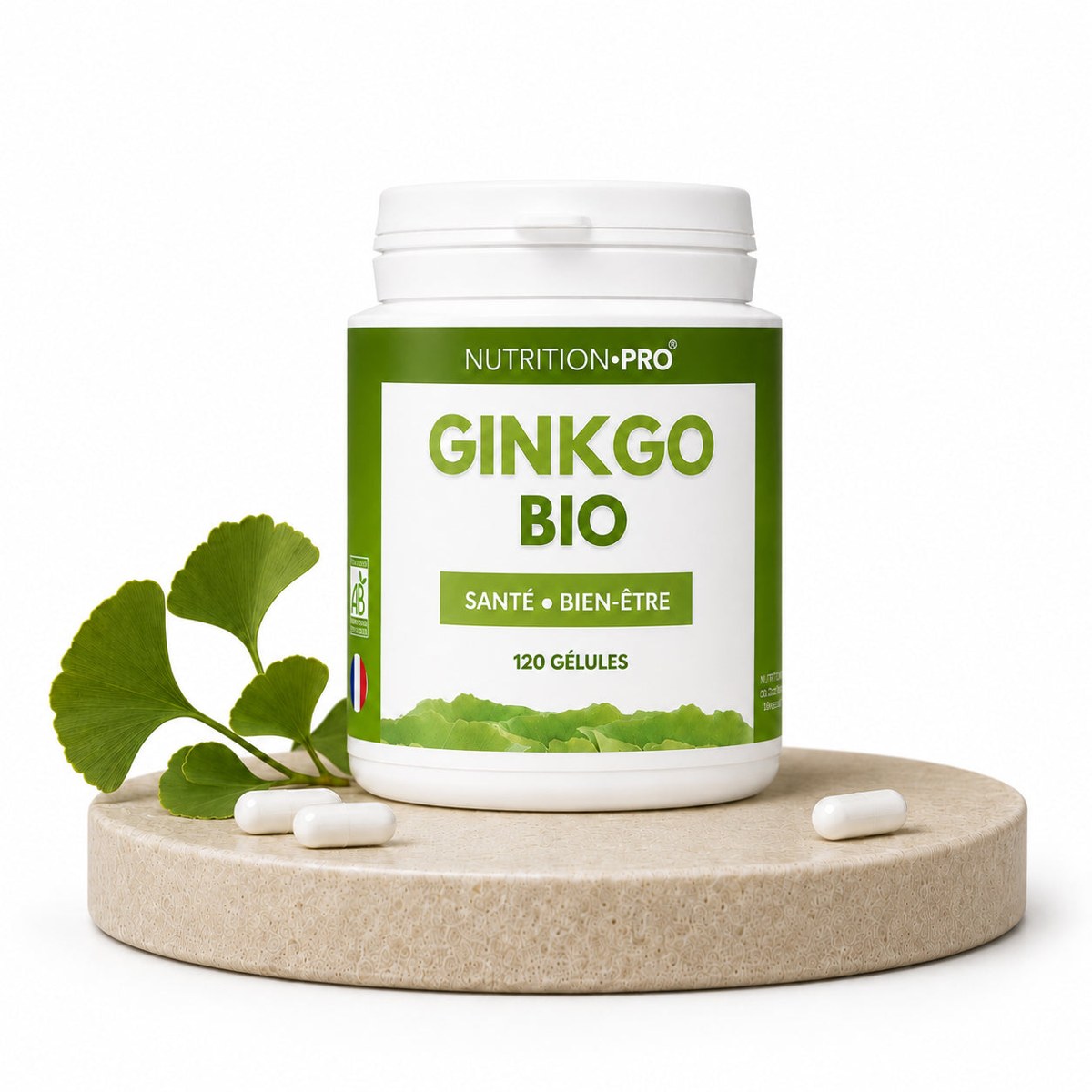
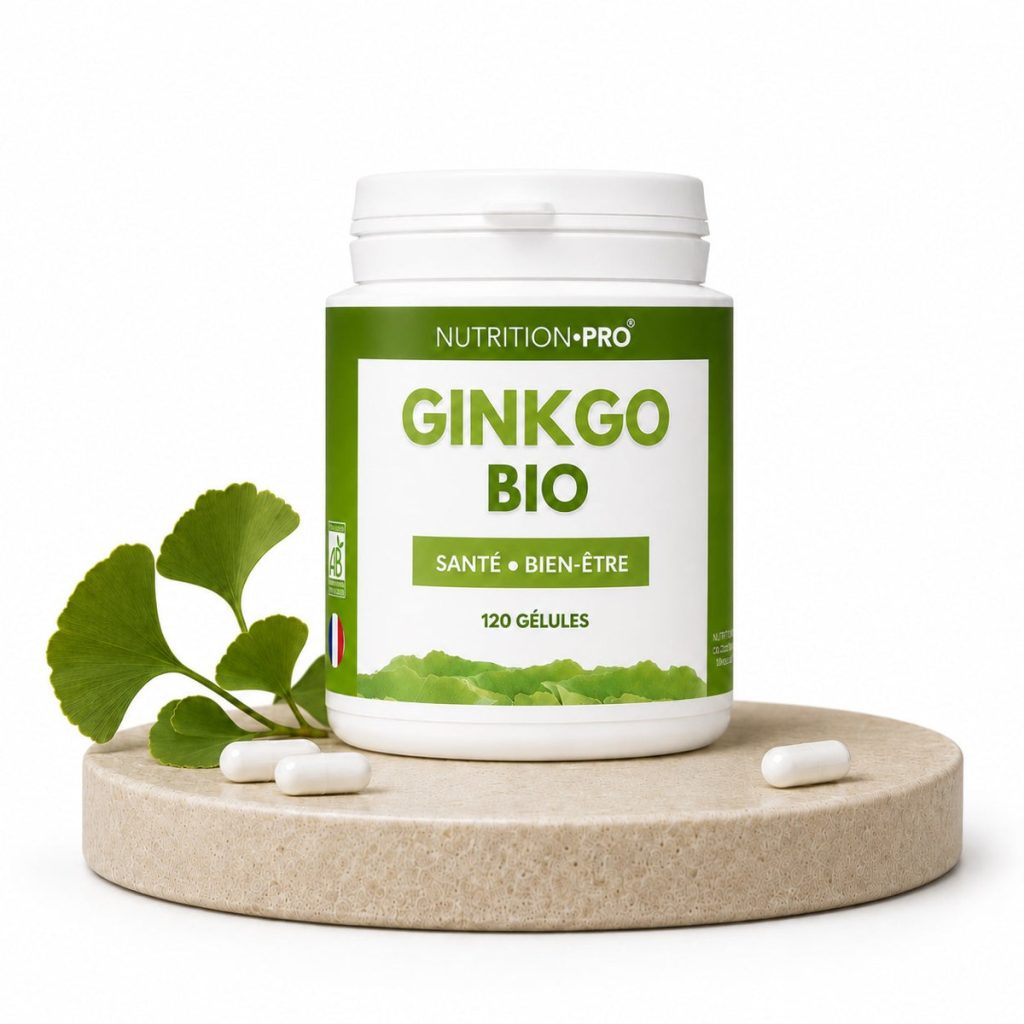
Nutrition•pro is a French brand that says it designs and makes its formulas in France. Its Ginkgo Bio keeps the formula short and clean:
- organic Ginkgo biloba leaf powder (EU organic logo on the jar), no additives or GMOs according to the product page;
- 4 capsules a day, which can be spread over the day, for 800 mg of leaf powder;
- 120 capsules, a 30-day course;
- €29.99 per jar (price checked on 22/11/2026), about €1 a day;
- clearly stated precautions on the product page: adults only, not advised for people on anticoagulant or antiplatelet treatment, in line with the EMA.
Worth knowing: this is powdered leaf, not a standardised extract. It matches the traditional use described by the EMA (heavy legs, cold extremities), for which the monograph sets a maximum of 750 mg a day: the suggested 800 mg is slightly above, and 3 capsules (600 mg) stay within it. The memory trials above used a standardised extract at 240 mg a day: their results do not apply as such to the leaf.
Promo code: SEOCONSULTINGSL for 10% off your order, €26.99 per jar (as of 22/11/2026).
See Nutrition•pro Ginkgo Bio →
Partner link: we earn a commission if you order through this link, at no extra cost to you.
Frequently asked questions
What is ginkgo biloba good for?
The EMA recognises a standardised extract for age-related cognitive impairment and mild dementia, and the powdered leaf for heavy legs and cold extremities (traditional use). In healthy adults, studies show no memory improvement, and it does not prevent Alzheimer’s disease.
Who should not take ginkgo biloba?
Pregnant women (contraindicated), breastfeeding women, under-18s, anyone within 3 to 4 days of surgery, and, without medical advice, people on blood thinners, aspirin or NSAIDs, people who bleed easily and people with epilepsy.
What are the side effects of ginkgo biloba?
Headache, dizziness and digestive upset are the most common. Rarer but more serious: bleeding, especially combined with blood-thinning treatment.
How long does ginkgo take to work?
The European monograph plans at least 8 weeks of treatment, and a review with a doctor if nothing changes after 3 months.
Can I take ginkgo with aspirin?
Not without medical advice: the EMA states that ginkgo may change the effect of aspirin, clopidogrel and anticoagulants.
Sources
- EMA, Committee on Herbal Medicinal Products. European Union herbal monograph on Ginkgo biloba L., folium. EMA/HMPC/321097/2012, 28/01/2015. ema.europa.eu
- DeKosky S.T. et al. Ginkgo biloba for prevention of dementia: a randomized controlled trial. JAMA, 2008; 300(19): 2253-62. PubMed 19017911
- Vellas B. et al. Long-term use of standardised Ginkgo biloba extract for the prevention of Alzheimer’s disease (GuidAge). Lancet Neurol, 2012; 11(10): 851-9. PubMed 22959217
- Birks J., Grimley Evans J. Ginkgo biloba for cognitive impairment and dementia. Cochrane Database Syst Rev, 2009; CD003120. PubMed 19160216
- Laws K.R. et al. Is Ginkgo biloba a cognitive enhancer in healthy individuals? A meta-analysis. Hum Psychopharmacol, 2012; 27(6): 527-33. PubMed 23001963
- Kellermann A.J., Kloft C. Is there a risk of bleeding associated with standardized Ginkgo biloba extract therapy? Pharmacotherapy, 2011; 31(5): 490-502. PubMed 21923430
- Anses (French food safety agency). Technical note on the herbs most involved in nutrivigilance reports (2021-AST-0133), 17/12/2021. anses.fr