Ashwagandha: benefits, side effects and dosage, according to studies
The short answer
Ashwagandha (Withania somnifera) is an Ayurvedic herb, taken as a supplement mostly for stress and sleep. Trials show lower perceived stress and anxiety and a small benefit for sleep, usually with 300 to 600 mg of root extract a day for about 8 weeks. But the certainty of the evidence is low: small, short trials with very mixed results. Side effects and risks: liver injury cases have been published, the herb affects the thyroid, and there is no safety data in pregnancy. Germany’s Federal Institute for Risk Assessment (BfR) advises children, pregnant or breastfeeding women and people with liver disease not to take it.
This article is for information and does not replace medical advice. If you take medication, have a thyroid or liver condition, or are pregnant or breastfeeding, talk to your doctor before taking ashwagandha.
What is ashwagandha?
Also called Indian ginseng or winter cherry, ashwagandha is a small shrub from the dry regions of India. Supplements mostly use the root, as powder or extract, and the best-studied compounds are withanolides. It is sold as an “adaptogen”, a traditional idea rather than a medical category.
Products differ a lot: the BfR notes that composition depends on the plant part (root or leaves) and the extraction method. Most trials used standardised root extracts such as KSM-66, standardised to 5% withanolides. Our best ashwagandha supplement comparison covers the main options.
Ashwagandha benefits: what the studies show
Stress and anxiety: a measurable effect, low-certainty evidence
The founding KSM-66 trial (Chandrasekhar et al., 2012) followed 64 stressed adults for 60 days on 300 mg of root extract twice a day. Stress scores and blood cortisol fell significantly more than with placebo, with mild side effects similar in both groups.
A meta-analysis of 12 trials and 1,002 people (Akhgarjand et al., 2022) found:
| Outcome | Ashwagandha vs placebo |
|---|---|
| Stress | Significant reduction, greatest at 300 to 600 mg a day |
| Anxiety | Significant reduction |
| Consistency between trials | Very low (heterogeneity 83% for stress, 94% for anxiety) |
| Certainty of evidence | Low for both |
The signal is real but fragile. Sleep, exercise and diet remain the best-proven levers: see diet and stress management.
Sleep: a small effect, clearer with insomnia
Across 5 trials and 400 people (Cheah et al., 2021), ashwagandha had a small but significant effect on sleep, stronger in people with insomnia, at 600 mg a day or more and over 8 weeks or more. No serious side effects were reported, but long-term safety data are lacking. See also our best sleep supplement comparison and foods that help you sleep.
Ashwagandha and thyroid
In a pilot trial in 50 adults with subclinical hypothyroidism (Sharma et al., 2018), 600 mg of root extract a day for 8 weeks raised thyroid hormones (T3, T4) and lowered TSH versus placebo. It is not a validated treatment, but it shows the herb acts on the thyroid, which matters if you have a thyroid condition or take thyroid medication.
Claims for sports performance, fertility or memory rest on even smaller trials. The BfR states that the advertised benefits have not been scientifically proven.
Ashwagandha side effects and risks
Common side effects
The BfR lists digestive upset (nausea, vomiting, diarrhoea), drowsiness, headache, dizziness and skin rashes, plus possible effects on the immune and hormonal systems (cortisol, blood sugar, thyroid and sex hormones). Trials were designed to find benefits and did not record side effects systematically.
Ashwagandha and the liver
A 2026 review (McIntyre et al.) gathered 25 patients from 13 publications. Injury typically appeared after a few weeks, often with jaundice and itching. Most recovered after stopping, over weeks to months, but there was one liver transplant and three deaths in people with pre-existing cirrhosis. Stop and see a doctor if you notice yellow skin or eyes, dark urine, itching or unusual fatigue. For everyday liver health, see foods for liver health.
Why some countries restrict it
According to the BfR (September 2024), reviews by the Technical University of Denmark (DTU), the Dutch RIVM and France’s ANSES point to possible effects on blood sugar, sex hormones, the nervous system, thyroid, adrenal glands and liver. No safe intake level could be set. The BfR and other European authorities advise against these supplements, especially for the groups below.
| Situation | Why |
|---|---|
| Pregnancy and breastfeeding | No safety data; historical use as an abortifacient noted by the BfR: avoid |
| Children and teens | No safety data: avoid |
| Liver disease, current or past | Published liver injury, including severe cases with cirrhosis: avoid |
| Thyroid disease or medication | Changes TSH and thyroid hormones: ask your doctor |
| Diabetes, blood pressure or immunosuppressant drugs | Possible interactions according to the BfR: ask your doctor |
| Sleeping pills, sedatives, driving | Possible drowsiness: be careful |
Ashwagandha dosage: how to take it
- Studied dose: 300 to 600 mg of standardised root extract a day, most often 600 mg split into two 300 mg doses. Raw root powder is not equivalent.
- Morning or night? Trials often split the dose. For sleep, the evening dose makes sense. Check how drowsy it makes you before driving.
- How long? Trials last 8 to 12 weeks. There is no solid long-term data: take a break after a course.
- Stop at any unusual sign, especially jaundice, itching or dark urine.
Ashwagandha or rhodiola? Ashwagandha is mainly studied for stress and sleep, rhodiola for fatigue: see rhodiola rosea benefits and side effects.
Nutrition•pro: organic KSM-66 ashwagandha made in France
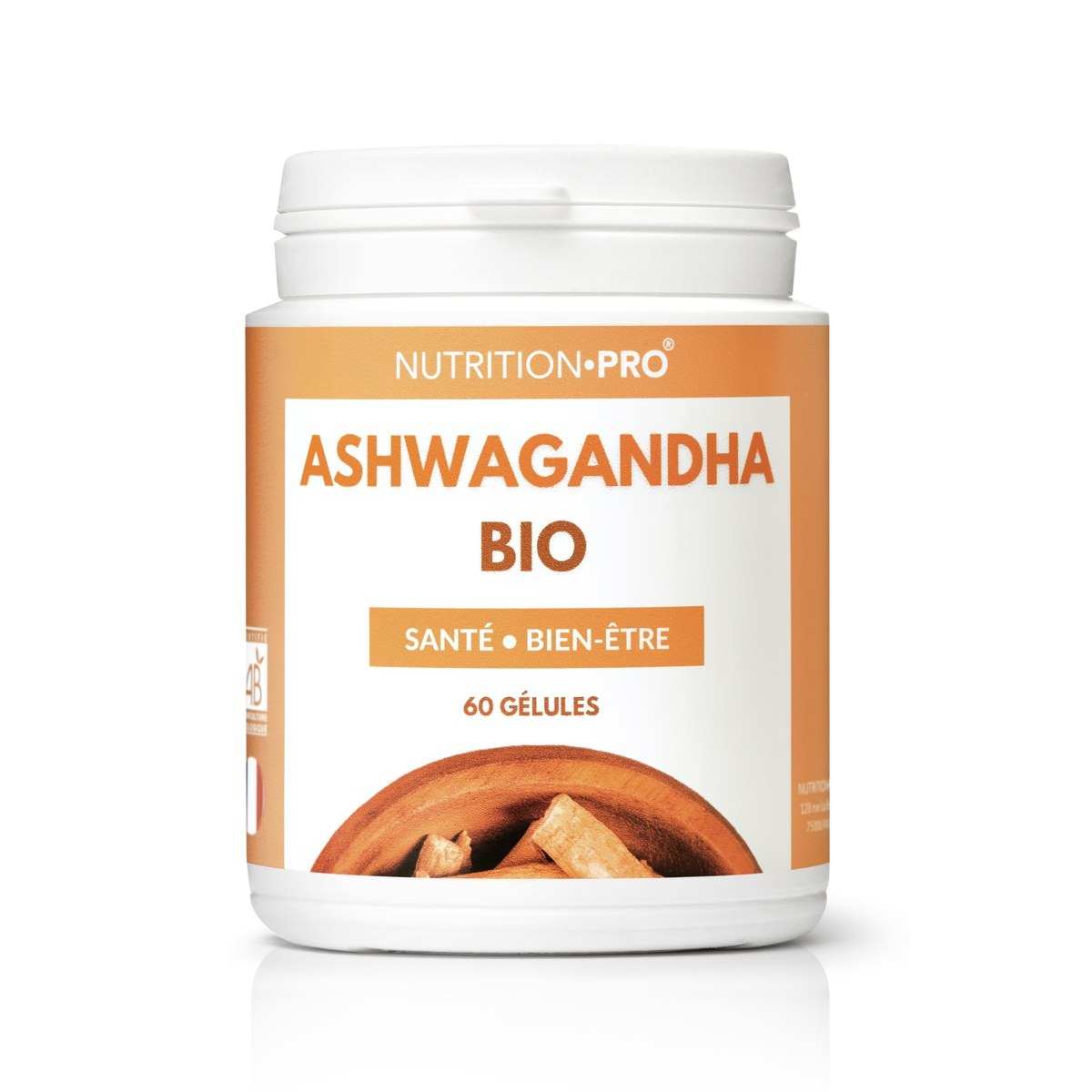
Nutrition•pro is a French brand based in Paris, which says it designs and makes its formulas in France. Its KSM-66 Ashwagandha uses the most studied extract, with nothing added:
- organic KSM-66 root extract, standardised to 5% withanolides;
- 660 mg a day in 2 capsules of 330 mg, about 33 mg of withanolides;
- short ingredient list: the extract and a vegetable capsule;
- 1 capsule in the morning with a meal and 1 in the evening, with a large glass of water;
- 60 capsules, a one-month course;
- €29.99 per jar (price checked on 22/11/2026), about €1.00 a day.
How does the dose compare? 660 mg sits just above the 600 mg used in the main KSM-66 trials, split into two doses as in Chandrasekhar’s trial: consistent with the research, and the one-month format suits a short course followed by a break. Trial results, with their limits, do not guarantee the effect of any single product. On top of the label’s precautions, follow the agencies’ advice: not in pregnancy or breastfeeding, not under 18, not with liver disease, and ask your doctor if you have a thyroid condition or take medication.
Promo code: SEOCONSULTINGSL for 10% off your order, €26.99 per jar, about €0.90 a day (as of 22/11/2026).
See Nutrition•pro KSM-66 Ashwagandha →
Partner link: we earn a commission if you order through this link, at no extra cost to you.
To compare KSM-66 products at the same dose, see our best ashwagandha supplement comparison.
Frequently asked questions
What does ashwagandha do?
In trials it lowers perceived stress and anxiety and slightly improves sleep, sometimes with lower cortisol. It also affects thyroid hormones. Effects are modest and the evidence is low-certainty.
What are the side effects of ashwagandha?
Mostly digestive upset, drowsiness, headache and rashes. Rarely, liver injury, which usually resolves after stopping but can be serious in people with liver disease.
Who should not take ashwagandha?
Pregnant or breastfeeding women, under-18s and people with liver disease. Ask your doctor first if you have a thyroid condition, diabetes, high blood pressure or take immunosuppressants or sedatives.
Can you take ashwagandha every day?
Yes during a course of a few weeks, as in trials (8 to 12 weeks). Long-term safety is not established, so take a break.
Is ashwagandha bad for your liver?
Liver injury is rare but documented, usually after a few weeks of use. Stop and see a doctor if you notice jaundice, itching or dark urine.
Sources
- Akhgarjand C. et al. Does Ashwagandha supplementation have a beneficial effect on the management of anxiety and stress? A systematic review and meta-analysis of randomized controlled trials. Phytother Res, 2022; 36(11): 4115-4124. PubMed 36017529
- Cheah K.L. et al. Effect of Ashwagandha (Withania somnifera) extract on sleep: A systematic review and meta-analysis. PLoS One, 2021; 16(9): e0257843. PubMed 34559859
- Chandrasekhar K. et al. A prospective, randomized double-blind, placebo-controlled study of safety and efficacy of a high-concentration full-spectrum extract of ashwagandha root in reducing stress and anxiety in adults. Indian J Psychol Med, 2012; 34(3): 255-62. PubMed 23439798
- Sharma A.K. et al. Efficacy and Safety of Ashwagandha Root Extract in Subclinical Hypothyroid Patients. J Altern Complement Med, 2018; 24(3): 243-248. PubMed 28829155
- McIntyre D. et al. Ashwagandha (Withania somnifera)-Associated Liver Injury: A Scoping Review of Clinical Characteristics and Safety Considerations. Cureus, 2026; 18(5): e109764. PubMed 42367407
- BfR (German Federal Institute for Risk Assessment). Ashwagandha: food supplements with potential health risks. Communication 39/2024, 10 September 2024. bfr.bund.de