Group · Cereals & grains
Amaranth
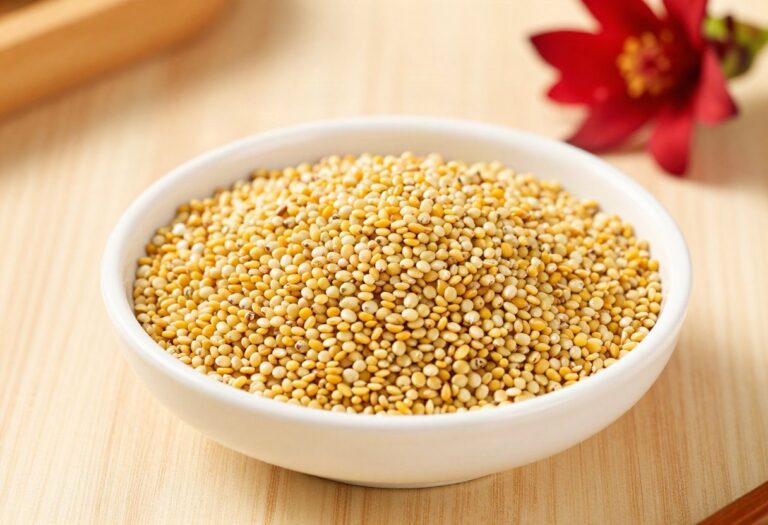
Amaranth is a pseudo-cereal from Central America, a staple of the Aztec diet before the conquistadors banned it for its ritual role. Its tiny seeds are cooked like quinoa or popped like popcorn.
In terms of nutrition facts, raw: 369 kcal per 100 g, with 14.5 g of protein, 58.6 g of carbohydrates and 6.7 g of fibre. It provides 557 mg of phosphorus, 248 mg of magnesium, 508 mg of potassium, 159 mg of calcium and 7.61 mg of iron per 100 g.
Macronutrient breakdown
Nutrition table per 100 g
| Calories | 369 kcal |
| Kilojoules | 1560 kJ |
| Protein | 14,5 g |
| Carbohydrate | 58,6 g |
| Fat | 7,1 g |
| Fibre | 6,7 g |
Micronutrients per 100 g
All measured nutrients, ranked by share of the daily reference intake.
- Manganese3,33 mg167 %
- Phosphorus557 mg80 %
- Magnesium248 mg66 %
- Iron7,61 mg54 %
- Copper0,53 mg53 %
- Vitamin B60,59 mg42 %
- Zinc2,87 mg29 %
- Omega-6 LA2,74 g27 %
- Vitamin B9dietary folate equivalents82 µg
See the other 10 nutrients
- Potassium508 mg25 %
- Vitamin B51,46 mg24 %
- Calcium159 mg20 %
- Vitamin B20,2 mg14 %
- Vitamin B10,12 mg11 %
- Vitamin E1,19 mg10 %
- Vitamin B30,92 mg6 %
- Vitamin C4,2 mg5 %
- Omega-3 ALA0,04 g2 %
- Vitamin A0,08 µg0 %
Anses Ciqual 2025. Source: Anses, 2025, Ciqual food composition table
Tips
7.61 mg of iron and 248 mg of magnesium: exceptional scores. That is 54% and 66% of the reference intakes per 100 g respectively. No common cereal comes close.
Its protein contains lysine. That is its real distinction: cereals are low in it, amaranth is not. Its amino acid profile is therefore far more complete than that of wheat or rice.
Its iron needs vitamin C. Like all plant iron, it is poorly absorbed on its own. Juice from a lemon or vegetables rich in vitamin C at the same meal make a measurable difference.
It is gluten-free. Like quinoa and buckwheat, it is not a grass. It can be used on a coeliac diet, as long as you check the packaging for cross-contamination.
It gets very sticky when cooked. Its tiny seeds release their starch: the result is a porridge, not separate grains. Mixed with a third of quinoa, the texture is much better.