Group · Nuts & seeds
Brazil nuts
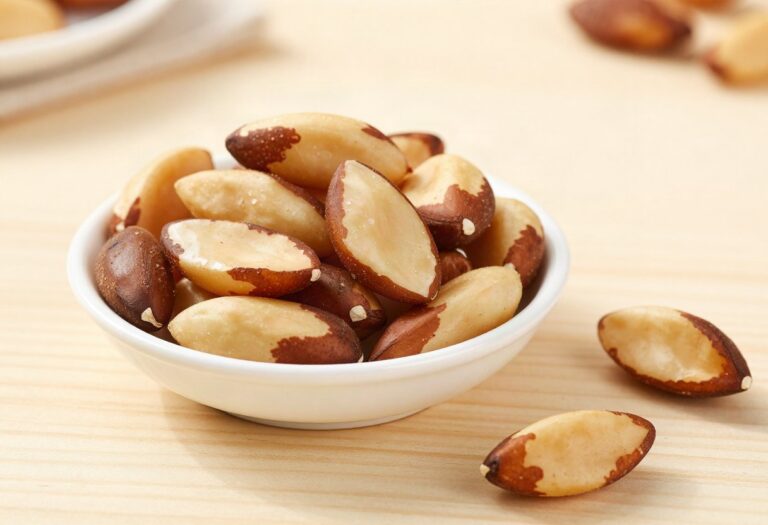
The Brazil nut, sometimes called the Amazon nut, is a large oily seed with a hard shell and creamy flesh, from a majestic tree of the South American rainforests. It is eaten plain, lightly roasted, or worked into sweet and savoury dishes. Rich in healthy fats, it stands out above all for its remarkable selenium content, a trace element rarely found so concentrated in a food. With around 701 kcal per 100 g, it is an energy-dense but nourishing nut. Eaten in moderation, it naturally has its place in a balanced, varied diet, alongside other nuts, bringing crunch, indulgence and nutritional density.
Macronutrient breakdown
Nutrition table per 100 g
| Calories | 701 kcal |
| Kilojoules | 2890 kJ |
| Protein | 16,4 g |
| Carbohydrate | 4,3 g |
| Fat | 67,1 g |
| Fibre | 7,5 g |
Micronutrients per 100 g
All measured nutrients, ranked by share of the daily reference intake.
- Omega-6 LA23,9 g239 %
- Selenium103 µg187 %
- Copper1,74 mg174 %
- Phosphorus725 mg104 %
- Magnesium376 mg100 %
- Manganese1,22 mg61 %
- Vitamin B10,62 mg56 %
- Vitamin E5,65 mg47 %
- Vitamin B9dietary folate equivalents22 µg
See the other 11 nutrients
- Zinc4,06 mg41 %
- Potassium659 mg33 %
- Calcium160 mg20 %
- Iron2,43 mg17 %
- Vitamin B60,1 mg7 %
- Vitamin B50,18 mg3 %
- Vitamin B20,04 mg3 %
- Vitamin B30,3 mg2 %
- Iodine2,53 µg2 %
- Omega-3 ALA0,02 g1 %
- Vitamin C0,7 mg1 %
Anses Ciqual 2025. Source: Anses, 2025, Ciqual food composition table
Tips
The Brazil nut is one of the highest-calorie in its family: given its 67.1 g of fat per 100 g, a reasonable portion of 2 to 4 nuts a day is more than enough. Its special feature is its very high selenium content: one or two nuts already cover daily needs, so there is no point overdoing it. It also provides magnesium, zinc, phosphorus, vitamin E and fibre (7.5 g/100 g), useful for digestive comfort and the feeling of fullness.
In terms of nutrition facts, remember a profile typical of nuts: little carbohydrate (4.23 g), a low glycaemic index and, above all, unsaturated fatty acids. To enjoy its benefits without unbalancing your calorie intake, choose it plain rather than salted or sugar-coated.
- How to eat it: as a snack, crushed over a yoghurt, a porridge or a salad, blended into a homemade spread, or chopped into baking recipes.
- Storage: in an airtight container, away from light and heat, to stop the fats going rancid.
- Pairings: it goes well with dried fruit, dark chocolate or other nuts such as almonds and cashew nuts.
For active people: the Brazil nut is a dense source of energy, ideal in a trail mix for a snack before a long effort or for recovery. Its protein (16.4 g/100 g) tops up your overall intake, although it does not replace a main protein source. When bulking up, it helps to increase your calorie intake easily; when cutting, measure it precisely. To go further on eating well while training, see our guide to fitness nutrition.
Weight control: its calorie density calls for moderation. Measure your portions rather than dipping into the packet, and include it in a varied routine. You can compare its figures with other foods using the calorie table, and explore the whole family of nuts and seeds to vary your pleasures. As part of a balanced diet, the Brazil nut remains a useful ally as long as you respect the quantities.