Group · Dairy
Chaource
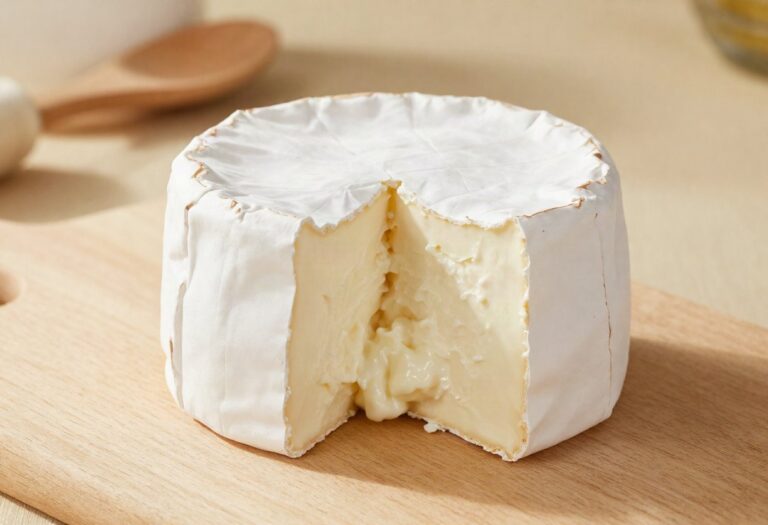
Chaource is a soft cheese from Champagne with a bloomy rind, PDO since 1970. Its paste, drained very slowly and without pressing, stays chalky white at the centre and becomes runny at the surface: two textures in the same cheese.
In terms of nutrition facts: 278 kcal per 100 g, with 22.9 g of fat of which 15.8 g is saturated, and 17 g of protein. It provides 220 mg of phosphorus, 110 mg of calcium, 63.2 µg of vitamin B9 and 1.6 µg of vitamin B12 per 100 g. One point to watch: 1.9 g of salt.
Macronutrient breakdown
Nutrition table per 100 g
| Calories | 278 kcal |
| Kilojoules | 1150 kJ |
| Protein | 17 g |
| Carbohydrate | 0,6 g |
| Fat | 22,9 g |
Micronutrients per 100 g
All measured nutrients, ranked by share of the daily reference intake.
- Vitamin B121,6 µg64 %
- Vitamin B20,53 mg38 %
- Vitamin B963,2 µg32 %
- Phosphorus220 mg31 %
- Vitamin A243 µg30 %
- Vitamin B60,2 mg14 %
- Calcium110 mg14 %
- Potassium130 mg7 %
See the other 11 nutrients
- Vitamin B50,36 mg6 %
- Zinc0,56 mg6 %
- Vitamin E0,59 mg5 %
- Omega-6 LA0,46 g5 %
- Omega-3 ALA0,09 g5 %
- Magnesium12 mg3 %
- Copper0,03 mg3 %
- Vitamin B10,03 mg3 %
- Manganese0,03 mg2 %
- Vitamin K10,89 µg1 %
- Iron0,06 mg0 %
Anses Ciqual 2025. Source: Anses, 2025, Ciqual food composition table
Tips
1.9 g of salt is high for a soft cheese. A 30 g portion provides 0.57 g. Salting is needed to form the bloomy rind, but Chaource is at the top of its category: see salt.
Little calcium, and that makes sense. 110 mg per 100 g: the very gentle draining leaves it with plenty of water, so few concentrated minerals. For calcium, pressed cheeses such as Tomme do five times better.
Young or matured, two different cheeses. At three weeks, its chalky heart is fresh and tangy; at two months, it runs completely and becomes much stronger. It is a matter of choice, not a defect of ripeness.
It is rarely cooked, and rightly so. Its melting paste turns in the heat. Keep it for the cheeseboard, or serve it cold, mashed with a fork and herbs as a spread.
Raw or pasteurised milk, depending on the producer. The PDO allows both: the label settles it, and it is what pregnant women should look at.