Group · Fruit
Conference pear
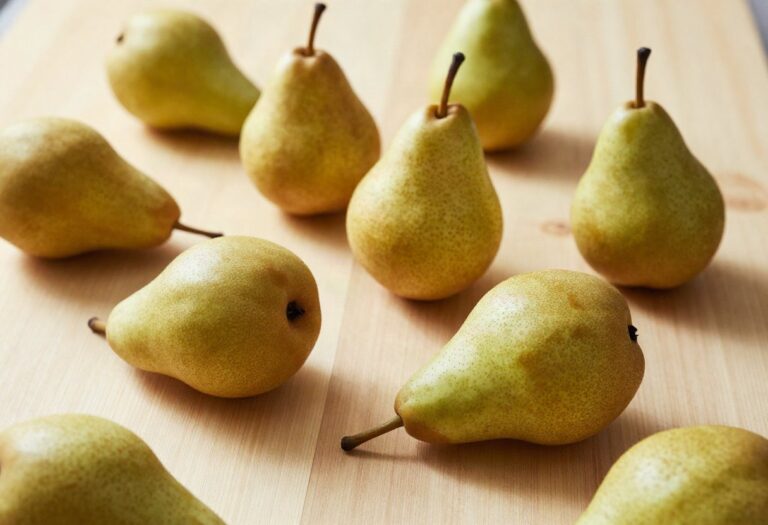
The Conference pear is an English variety from 1885, named after the horticultural conference where it won a prize. Long, with bronzed skin, it is the best-selling pear in Europe thanks to its good keeping qualities.
In terms of nutrition facts, raw flesh without skin: 49.1 kcal per 100 g, with 11.4 g of carbohydrates including 9.4 g of sugars and 3.1 g of fibre. It provides 99 mg of potassium and 19.3 µg of beta-carotene per 100 g.
Macronutrient breakdown
Nutrition table per 100 g
| Calories | 49 kcal |
| Kilojoules | 207 kJ |
| Protein | 0,3 g |
| Carbohydrate | 11,4 g |
| Fibre | 3,1 g |
Micronutrients per 100 g
All measured nutrients, ranked by share of the daily reference intake.
- Copper0,05 mg5 %
- Potassium99 mg5 %
- Vitamin C1,39 mg2 %
- Magnesium5,3 mg1 %
- Phosphorus9,3 mg1 %
- Vitamin B50,07 mg1 %
- Manganese0,02 mg1 %
- Zinc0,07 mg1 %
- Vitamin B9dietary folate equivalents12,6 µg
See the other 3 nutrients
- Iron0,09 mg1 %
- Calcium3,9 mg0 %
- Vitamin A1,61 µg0 %
Anses Ciqual 2025. Source: Anses, 2025, Ciqual food composition table
Tips
It keeps far better than a Williams. That is its commercial purpose: several weeks in the fridge, against a few days for a Williams. Its ripeness window is much wider.
3.1 g of fibre for 49 kcal: an excellent ratio. A 180 g portion provides 5.6 g of fibre, a fifth of the recommended daily intake.
It is less fragrant, and that is the trade-off. Its firmness is paid for in aroma: a Conference will never have the scent of a perfectly ripe Williams. It is, however, much more reliable.
It can be cooked in savoury dishes. Its firmness lets it hold up in a pan-fry or on a tart: with Fourme d’Ambert and walnuts, it is a classic pairing.
Do not peel it as a habit. Its skin is thin and holds some of the fibre. These values are measured on the flesh alone: with the skin, the score goes up further.