Group · Sweet foods
Dark baking chocolate
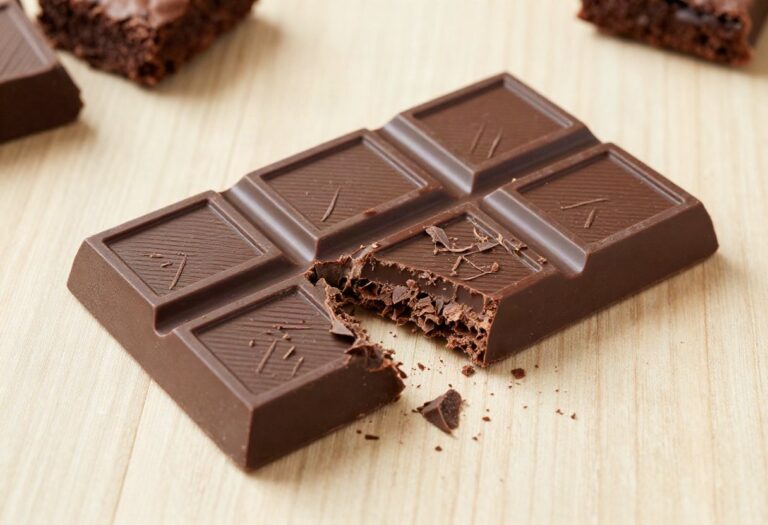
Dark baking chocolate is the essential ally of home bakers. Rich in cocoa (often 50 to 70%), it comes as bars, drops or chips, and is the base of many recipes: brownies, mousses, ganaches and icings. Its concentrated cocoa mass gives it an intense, slightly bitter flavour and a high content of dry cocoa solids, which provide some interesting compounds. With around 546 kcal per 100 g, it remains an energy-dense product, but its richness in fibre (8.76 g) and magnesium sets it apart from very sugary chocolates. In a balanced diet, it is used in moderation, especially in cooking, where a small amount is enough to flavour a dessert.
Macronutrient breakdown
Nutrition table per 100 g
| Calories | 546 kcal |
| Kilojoules | 2280 kJ |
| Protein | 6,4 g |
| Carbohydrate | 51,4 g |
| Fat | 33,1 g |
| Fibre | 8,8 g |
Micronutrients per 100 g
All measured nutrients, ranked by share of the daily reference intake.
- Magnesium130 mg35 %
- Iron4,35 mg31 %
- Phosphorus186 mg27 %
- Potassium300 mg15 %
- Zinc1,3 mg13 %
- Omega-6 LA0,93 g9 %
- Vitamin B10,07 mg6 %
- Vitamin B912 µg6 %
See the other 8 nutrients
- Calcium46 mg6 %
- Vitamin B20,07 mg5 %
- Vitamin B30,6 mg4 %
- Omega-3 ALA0,07 g3 %
- Total omega-30,08 g3 %
- Vitamin B60,03 mg2 %
- Vitamin A4,5 µg1 %
- Vitamin C0,28 mg0 %
Anses Ciqual 2025. Source: Anses, 2025, Ciqual food composition table
Tips
Dark baking chocolate is chosen by its cocoa percentage: the higher it is, the more intense and the less sweet it is. For baking, cocoa at 52-64% offers a good balance between melting smoothness and bitterness. Store it away from heat and humidity, in a dry place, to avoid fat bloom (the harmless thin white film that appears with temperature changes).
In terms of nutrition facts, this chocolate provides per 100 g around 501 kcal, 6.39 g of protein, 51.4 g of carbohydrate, 33.1 g of fat and 8.76 g of fibre. Its calorie density comes mainly from the cocoa butter. It also provides magnesium, iron and antioxidants naturally present in cocoa. To put these amounts in context, you can consult the food calorie table.
Eating and cooking tips:
- Melt it in a bain-marie or in short bursts in the microwave to stop it burning.
- Pair it with dried fruit, hazelnuts or a little fleur de sel to bring out the aromas.
- Use it for homemade recipes rather than very sugary shop-bought versions: that way you control the amount of sugar.
- A few squares eaten plain as a snack may be enough to satisfy a sweet craving.
If you bake, compare it with liquid chocolate for toppings, or with a classic chocolate bar made for eating. It belongs to the large family of sugary foods, to be enjoyed in moderation.
For active people, a few squares of dark chocolate can be part of an energy snack before prolonged exercise, thanks to their carbohydrates and their magnesium, which is useful for muscle function. For recovery, better-balanced sources of protein are preferable: discover our high-protein snack ideas to combine pleasure and protein.
Weight control: with over 33.1 g of fat per 100 g, this chocolate is calorific. Stick to small portions (10 to 20 g), savour it slowly, and choose a high cocoa percentage, which is more filling and less sweet. Used in home baking rather than for repeated nibbling, it fits easily into a balanced diet that still leaves room for treats.