Group · Meat
Duck liver mousse
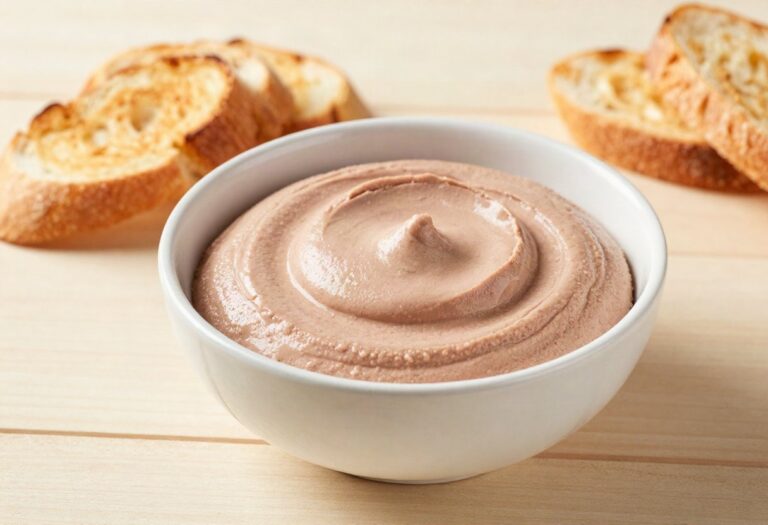
Duck mousse (mousse de canard) is a duck liver preparation emulsified with fat and sometimes cream, sieved to give a smooth texture. It is the fattiest of the liver preparations, with the cream and fat carrying the mousse.
As for nutrition facts: 394 kcal per 100 g, with 36.1 g of fat including 13.7 g of saturated fat, and only 10.1 g of protein. It contains 7.07 g of carbohydrate and 1.58 g of salt per 100 g.
Macronutrient breakdown
Nutrition table per 100 g
| Calories | 394 kcal |
| Kilojoules | 1630 kJ |
| Protein | 10,1 g |
| Carbohydrate | 7,1 g |
| Fat | 36,1 g |
| Fibre | 0,5 g |
Micronutrients per 100 g
All measured nutrients, ranked by share of the daily reference intake.
- Omega-6 LA5,67 g57 %
- Omega-3 ALA0,37 g19 %
Anses Ciqual 2025. Source: Anses, 2025, Ciqual food composition table
Tips
36.1 g of fat for 10.1 g of protein. This is the most unbalanced ratio in the family: the mousse is essentially a fat flavoured with liver. A 20 g spoonful provides 79 kcal.
It contains liver: vitamin A and pregnancy. Like all liver preparations, it can contain large amounts. Excess vitamin A is teratogenic: pregnant women should avoid it, as they should duck terrine.
Its carbohydrate comes from elsewhere. 7.07 g per 100 g: neither liver nor fat contains any. They are sugars, starch or port added to the recipe.
It counts towards the processed meat guideline. 150 g a week, all products combined.
Spread it thinly. Its smooth texture invites you to load the slice, and that is where the count goes wrong. A thin layer on toasted country bread gives just as much flavour.