Group · Fish
Eel
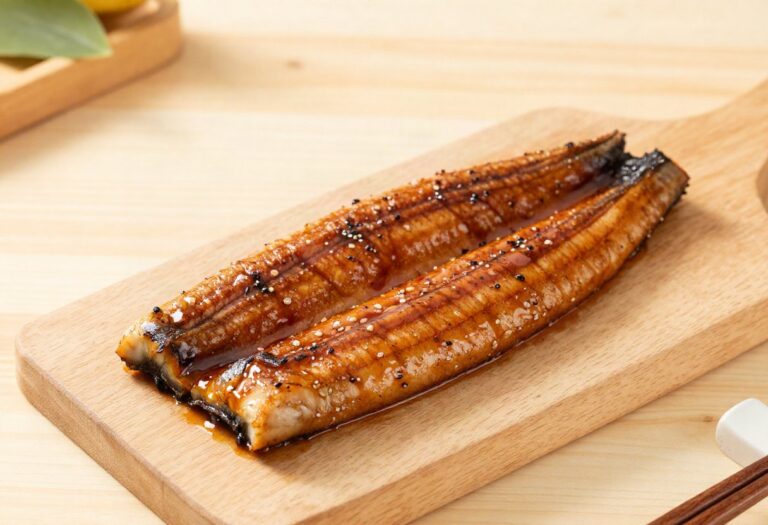
Eel is a long, snake-like fish with fine, melt-in-the-mouth flesh, much appreciated in regional cooking (wine stew, smoked eel, Japanese-style unagi). Its thick skin and fatty flesh give it a pronounced flavour, halfway between a lean and an oily fish. Nutritionally, eel provides around 213 kcal per 100 g, a good amount of protein (22.1 g) and a relatively high fat content (13.8 g), including a share of valuable fatty acids. With no carbohydrate or fibre, it fits into a balanced, varied diet as long as you take its energy density into account. It is a tasty fish that deserves an occasional place on your menu.
Macronutrient breakdown
Nutrition table per 100 g
| Calories | 213 kcal |
| Kilojoules | 888 kJ |
| Protein | 22,1 g |
| Fat | 13,8 g |
Micronutrients per 100 g
All measured nutrients, ranked by share of the daily reference intake.
- DHA0,37 g148 %
- EPA0,2 g80 %
- Total omega-30,57 g23 %
- Zinc2,08 mg21 %
- Iodine8 µg5 %
- Copper0,03 mg3 %
- Manganese0,04 mg2 %
Anses Ciqual 2025. Source: Anses, 2025, Ciqual food composition table
Tips
Eel suits many preparations: grilled, simmered in a stew, smoked in thin slices or cooked Japanese-style as glazed unagi. Its fatty flesh stands up well to gentle cooking and marinades. To preserve its qualities, choose gentle cooking that keeps the fillet tender without drying it out. A sensible portion of 100 to 130 g suits a meal, served with steamed green vegetables or brown rice.
In terms of nutrition facts, eel stands out for its good-quality protein (nearly 22.1 g per 100 g) and the complete absence of carbohydrate and fibre. Its fat, which is higher than that of a white fish, gives it a notable calorie density. It is an interesting source of fat-soluble vitamins (A and D) and minerals. Its glycaemic index is zero, which makes it a food compatible with a diet that keeps glycaemic load under control.
- Storage: eat fresh eel quickly, or keep the smoked version in the fridge and respect the date shown.
- Pairings: fresh herbs, lemon, light soy sauce or a fragrant court-bouillon bring out its flavour.
- Timing: ideal at lunch or dinner, as part of a complete meal.
For active people, eel offers a valuable protein intake to support muscle recovery after exercise. Its fat, however, makes it a higher-calorie food: when bulking, that is an asset, but when cutting it is better to alternate it with leaner fish such as cod or whiting. You can top up your intake by drawing on the advice on fitness nutrition to adjust your portions to your goals.
For weight control, keep its energy density in mind: 213 kcal per 100 g is more than a white fish. Limit breaded or fried versions, and prefer grilled or simmered. Moderation is the key to enjoying its benefits without adding to your calorie total. Discover other options in the fish family and compare intakes with the food calorie table to vary your menus sensibly.