Group · Sweet foods
Filled wafer biscuits
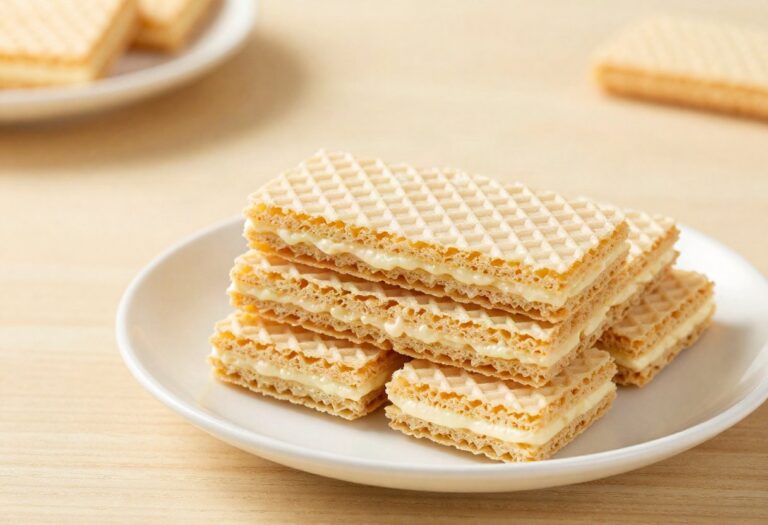
The filled wafer (gaufrette fourrée) is a light, crisp dry biscuit made of thin layers of waffle-textured wafer separated by a cream filling. It comes in many flavours: vanilla, chocolate, coffee, hazelnut, strawberry or lemon. Very common at teatime and with coffee, it appeals with its airy, melt-in-the-mouth texture. In terms of nutrition facts, the filled wafer provides around 562 kcal per 100 g, with 49 g of carbohydrate, 36.1 g of fat and only 9 g of protein. It is therefore a sweet treat belonging to the sugary foods, to be enjoyed in moderation as part of a balanced diet. Its high energy density calls for attention to portion sizes.
Macronutrient breakdown
Nutrition table per 100 g
| Calories | 562 kcal |
| Kilojoules | 2340 kJ |
| Protein | 9 g |
| Carbohydrate | 49 g |
| Fat | 36,1 g |
| Fibre | 2,5 g |
Micronutrients per 100 g
All measured nutrients, ranked by share of the daily reference intake.
- Manganese1,2 mg60 %
- Copper0,36 mg36 %
- Phosphorus247 mg35 %
- Vitamin E4,07 mg34 %
- Omega-6 LA2,76 g28 %
- Calcium219 mg27 %
- Vitamin B120,63 µg25 %
- Iron3,5 mg25 %
- Vitamin B9dietary folate equivalents19,3 µg
See the other 15 nutrients
- Potassium498 mg25 %
- Vitamin B20,34 mg24 %
- Iodine32 µg21 %
- Magnesium63,3 mg17 %
- Vitamin B50,88 mg15 %
- Zinc1,3 mg13 %
- Vitamin C6,4 mg8 %
- Selenium4,34 µg8 %
- Vitamin B60,11 mg8 %
- Vitamin K15 µg7 %
- Vitamin B10,06 mg5 %
- Total omega-30,12 g5 %
- Vitamin B30,75 mg5 %
- Omega-3 ALA0,09 g4 %
- Vitamin A9,25 µg1 %
Anses Ciqual 2025. Source: Anses, 2025, Ciqual food composition table
Tips
Filled wafers are best enjoyed in small amounts, during an indulgent break or with a tea. A sensible portion is 2 or 3 wafers (around 20 to 30 g), enough for a treat without piling up too many calories. Like any sugary product, they rank among occasional sweets rather than everyday foods.
Understanding the nutrition facts. With nearly 562 kcal per 100 g, the filled wafer is rich in carbohydrate (fast sugars from the filling) and in fat, often added fat. Its glycaemic index is fairly high and its fibre very low (2.5 g). It provides little protein. It is typically a source of dense calories, to be eaten mindfully. If you are watching your weight, it is better to limit how often you have them and look after portion sizes rather than nibbling through the packet without counting.
Practical tips and pairings. Keep the wafers in airtight packaging to preserve their crunch, away from damp. For a more balanced teatime, pair them with fresh fruit or a plain dairy product, which adds fibre and protein. You can also vary your treats with dry biscuits such as the petit beurre or an oat biscuit, more filling thanks to the oat flakes.
For active people. The filled wafer provides quickly available carbohydrate, useful as a small boost before a short effort or to replenish stores after training. But its fat content makes it a poor fit just before an intense session, as it is digested slowly. For muscle recovery, favour sources of protein: discover our protein snack ideas, more complete to support your goals of gaining or maintaining muscle mass.
Varieties and culinary uses. Wafers come in chocolate-coated versions, in sticks, in rolled formats or as thin sheets to crumble over ice cream. They are also used to decorate desserts or served with vanilla ice cream. To explore other treats and compare their nutrition, browse the sugary foods family. In short, the filled wafer is a pleasure to enjoy now and then, within a varied and balanced diet.