Group · Condiments & sauces
Nuoc-mam sauce
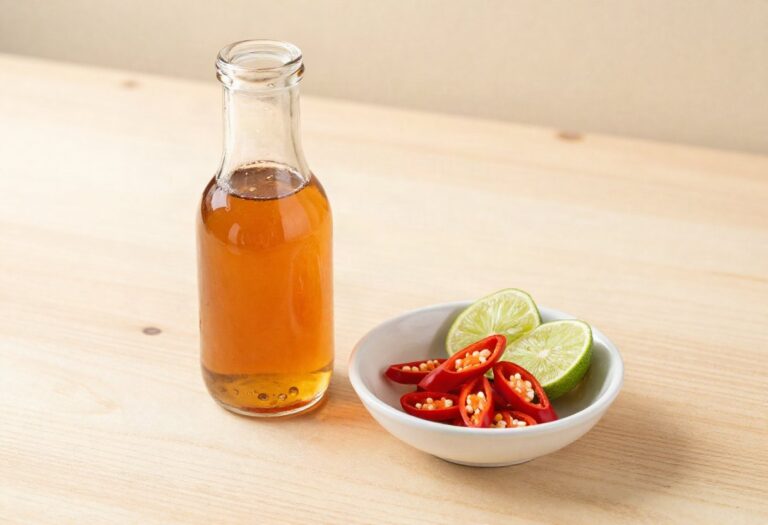
Nuoc-mam is a brine of anchovies fermented for several months to a year, then filtered and bottled. It is the base seasoning of Vietnamese and Thai cooking, and the direct descendant of Roman garum, made in exactly the same way two thousand years ago.
On nutrition facts: 81.2 kcal per 100 g, with 9.3 g of protein, 10.9 g of carbohydrate and no fat. But the key information is the salt: 22.2 g per 100 g, one of the saltiest foods in the whole database. It is a brine, and it remains one.
Macronutrient breakdown
Nutrition table per 100 g
| Calories | 81 kcal |
| Kilojoules | 345 kJ |
| Protein | 9,3 g |
| Carbohydrate | 10,9 g |
| Fibre | 0,2 g |
Tips
Bring it back to real-life use. One teaspoon, or 5 g, provides a little over 1 g of salt: a fifth of the daily reference, to season an entire dish. That is not nothing, but it is very far from what the raw 22.2 g suggests.
It is a salt, not just another condiment. The direct consequence: a nuoc-mam dish is never salted. The habit of tasting before reaching for the salt cellar is the only one that matters here (see salt for reference points).
Table nuoc-mam is already diluted. The dipping sauce served with spring rolls, nuoc cham, is nuoc-mam thinned with water, lemon juice, sugar and garlic. Its salt content is much lower, but it brings sugar.
Quality shows in the ingredients list. A good nuoc-mam contains only anchovy, salt and sometimes sugar. Lower-end versions add hydrolysates, flavour enhancers and colourings, and have neither the taste nor the amber clarity of a first-press product.
It contains fish, of course. Avoid it if you have a fish allergy, and mention it when cooking for others: it is an allergen that hides in dishes where you would not expect it, such as a curry or a papaya salad.
Sources
Average nutrition values per 100 g, given for guidance (may vary by brand and preparation).