Group · Fruit
Papaya
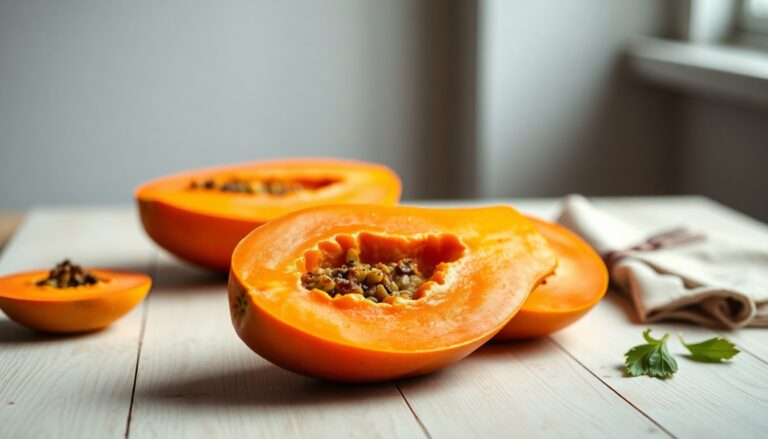
The papaya is a tropical fruit with bright orange flesh, sweet and melting, native to Central America and now grown in most warm regions of the globe. Its elongated shape recalls that of a large pear, and its centre holds small, edible black seeds with a peppery taste. It comes in two main varieties: the large solo papaya and the small papaya with denser flesh. With only 39.6 kcal per 100 g, it fits easily into a balanced diet. Rich in water, fibre and vitamin C, it appeals as much to people with a sweet tooth as to those watching their weight. Its natural sweetness makes it a versatile fruit, as good plain as in a recipe.
Macronutrient breakdown
Nutrition table per 100 g
| Calories | 40 kcal |
| Kilojoules | 167 kJ |
| Protein | 0,8 g |
| Carbohydrate | 8,6 g |
| Fat | 0,2 g |
| Fibre | 1,8 g |
Micronutrients per 100 g
All measured nutrients, ranked by share of the daily reference intake.
- Vitamin C65,3 mg82 %
- Potassium200 mg10 %
- Magnesium18 mg5 %
- Vitamin A29,3 µg4 %
- Vitamin B50,18 mg3 %
- Calcium22 mg3 %
- Manganese0,04 mg2 %
- Vitamin B30,29 mg2 %
- Vitamin B9dietary folate equivalents55,3 µg
See the other 6 nutrients
- Vitamin B10,02 mg2 %
- Vitamin B60,02 mg1 %
- Phosphorus8,7 mg1 %
- Vitamin B20,02 mg1 %
- Total omega-30,03 g1 %
- Iron0,16 mg1 %
Anses Ciqual 2025. Source: Anses, 2025, Ciqual food composition table
Tips
The papaya is ideally eaten fully ripe, when its skin turns from green to orange-yellow and gives slightly under your finger. Cut it in half, scoop out the seeds with a spoon, then enjoy the flesh plain, with a drizzle of lemon juice that nicely lifts its flavour. A portion of about 150 g is a reasonable amount, perfect at breakfast, as a snack or as a light dessert.
In terms of nutrition facts, the papaya has a low energy density thanks to its high water content. It provides vitamin C, beta-carotene (responsible for its colour), potassium and gentle fibre that contributes to digestive comfort. Its glycaemic index stays moderate, which makes it an interesting fruit for slimming, as long as you stick to the fresh fruit rather than candied or very sweet versions.
In the kitchen, the papaya has a thousand uses:
- in an exotic fruit salad with mango and pineapple;
- in a creamy smoothie blended with plain yoghurt;
- green and grated, in the style of a spicy Thai salad;
- alongside meats or fish, thanks to its mild sweetness.
Keep it at room temperature until ripe, then in the fridge for a few days. Once cut, cover the flesh and eat it quickly to preserve its vitamin C, which is fragile when exposed to air and heat.
For active people, the papaya is a handy ally. Before exercise, it provides easily absorbed carbohydrates without weighing on the stomach. After training, its natural sugars and potassium help with rehydration and refuelling. You can add it to a post-workout protein bowl, or to one of these high-protein snack ideas to combine pleasure and recovery. Paired with a source of protein such as fromage blanc, it makes a balanced, filling snack.
For weight control, the papaya remains one of the lightest fruits: enjoy it without overdoing it, varying your treats with the other riches of the fruit family. Just be wary of industrial preparations and dried fruits, which are much more concentrated in sugars. To compare intakes, take a look at the food calorie table and build colourful plates that put freshness first.