Group · Dairy
Gruyère
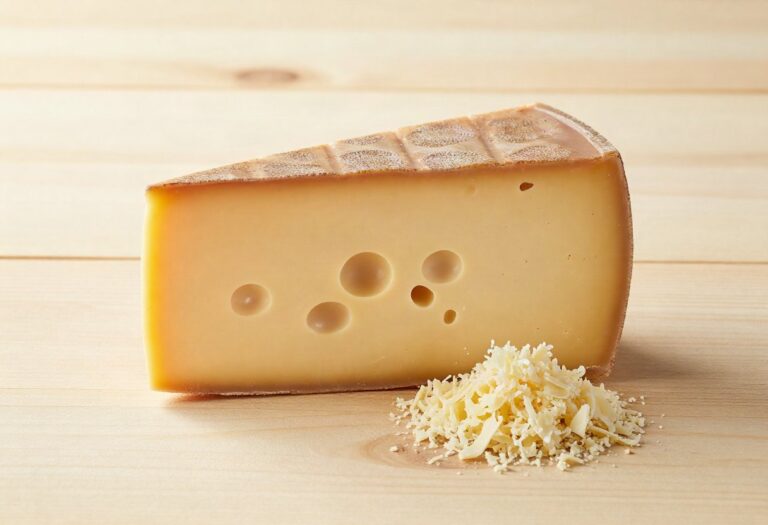
Gruyère is a hard, cooked pressed-curd cheese from Switzerland, recognisable by its firm, ivory-coloured, fruity paste. Matured for several months, sometimes up to a year, it develops intense, slightly nutty aromas and a dense texture sometimes dotted with small holes. It is a cheese that is particularly rich in protein and calcium, but also high in calories and fat, so it is best enjoyed in moderation. At around 408 kcal per 100 g, it fits into a balanced diet as long as you respect the portions. Grated, shaved or cubed, gruyère suits many hot and cold dishes, and remains a pillar of gratin-topped, convivial cooking.
Macronutrient breakdown
Nutrition table per 100 g
| Calories | 408 kcal |
| Kilojoules | 1690 kJ |
| Protein | 25,8 g |
| Carbohydrate | 0,8 g |
| Fat | 33,5 g |
Micronutrients per 100 g
All measured nutrients, ranked by share of the daily reference intake.
- Calcium800 mg100 %
- Phosphorus605 mg86 %
- Vitamin B121,6 µg64 %
- Zinc4,89 mg49 %
- Copper0,41 mg41 %
- Vitamin A271 µg34 %
- Vitamin B20,28 mg20 %
- Omega-3 ALA0,34 g17 %
See the other 15 nutrients
- Iodine23,1 µg15 %
- Vitamin D0,6 µg12 %
- Magnesium39,2 mg10 %
- Selenium5,33 µg10 %
- Vitamin B50,56 mg9 %
- Omega-6 LA0,63 g6 %
- Vitamin B60,08 mg6 %
- Vitamin B10,06 mg5 %
- Vitamin B910 µg5 %
- Potassium81 mg4 %
- Vitamin K12,7 µg4 %
- Vitamin E0,28 mg2 %
- Manganese0,03 mg2 %
- Iron0,17 mg1 %
- Vitamin B30,11 mg1 %
Anses Ciqual 2025. Source: Anses, 2025, Ciqual food composition table
Tips
Gruyère has dense nutrition facts: nearly 25.8 g of protein, 33.5 g of fat and only 0.78 g of carbohydrates per 100 g. Its near-absence of sugars and very low glycaemic index make it a cheese that is compatible with a balanced diet, as long as you watch the quantity. A reasonable 30 g portion provides around 124 kcal: enough to enjoy its benefits without tipping your day out of balance.
How to eat gruyère? Grated over gratins, pasta or soup, shaved into a salad, melted into an omelette or simply cubed with drinks. It also goes very well with wholemeal bread. To limit calories, go for quality over quantity: a well-matured gruyère has more flavour, so you use less of it.
- Portion guide: 30 g a day is enough to cover part of your calcium and protein needs.
- Storage: wrapped in greaseproof paper then a cloth, in the bottom of the fridge, so it can breathe without drying out.
- Smart pairings: with vegetables, wholegrain cereals or a green salad to balance the meal.
In terms of nutrients, gruyère is an excellent source of calcium, phosphorus and vitamin B12, as well as complete protein useful for maintaining muscle mass. If you like hard cooked cheeses, you will find similar profiles in Comté or Emmental, other essentials of the dairy products family.
For active people: its richness in protein and calcium makes it an ally for recovery, to include in a snack or a meal after exercise. A few cubes of gruyère with wholemeal bread make a practical way to replenish your reserves. If you are looking for tasty, protein-rich ideas, take a look at these protein snack recipes. When you are trying to gain mass, gruyère provides good energy density; when you are cutting, reduce the portion and favour a leaner cheese such as 0% fromage blanc.
Weight control: with around 33.5 g of fat per 100 g and a notable salt content, gruyère is a food to eat in moderation. Weigh your portions, avoid combining it with other fatty foods at the same meal, and keep it as a flavourful touch rather than the base of your plate. Well measured, it has its place in a varied diet that includes pleasure.