Group · Fruit
Lychee
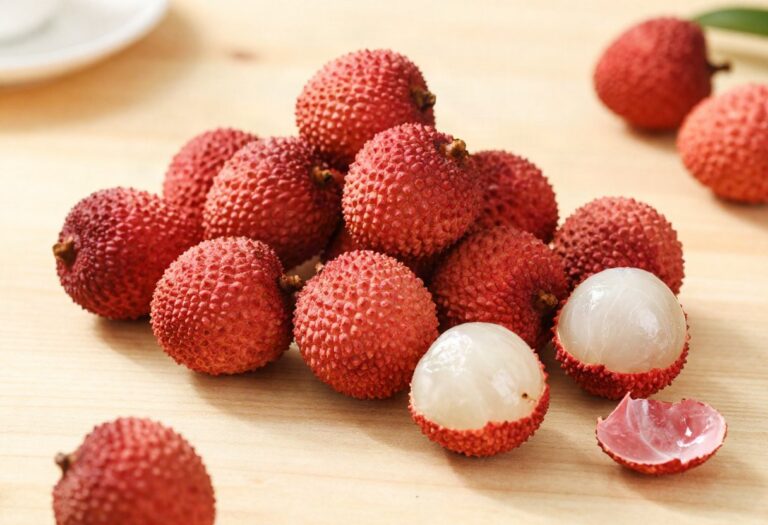
Native to South-East Asia, the lychee is a small exotic fruit recognisable by its rough, pinkish-red shell, which encloses white, translucent, fragrant flesh and a glossy stone. Its sweet, delicately floral flavour makes it one of the star treats of winter, when it arrives on our shelves. With only 77.5 kcal per 100 g, the lychee remains a light fruit despite its very sweet taste. It provides carbohydrates, a little fibre and vitamin C. Fresh, tinned or dried, it fits easily into a balanced diet, as a dessert or as an original touch in sweet-and-savoury dishes.
Macronutrient breakdown
Nutrition table per 100 g
| Calories | 78 kcal |
| Kilojoules | 329 kJ |
| Protein | 1,2 g |
| Carbohydrate | 16,1 g |
| Fat | 0,5 g |
| Fibre | 2 g |
Micronutrients per 100 g
All measured nutrients, ranked by share of the daily reference intake.
- Vitamin C19,2 mg24 %
- Copper0,2 mg20 %
- Potassium200 mg10 %
- Vitamin B60,12 mg9 %
- Vitamin B31,06 mg7 %
- Manganese0,1 mg5 %
- Magnesium18 mg5 %
- Phosphorus27 mg4 %
- Vitamin B9dietary folate equivalents28,3 µg
See the other 6 nutrients
- Zinc0,23 mg2 %
- Iron0,26 mg2 %
- Total omega-30,03 g1 %
- Vitamin B50,06 mg1 %
- Calcium3,6 mg0 %
- Vitamin A0,21 µg0 %
Anses Ciqual 2025. Source: Anses, 2025, Ciqual food composition table
Tips
The lychee is best eaten fresh, simply peeled, to enjoy its juicy flesh to the full. Choose fruits with a supple, coloured shell and no brown spots, a sign of freshness. A reasonable portion is around 8 to 10 lychees, the equivalent of a standard portion of fruit. Keep them in the fridge, in the salad drawer alongside the vegetables, where they last a few days.
In terms of nutrition facts, the lychee has about 16.1 g of carbohydrate per 100 g, mainly natural sugars, which explains its pronounced flavour and its fairly moderate glycaemic index. It provides vitamin C, potassium and small amounts of fibre. If you are watching your weight, bear in mind that this fruit, very easy to eat in large quantities, can quickly push up your sugar intake: it is better to count it and include it as part of a gradual balanced diet.
In the kitchen, the lychee lends itself to lovely pairings. You can combine it with other exotic fruits such as mango or pineapple in a colourful salad, add it to a plain yoghurt, or use it to lift a sweet-and-savoury poultry dish. Its dried version concentrates sugars and calories: eat it in small amounts. To vary your treats, also discover other fresh seasonal fruits.
- Breakfast: a few lychees with fromage blanc for a fresh, fruity touch.
- Snack: as a light bite, on their own or mixed with red berries.
- Dessert: in an exotic salad or as a topping for a homemade sorbet.
For active people, the lychee is a source of quickly absorbed carbohydrates, useful as a snack before moderate exercise or to kick-start recovery after training. Paired with a source of protein (yoghurt, fromage blanc, a handful of nuts), it rounds off a high-protein snack nicely. Its richness in water also contributes to hydration. Stick to measured portions, however, if your goal is weight loss, because its sugars add up quickly over the day.
If you want to compare its calories with those of other foods, see the calorie table. In short, the lychee is a tasty, light fruit whose benefits are best enjoyed when you keep to reasonable portions and include it in a varied diet.