Group · Sweet foods
Milk chocolate
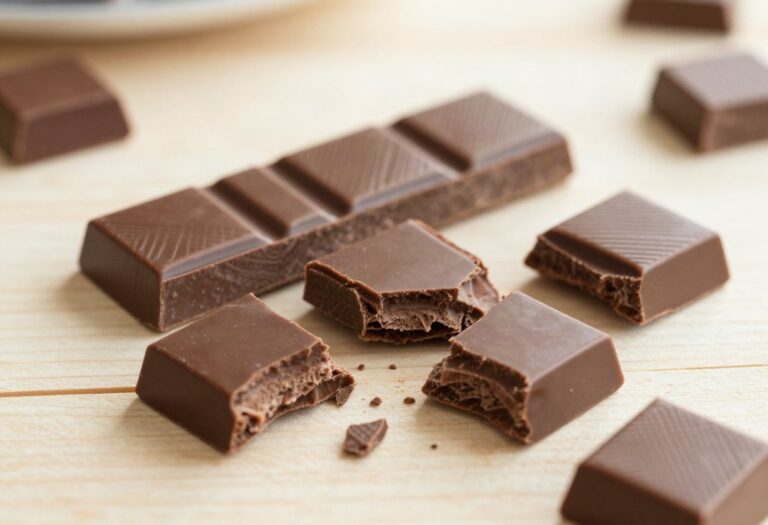
Milk chocolate combines cocoa mass, sugar, cocoa butter and milk powder. It is the most widely eaten form of chocolate in France, and the sweetest: regulations only require a minimum of 25% cocoa, compared with 43% for an eating dark chocolate.
In terms of nutrition facts, it provides 550 kcal per 100 g, with 58.9 g of carbohydrate (of which 56.3 g are sugars, nearly all of it), 30.8 g of fat including 18.7 g of saturated fat, 7.5 g of protein and 2.9 g of fibre. The milk powder does add calcium (220 mg) and magnesium (59 mg), whereas dark chocolate is richer in iron and polyphenols.
Macronutrient breakdown
Nutrition table per 100 g
| Calories | 550 kcal |
| Kilojoules | 2300 kJ |
| Protein | 7,5 g |
| Carbohydrate | 58,9 g |
| Fat | 30,8 g |
| Fibre | 2,9 g |
Micronutrients per 100 g
All measured nutrients, ranked by share of the daily reference intake.
- Phosphorus230 mg33 %
- Vitamin D1,5 µg30 %
- Copper0,29 mg29 %
- Calcium220 mg28 %
- Iron3,6 mg26 %
- Potassium510 mg26 %
- Iodine33,7 µg22 %
- Vitamin B120,54 µg22 %
See the other 16 nutrients
- Vitamin B51,26 mg21 %
- Vitamin B20,26 mg19 %
- Manganese0,35 mg18 %
- Magnesium59 mg16 %
- Zinc1,1 mg11 %
- Omega-6 LA0,95 g10 %
- Vitamin B918,7 µg9 %
- Vitamin K15,87 µg8 %
- Vitamin B10,07 mg6 %
- Vitamin A42,8 µg5 %
- Vitamin B60,07 mg5 %
- Omega-3 ALA0,08 g4 %
- Total omega-30,1 g4 %
- Vitamin E0,45 mg4 %
- Vitamin C1,58 mg2 %
- Vitamin B30,18 mg1 %
Anses Ciqual 2025. Source: Anses, 2025, Ciqual food composition table
Tips
Sugar is the real marker. Of 58.9 g of carbohydrate, 56.3 g are sugars: almost all of it. That is what sets milk chocolate apart from dark chocolate, far more than the calories: dark baking chocolate has 546 kcal, practically the same energy density. Choosing dark will not make you lose weight; it cuts the sugar and increases the cocoa.
Think in squares. A square of bar chocolate weighs around 5 to 10 g depending on the brand, or 28 to 55 kcal. Two or three squares fit easily into a balanced day; it is the bar half-eaten in front of a screen that is the problem, not the chocolate itself.
What it really provides. 220 mg of calcium and 59 mg of magnesium per 100 g is not negligible, but you would have to eat 100 g to get there, which is 550 kcal. A plain yoghurt provides calcium for a fraction of those calories. Milk chocolate is a pleasure, not a source of nutrients.
Weight control. With an energy density of 5.5 kcal per gram, milk chocolate is one of those foods where portion size matters more than frequency. Enjoying it slowly, at the end of a meal rather than on an empty stomach, limits the blood sugar spike and the craving that follows. To see where it sits among other sugary foods, see the food calorie table.
For active people. Its sugars are quickly available, but its 30.8 g of fat slow down digestion: it is not a pre-workout snack. For recovery, an easier-to-digest source of carbohydrate paired with protein does the job better.
Storage. Keep it away from heat and light, at around 18 °C and dry. Putting it in the fridge causes fat bloom, which dulls the surface without making the chocolate unfit to eat.