Group · Drinks
Orange juice
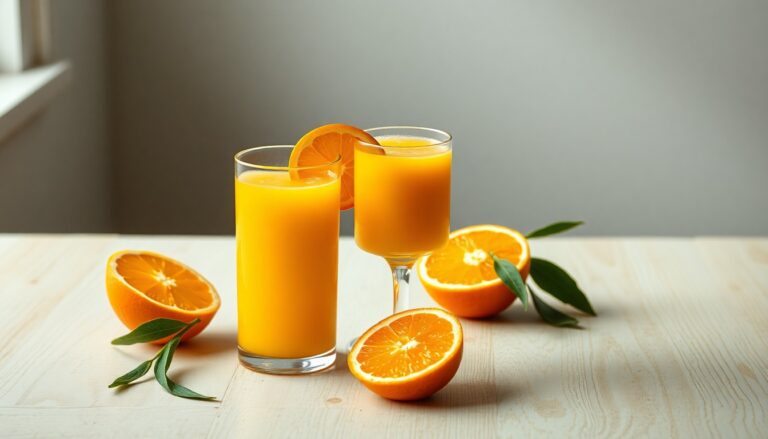
Orange juice is one of the most popular fruit drinks at breakfast. Squeezed at home, fresh or made from concentrate, it comes in several forms: pure juice, juice with pulp, or reconstituted versions. Made from juicy oranges, it has a sweet, tangy flavour that everyone enjoys. Nutritionally, orange juice provides about 45.6 kcal per 100 g, mainly as carbohydrate (9.59 g), with very little fat and protein. It is best known for its vitamin C content and the natural compounds of the fruit. Convenient and refreshing, it has a place in a varied diet, as long as you keep an eye on how much you drink.
Macronutrient breakdown
Nutrition table per 100 ml
| Calories | 46 kcal |
| Kilojoules | 194 kJ |
| Protein | 0,7 g |
| Carbohydrate | 9,6 g |
| Fat | 0,2 g |
| Fibre | 0,3 g |
Micronutrients per 100 ml
All measured nutrients, ranked by share of the daily reference intake.
- Vitamin C44,2 mg55 %
- Vitamin B930 µg15 %
- Potassium154 mg8 %
- Vitamin B10,08 mg7 %
- Vitamin B60,1 mg7 %
- Vitamin B50,24 mg4 %
- Magnesium10,9 mg3 %
- Vitamin B20,04 mg3 %
See the other 12 nutrients
- Phosphorus16,9 mg2 %
- Copper0,02 mg2 %
- Vitamin B30,3 mg2 %
- Vitamin E0,2 mg2 %
- Manganese0,02 mg1 %
- Calcium7,25 mg1 %
- Iron0,08 mg1 %
- Omega-3 ALA0,01 g0 %
- Iodine0,45 µg0 %
- Omega-6 LA0,02 g0 %
- Zinc0,02 mg0 %
- Vitamin A0,88 µg0 %
Anses Ciqual 2025. Source: Anses, 2025, Ciqual food composition table
Tips
Orange juice is ideally enjoyed in the morning, fresh and well chilled. To get the most from it, choose homemade squeezed juice over commercial versions, which often contain more added sugar. Once squeezed, drink it quickly because vitamin C breaks down when exposed to air and light. Keep it in the fridge in a closed container and drink it within 24 to 48 hours.
In terms of nutrition facts, orange juice contains carbohydrates that come mostly from the natural sugars of the fruit (fructose, glucose), which gives it a relatively moderate glycaemic index but faster absorption than a whole fruit, because fibre is almost absent (0.25 g per 100 g). This is why biting into an orange is still better for fullness. The juice is nonetheless a useful source of vitamin C, folate and potassium.
- Recommended portion: a small glass (about 150 ml) is plenty for everyday.
- Pairings: with a complete breakfast including cereals, bread or dairy products.
- Variations: mix it with carrot juice or grapefruit juice to vary the flavours and nutrients.
For active people, orange juice is a handy ally. Before exercise, it provides quickly available carbohydrate for energy. After training, it helps replenish stores and supports hydration, especially when combined with a source of protein. You can, for example, add it to a post-training shaker or a recovery snack. Its potassium content is welcome after an intense session where you have sweated a lot.
When it comes to weight control, keep in mind that orange juice, even 100% pure, is still a sugary drink with a significant energy density if you drink several glasses. Unlike water, it provides calories that add up quickly. If you are trying to lose weight, limit yourself to one glass and avoid nectars and sweetened citrus drinks. To manage your intake better, check the food calorie table and discover the other drinks in our guide. If you want to cut down on liquid sugars, choose water, tea or an unsweetened herbal tea during the day.