Group · Fats & oils
Palm oil
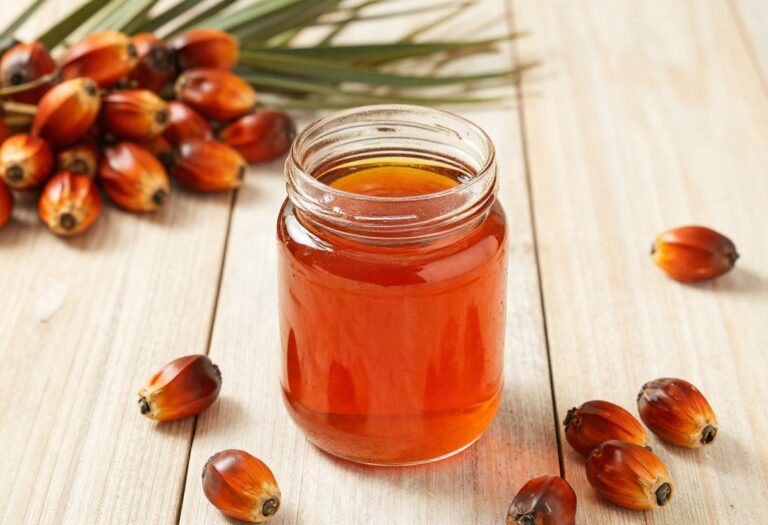
Palm oil is a vegetable fat extracted from the pulp of the oil palm fruit. Orange in colour when raw (red palm oil), it is most often refined to become neutral and pale. You rarely come across it in a bottle at home, but it is everywhere in processed products: spreads, industrial pastries, biscuits, ready meals, margarines. Its solid texture at room temperature and its stability when cooking explain its industrial success. With 885 kcal and 100 g of fat per 100 g, it is a pure fat, rich in saturated fatty acids. Knowing its nutrition facts helps you decode labels better and keep its place in your diet in check.
Macronutrient breakdown
Nutrition table per 100 g
| Calories | 900 kcal |
| Kilojoules | 3700 kJ |
| Fat | 100 g |
Micronutrients per 100 g
All measured nutrients, ranked by share of the daily reference intake.
- Vitamin E15,9 mg133 %
- Omega-6 LA9,1 g91 %
- Vitamin K18 µg11 %
- Omega-3 ALA0,2 g10 %
- Iron0,01 mg0 %
Anses Ciqual 2025. Source: Anses, 2025, Ciqual food composition table
Tips
Palm oil stands out for its richness in saturated fatty acids (notably palmitic acid), which gives it a semi-solid consistency and great resistance to oxidation and high temperatures. In terms of calories, it is identical to other oils: about 90 kcal per tablespoon. Its distinctive feature is therefore not its calorie density but its fat profile, which is more saturated than that of liquid vegetable oils.
- Moderation above all: guidelines advise limiting saturated fat. Day to day, favour more unsaturated oils such as olive oil or rapeseed oil, which is rich in omega-3.
- Spot it on labels: it often hides under « vegetable oil » in processed products. These foods frequently combine saturated fat and sugars, which fits the logic of empty calories.
- Cooking: its stability makes it a popular fat for industrial frying, but at home you do not need to use it.
Red palm oil, which is unrefined, keeps an orange tint linked to its carotenoid (provitamin A) and vitamin E content. It is used in some West African and Brazilian cuisines. The refined version, more common in the food industry, loses a large share of these compounds. Be careful not to confuse palm oil with palm kernel oil, extracted from the kernel of the same fruit and even more saturated.
For active people: fats contribute to overall energy intake and to the transport of fat-soluble vitamins. But for performance and recovery, it is better to get your fats from unsaturated sources (oils, nuts, oily fish) and to look after your carbohydrate and protein intake. If you are structuring your nutrition around training, these principles are detailed in our fitness nutrition guide.
Weight control: like any fat, palm oil is very high in calories. The real watch-point is its presence in ultra-processed products, which are easy to overeat. Cook at home, read ingredient lists and keep a balanced approach. To compare fats objectively, the calorie table and the page for the fats and oils family give you a useful overview to make your choices.