Group · Vegetables
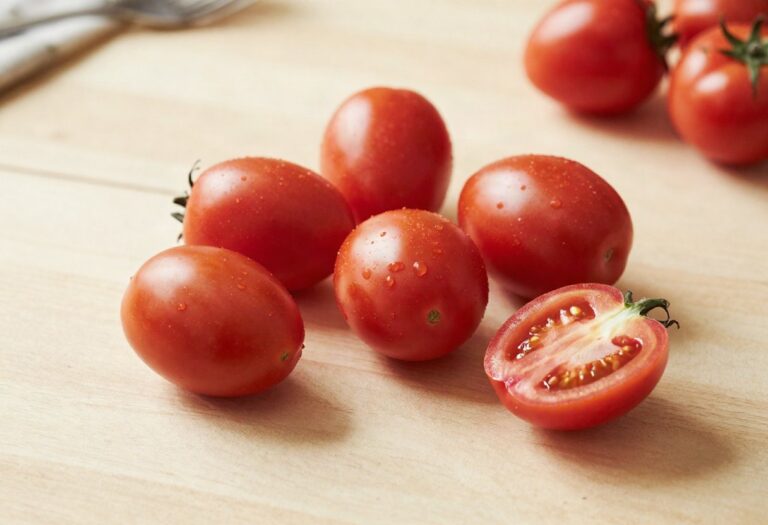
Plum tomato
The plum tomato, also known as the Roma or olivette, has firm flesh, few seeds and little juice. It is the tomato of tinned tomatoes and Italian sauces: its low water content shortens the reduction time.
In terms of nutrition facts, raw it provides 18.8 kcal per 100 g, with 3.29 g of carbohydrate, 2.1 g of fibre and 16.8 mg of vitamin C per 100 g. It contains 94.4 g of water.
Macronutrient breakdown
Nutrition table per 100 g
| Calories | 19 kcal |
| Kilojoules | 79 kJ |
| Carbohydrate | 3,3 g |
| Fibre | 2,1 g |
Micronutrients per 100 g
All measured nutrients, ranked by share of the daily reference intake.
- Vitamin C16,8 mg21 %
- Vitamin E0,54 mg5 %
Anses Ciqual 2025. Source: Anses, 2025, Ciqual food composition table
Tips
2.1 g of fibre: the best score among the tomatoes in our database. Twice as much as a round tomato. Its dense flesh and thick skin explain the gap.
It is the sauce tomato, no question. Less water to evaporate means a sauce ready in thirty minutes instead of an hour, with a more concentrated taste. That is why Italian tinned tomatoes use it almost exclusively.
It peels easily. Thirty seconds in boiling water after scoring a cross in the base, then into iced water. Its thick skin comes away in one piece.
It dries very well. Halved and left for three hours in the oven at 90 °C, it becomes a slow-roasted tomato. It is the variety to choose for this, as the others release too much water.
Raw, it is less interesting. Its firm flesh lacks juice and aroma in a salad: for eating raw, a beefsteak tomato or a vine tomato is much better.