Group · Fish
Sea trout
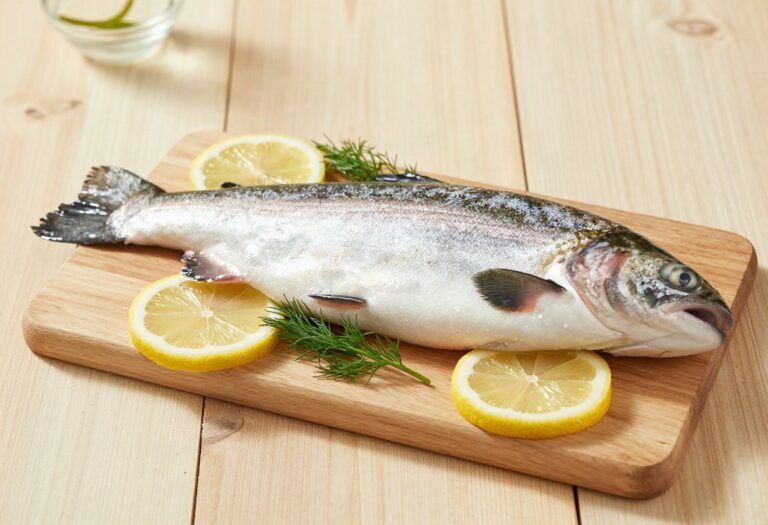
The sea trout is a common trout that has migrated to sea before swimming back up rivers to spawn, like a salmon. This time at sea changes its flesh: it becomes pinkish, richer and tastier than that of a river trout.
In terms of nutrition facts, raw: 114 kcal per 100 g, with 19.6 g of protein and 3.63 g of fat. It provides 5 µg of vitamin B12 (twice the reference intake), 458 mg of potassium, 270 mg of phosphorus and 22.9 µg of selenium per 100 g, with 0.14 g of salt.
Macronutrient breakdown
Nutrition table per 100 g
| Calories | 114 kcal |
| Kilojoules | 481 kJ |
| Protein | 19,6 g |
| Carbohydrate | 0,9 g |
| Fat | 3,7 g |
Micronutrients per 100 g
All measured nutrients, ranked by share of the daily reference intake.
- Vitamin B125 µg200 %
- Vitamin D2,1 µg42 %
- Selenium22,9 µg42 %
- Phosphorus270 mg39 %
- Vitamin B60,54 mg39 %
- Vitamin B51,95 mg33 %
- Potassium458 mg23 %
- Vitamin B33,5 mg22 %
See the other 13 nutrients
- Iodine20 µg13 %
- Vitamin B20,14 mg10 %
- Zinc0,95 mg10 %
- Vitamin B10,1 mg9 %
- Iron1,23 mg9 %
- Vitamin B916 µg8 %
- Magnesium29,3 mg8 %
- Vitamin E0,65 mg5 %
- Copper0,04 mg4 %
- Calcium12,7 mg2 %
- Manganese0,03 mg1 %
- Omega-6 LA0,11 g1 %
- Vitamin C0,55 mg1 %
Anses Ciqual 2025. Source: Anses, 2025, Ciqual food composition table
Tips
It is leaner than a farmed trout. 114 kcal against 183 for a roasted trout: a natural diet at sea gives a different profile from a fish fed in a tank.
5 µg of vitamin B12 per 100 g. Twice the reference intake. Salmonids are among the best food sources of this vitamin.
458 mg of potassium: a very good score. A 150 g portion covers more than a third of the reference intake.
Its pink flesh is cooked like salmon. Steamed, in a gentle oven or pan-fried skin side down. It needs no added fat: 3.63 g of fat is enough to protect it.
It is rare and seasonal. Fishing is regulated and populations are fragile in several river basins. It is a fish for special occasions, not a supermarket staple.