Group · Cereals & grains
Spelt
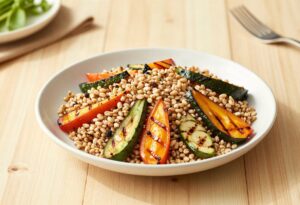
Spelt is an ancient wheat with a hulled grain: its husk clings to the grain and has to be removed. Grown since the Neolithic period, it was displaced by common wheat in the 20th century before making a recent comeback. « Petit épeautre » is a different species, einkorn.
On the nutrition side, raw spelt provides 344 kcal per 100 g, with 15.6 g of protein (a lot for a cereal), 59.5 g of carbohydrate and 10.7 g of fibre. It provides 136 mg of magnesium, 401 mg of phosphorus, 4.44 mg of iron and 3.28 mg of zinc per 100 g.

Macronutrient breakdown
Nutrition table per 100 g
| Calories | 344 kcal |
| Kilojoules | 1450 kJ |
| Protein | 15,6 g |
| Carbohydrate | 59,5 g |
| Fat | 2,5 g |
| Fibre | 10,7 g |
Micronutrients per 100 g
All measured nutrients, ranked by share of the daily reference intake.
- Manganese2,98 mg149 %
- Phosphorus401 mg57 %
- Copper0,51 mg51 %
- Vitamin B36,84 mg43 %
- Magnesium136 mg36 %
- Zinc3,28 mg33 %
- Vitamin B10,36 mg33 %
- Iron4,44 mg32 %
- Vitamin B9dietary folate equivalents45 µg
See the other 9 nutrients
- Potassium388 mg19 %
- Vitamin B51,07 mg18 %
- Vitamin B60,23 mg16 %
- Vitamin B20,11 mg8 %
- Vitamin E0,79 mg7 %
- Vitamin K13,6 µg5 %
- Calcium27 mg3 %
- Omega-3 ALA0,07 g3 %
- Vitamin A0,42 µg0 %
Anses Ciqual 2025. Source: Anses, 2025, Ciqual food composition table
Tips
15.6 g of protein is its main selling point. It is clearly ahead of common wheat and most cereals. Combined with a pulse such as lentils or chickpeas, it makes a complete protein intake.
These values are for the raw grain. A 70 g dry portion gives about 200 g cooked: the grain absorbs nearly three times its weight in water, so the figures per 100 g cooked are much lower.
It contains gluten, despite its reputation. This is a stubborn misconception: spelt is a wheat, and its gluten is simply more fragile and sometimes better tolerated in cases of non-coeliac sensitivity. If you have confirmed coeliac disease, it is strictly off limits.
Soak it, as it makes all the difference. A night in cold water halves the cooking time and improves the absorption of iron and zinc by breaking down some of the grain’s phytic acid.
It replaces rice without any fuss. In a risotto, a salad or a soup, it adds a chew that rice does not have, with far more protein and minerals. It is one of the easiest swaps to stick to.
Sources
Average nutrition values per 100 g, given as a guide only (they may vary by brand and preparation).