Acerola cherry: vitamin C content, benefits, dosage and side effects
The short answer
Acerola cherry is one of the richest natural sources of vitamin C on earth: 1,500 to 4,500 mg per 100 g of fresh fruit, versus 47.5 mg for an orange. Because the fruit spoils within days, outside the tropics it is sold as juice, acerola powder or tablets. Is natural vitamin C better than synthetic? The molecule is identical, and human studies show no long-term difference in bioavailability; acerola’s real plus is delivering vitamin C alongside the rest of the fruit. 100 to 200 mg of vitamin C a day is plenty. The one real warning: a risk of allergy in people allergic to peach, peanut or certain pollens, mainly with juice and powder.
This article is for information and does not replace medical advice. If you have food allergies, kidney stones or iron overload, check with your doctor.
What is acerola?
Acerola (Malpighia emarginata, also listed as M. punicifolia or M. glabra) is the fruit of a shrub from tropical America, also called Barbados cherry or West Indian cherry. Brazil has built a structured industry around it. The fruit is red, juicy and tart, somewhere between a sour cherry and citrus. It also contains carotenoids, polyphenols and anthocyanins, the pigments behind its colour.
Acerola cherry vitamin C content
According to a reference review (Prakash and Baskaran, 2018), fresh acerola holds 1,500 to 4,500 mg of vitamin C per 100 g, depending on variety, ripeness and processing. For comparison:
| Food (100 g) | Vitamin C |
|---|---|
| Fresh acerola | 1,500 to 4,500 mg |
| Guava | 228 mg |
| Blackcurrants | 181 mg |
| Red pepper, raw | 121 mg |
| Kiwi fruit | 81.9 mg |
| Orange | 47.5 mg |
Supplements often use a standardised extract: a 17% extract gives 170 mg of vitamin C per gram. So a product labelled “acerola 1000” does not deliver 1,000 mg of vitamin C: always read the vitamin C line. To get it from food, see our foods high in vitamin C guide.
Natural vs synthetic vitamin C: what the evidence says
- Same molecule. Ascorbic acid from fruit and from a tablet are chemically identical.
- No steady-state difference in humans. A review of all comparative studies (Carr and Vissers, Nutrients, 2013) found that every human steady-state study showed no difference in bioavailability between natural and synthetic vitamin C. Some short pharmacokinetic studies found small, transient differences with little likely physiological impact.
- A small signal for acerola. In young Japanese men (Uchida et al., 2011), 50 mg of vitamin C from acerola juice gave slightly higher blood levels and lower urinary loss than the same dose of ascorbic acid. A small, short study.
- The fruit matrix may matter. A 2026 review (Aquino et al.) says human evidence is limited but hints at matrix-dependent effects.
Bottom line: acerola is not “stronger” than regular vitamin C at the same dose. Its appeal lies in its plant origin and the fruit’s other compounds. Compare all forms in our best vitamin C supplement comparison.
Acerola benefits: realistic expectations
Acerola’s benefits are those of vitamin C, which European regulators recognise as contributing to normal immune function, reduced tiredness, collagen formation and absorption of non-heme (plant) iron.
Colds and immunity
The Cochrane review (Hemilä and Chalker, 2013, 29 trial comparisons, over 11,000 people) shows that regular vitamin C (at least 200 mg a day):
- does not reduce how often the general population catches colds;
- shortens colds slightly: by 8% in adults and 14% in children;
- halves the risk of colds in people under intense physical stress (marathon runners, skiers, soldiers in subarctic conditions);
- taken only once a cold starts, shows no consistent effect.
Immunity is mostly built on your plate and lifestyle: see how to boost your immune system with food and our best immune support supplements.
Iron absorption
Taken with a meal rich in plant iron, vitamin C helps absorb it, a real advantage for vegetarians. Our iron deficiency guide explains how to pair foods.
Acerola side effects and who should avoid it
Allergy
In 2022, researchers at the Institut Pasteur and a Paris children’s hospital found a lipid transfer protein (LTP), a potent allergen, in fresh acerola, commercial juice and a commercial powder. LTPs look alike across plants, so people allergic to peach, apple, peanut, tree nuts or plane and olive pollen may react severely. An anaphylaxis case involving apple juice containing acerola was published in 2002. According to Pasteur, tablets do not appear to contain allergenic LTP because of how they are made: juice and powder are the main concern.
Digestive upset and kidney stones
High doses can have a laxative effect. In a large US cohort (Ferraro et al., 2016, over 40,000 men), supplements of 1 g or more a day were linked to a 19% higher risk of kidney stones in men, with no link in women. Typical acerola doses (100 to 200 mg) are far below that.
Other cautions
- hemochromatosis or iron overload: vitamin C boosts iron absorption, ask your doctor;
- pregnancy and breastfeeding: needs are usually met by food, so no high doses without advice;
- teeth: chewable tablets and powder are acidic and often sweetened; rinse afterwards.
How much acerola per day?
- Needs: the French food agency (Anses) sets 110 mg a day for adults; the EU label reference value is 80 mg.
- Useful dose: 100 to 200 mg of vitamin C a day tops up a diet low in fruit and vegetables. Cochrane trials used at least 200 mg.
- Timing: with breakfast or lunch, ideally the meal with the most plant iron.
- No need to go high: your body does not store the excess.
Nutrition•pro organic acerola: tablets and powder
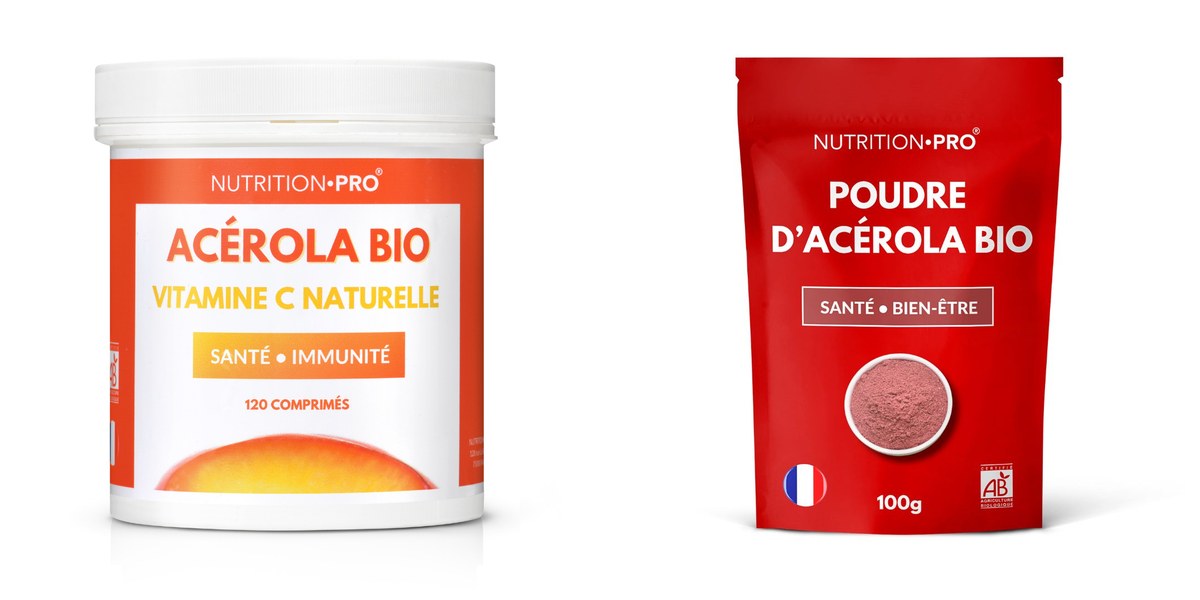
Nutrition•pro is a French brand based in Paris. Its acerola is organic and grown in Brazil, the home of the crop, and comes in two forms for two different uses.
| Organic acerola (tablets) | Organic acerola powder | |
|---|---|---|
| Ingredients | Organic acerola extract standardised to 17% (1,000 mg), organic glucose syrup, natural red fruit flavour | 100% organic acerola powder |
| Vitamin C per day | 170 mg (212.5% of the reference value) | Not stated on the product page |
| Suggested use | 1 tablet a day, sucked or chewed | 1 teaspoon (3 to 5 g) a day |
| Pack | 120 tablets, 120 days | 100 g (20 to 33 days) or 500 g |
| Price (checked 22 Nov 2026) | €29.99, about €0.25 a day | €24.99 per 100 g; €99.99 per 500 g |
| With the code | €26.99, about €0.22 a day | €22.49 per 100 g; €89.99 per 500 g |
Our take. The tablets stand out for a clearly stated, precise dose of 170 mg of vitamin C, right in the useful range, and 120 days of supply for under €30 makes them one of the most affordable ways to take plant-sourced vitamin C. Each contains a little sugar (1.47 g of glucose syrup), and per Pasteur the tablet form appears least affected by the LTP allergen. Cochrane trials used at least 200 mg, so one tablet comes close without reaching it.
The powder, with nothing added, suits anyone who wants plain acerola cherry powder for smoothies, yoghurt or juice, with its tangy taste. Its vitamin C per spoon is not stated, so choose the tablets if you want an exact dose, and skip the powder if you are allergic to peach or pollens.
Promo code: SEOCONSULTINGSL for 10% off your order (prices checked 22 Nov 2026).
See Nutrition•pro acerola tablets →
See Nutrition•pro acerola powder →
Partner link: we earn a commission if you order through this link, at no extra cost to you.
FAQ
What is acerola cherry good for?
Mainly as a natural source of vitamin C: immune function, tiredness, collagen and plant iron absorption. Regular vitamin C shortens colds slightly but does not prevent them.
Is acerola better than ascorbic acid?
Same molecule, same long-term bioavailability in human studies. Acerola adds the fruit’s other compounds and a plant origin.
Who should not take acerola?
People with LTP allergy (peach, apple, peanut, tree nuts, plane or olive pollen), especially with juice or powder. Caution with kidney stones or hemochromatosis.
What does acerola taste like?
Tart and fruity, between sour cherry and citrus. Tablets are usually flavoured.
Is acerola juice a good source of vitamin C?
Yes, but content varies widely with processing and dilution, and juice carries the allergy risk. Check the label for the vitamin C amount.
Sources
- Prakash A., Baskaran R. Acerola, an untapped functional superfruit: a review on latest frontiers. J Food Sci Technol, 2018; 55(9): 3373-3384. PubMed 30150795
- Carr A.C., Vissers M.C. Synthetic or food-derived vitamin C: are they equally bioavailable? Nutrients, 2013; 5(11): 4284-4304. PubMed 24169506
- Uchida E. et al. Absorption and excretion of ascorbic acid alone and in acerola juice. Biol Pharm Bull, 2011; 34(11): 1744-1747. PubMed 22040889
- Aquino J.S. et al. Acerola and Its By-Products as Sources of Bioactive Compounds. Molecules, 2026; 31(11): 1792. PubMed 42280099
- Hemilä H., Chalker E. Vitamin C for preventing and treating the common cold. Cochrane Database Syst Rev, 2013; (1): CD000980. PubMed 23440782
- Ferraro P.M. et al. Total, Dietary, and Supplemental Vitamin C Intake and Risk of Incident Kidney Stones. Am J Kidney Dis, 2016; 67(3): 400-407. PubMed 26463139
- Raulf-Heimsoth M. et al. Anaphylactic reaction to apple juice containing acerola. J Allergy Clin Immunol, 2002; 109(4): 715-716. PubMed 11941325
- Institut Pasteur. Acérola : attention aux risques d’allergie, 2022 (updated 2026). pasteur.fr