Glucosamine and chondroitin: does it work, benefits and side effects

The short answer
Glucosamine and chondroitin are natural building blocks of cartilage, sold as supplements for osteoarthritis. Does glucosamine work? The large independent trials are disappointing: in the US GAIT trial (1,583 patients), neither supplement, nor the combination, beat placebo for knee pain overall. A BMJ meta-analysis found effects too small to be noticeable. France’s health authority rated these drugs as offering insufficient benefit and they are no longer reimbursed there. Three safety points matter: shellfish allergy (glucosamine is often made from shells), diabetes (monitor blood sugar) and warfarin-type blood thinners (bleeding risk).
This article is for information and does not replace medical advice. If you have painful osteoarthritis, diabetes, asthma or take a blood thinner, talk to your doctor or pharmacist before taking glucosamine.
What is glucosamine?
Glucosamine is an amino sugar your body makes on its own. It is a building block of the large molecules that keep cartilage springy. Chondroitin is one of those large molecules: it holds water in cartilage so it can absorb shocks.
In supplements, glucosamine is usually extracted from shellfish shells (crab, shrimp, lobster), sometimes made by fermentation. Chondroitin mostly comes from animal cartilage. Glucosamine comes in two main forms:
- glucosamine sulfate, used in most European trials;
- glucosamine hydrochloride (HCl), more concentrated but with fewer positive results.
Collagen is a different thing: a protein, not an amino sugar. See our guide to collagen benefits and types.
Does glucosamine chondroitin work for osteoarthritis?
The GAIT trial: no better than placebo overall
This is the largest independent trial (Clegg et al., 2006, New England Journal of Medicine). 1,583 people with knee osteoarthritis took, for 24 weeks, 1,500 mg of glucosamine (hydrochloride), 1,200 mg of chondroitin, both, the anti-inflammatory celecoxib, or placebo. The goal: at least a 20% drop in pain.
| Group | Difference vs placebo (60.1% responders) | Significant? |
|---|---|---|
| Glucosamine 1,500 mg | +3.9 points | No |
| Chondroitin 1,200 mg | +5.3 points | No |
| Glucosamine + chondroitin | +6.5 points | No |
| Celecoxib 200 mg | +10 points | Yes |
In the 354 patients with moderate to severe pain, the combination gave 79.2% responders vs 54.3% on placebo, but this was an exploratory subgroup analysis that needs confirming.
Meta-analyses: a small effect, below what patients notice
A BMJ network meta-analysis (Wandel et al., 2010) pooled 10 large trials (3,803 patients). On a 10 cm pain scale, the difference vs placebo was 0.4 cm for glucosamine, 0.3 cm for chondroitin and 0.5 cm for the combination, against a pre-set noticeable threshold of 0.9 cm, with no effect on joint space narrowing. Industry-funded trials showed larger effects than independent ones.
For chondroitin alone, the Cochrane review (Singh et al., 2015, 43 trials) is a little more positive: about 8 points better pain on a 100-point scale in the short term, and 53% vs 47% of patients with at least 20% less pain in the two best trials. But most trials were low quality, and the benefit became uncertain in larger or non-industry trials.
Glucosamine sulfate vs glucosamine hydrochloride
A meta-analysis of 19 trials (Wu et al., 2013, 3,159 patients) found glucosamine hydrochloride ineffective for knee pain. Results for glucosamine sulfate were very inconsistent: no clear effect on pain, but a small effect on function after more than 6 months. Sulfate is the better-documented form, with no guarantee.
| Question | What studies show | Evidence |
|---|---|---|
| Knee osteoarthritis pain | Small or no effect in independent trials | Weak |
| Moderate to severe pain | Positive signal for the combination in a GAIT subgroup | Exploratory |
| Slowing cartilage loss | No clear X-ray effect (BMJ); small effect for chondroitin (Cochrane) | Weak |
| Glucosamine hydrochloride | No effect on pain | Negative |
In France, glucosamine and chondroitin are also sold as prescription-style medicines. In 2013, the French health authority (HAS) rated their benefit as insufficient for mild to moderate knee osteoarthritis, and they are no longer reimbursed. Their label advises reconsidering treatment if there is no improvement after 2 to 3 months.
Glucosamine side effects and who should avoid it
Shellfish allergy
The French label of a shellfish-derived glucosamine medicine contraindicates it in people allergic to shellfish. If you are allergic, choose a product clearly labelled as non-marine (fermentation or plant-based) and ask your allergist.
Diabetes and blood sugar
A review (Simon et al., 2011) found no effect on fasting blood sugar in trials, including in people with diabetes, but notes there is no solid long-term study in prediabetes. The French label still advises checking blood glucose before and during treatment if you have diabetes or impaired glucose tolerance.
Warfarin and other blood thinners
This is the most serious issue. The European Food Safety Authority (EFSA, 2011) reviewed more than 40 cases in which INR (a clotting test) rose after people on coumarin anticoagulants, mostly warfarin, started glucosamine, sometimes with bleeding. In most cases INR returned to normal when glucosamine was stopped. Don’t take glucosamine with warfarin without your doctor’s approval and INR monitoring.
Other precautions
| Situation | What to know |
|---|---|
| Side effects | Usually mild: nausea, stomach pain, diarrhea or constipation, headache, fatigue, rash |
| Asthma | Worsening reported after starting: watch your symptoms |
| Cardiovascular risk | Blood lipid checks advised (high cholesterol reported, no proven link) |
| Tetracycline antibiotics | Absorption may increase, limited importance |
| Pregnancy | Do not use: not enough data |
| Breastfeeding | Not recommended: no data |
How to take glucosamine
- Trial dose: 1,500 mg of glucosamine a day (sulfate preferred) and 800 to 1,200 mg of chondroitin. Many supplements provide less.
- Timing: with or without food, in one or more doses; with food if your stomach is sensitive.
- How long: any effect takes weeks. Reassess after 2 to 3 months and stop if nothing has changed.
- The basics matter more: weight loss if needed, exercise and muscle strengthening remain the core of osteoarthritis care.
See also our guides to devil’s claw, turmeric safety and the anti-inflammatory diet.
Dynveo: a shellfish-free glucosamine sulfate, the highest dose in our selection
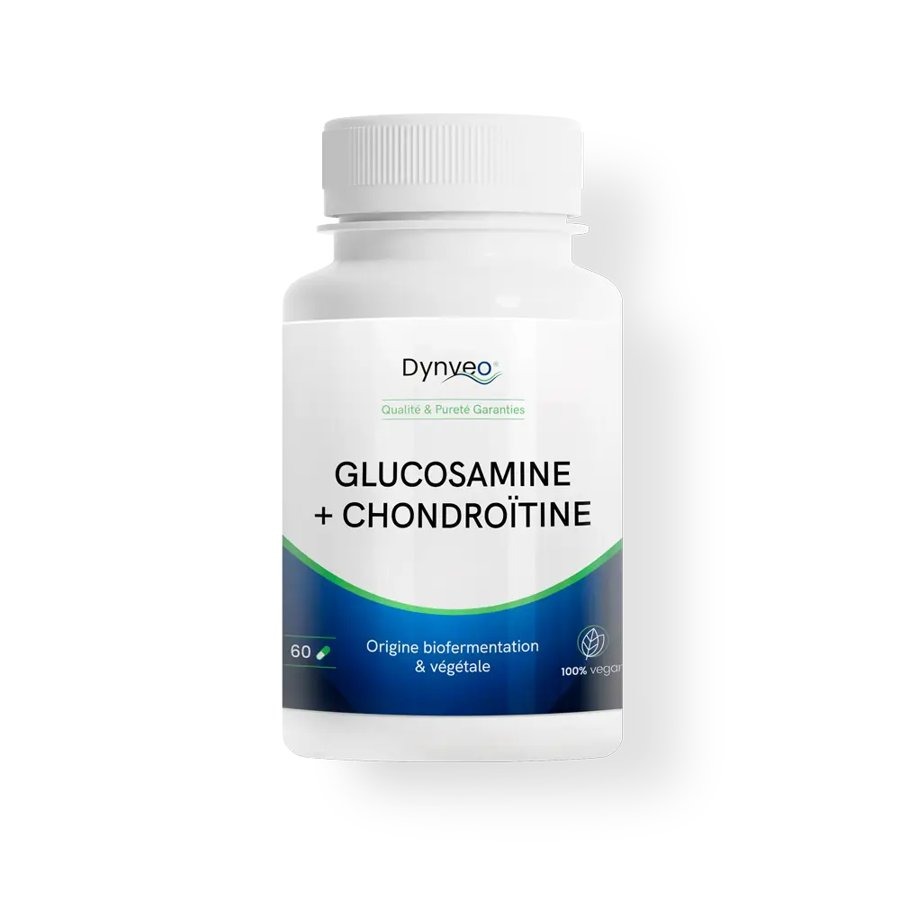
If you want to try it after talking to your doctor, Dynveo’s Glucosamine Chondroïtine ticks two important boxes: the sulfate form and a shellfish-free origin. Its product page lists:
- 1,125 mg of glucosamine sulfate per 3 capsules, made by fermentation rather than from shells;
- 900 mg of Phytodroitin, a seaweed complex (sea lettuce, fucus) offered as a plant alternative to chondroitin;
- a 100% plant-based formula with no fillers, in pullulan capsules; batch analysis certificates published on the page;
- 3 capsules a day with a meal (1 to 2 for maintenance); 60 capsules last 20 days at 3 a day;
- €22.90 for 60 capsules (price checked on 22/11/2026), about €1.15 a day; also sold in 180 capsules (€64.90).
How does the dose compare? 1,125 mg is 75% of the 1,500 mg used in trials, and the highest glucosamine dose among the products in our best joint supplement comparison. Phytodroitin, however, is not chondroitin: the chondroitin trials above used animal chondroitin sulfate, not this seaweed extract, and none of the studies tested this product.
To its credit, the page itself advises against the product for people with diabetes, prediabetes or asthma, on blood thinners, on sodium or potassium-restricted diets, during pregnancy or breastfeeding, and for children.
See Dynveo Glucosamine Chondroitin →
Partner link: we earn a commission if you order through this link, at no extra cost to you.
Frequently asked questions
What are the benefits of glucosamine?
It is used for osteoarthritis. Large independent trials show a small or no effect on pain; some people may get a modest benefit, mainly with the sulfate form, to be judged after 2 to 3 months.
Does glucosamine chondroitin really work?
Not much on average: in GAIT, the combination did not beat placebo overall, and meta-analyses find effects below what patients notice.
What are the side effects of glucosamine chondroitin?
Mild digestive upset, headache and rare skin reactions; bleeding risk with warfarin; blood sugar monitoring in diabetes; possible asthma flare-ups.
Is glucosamine safe with a shellfish allergy?
Shellfish-derived glucosamine is contraindicated on the French medicine label. Choose a fermentation or plant-based product and ask your allergist.
Glucosamine sulfate or hydrochloride?
Sulfate: hydrochloride showed no effect on pain in a meta-analysis of 19 trials, while sulfate results are mixed but somewhat better.
Sources
- Clegg D.O. et al. Glucosamine, chondroitin sulfate, and the two in combination for painful knee osteoarthritis. N Engl J Med, 2006; 354(8): 795-808. PubMed 16495392
- Wandel S. et al. Effects of glucosamine, chondroitin, or placebo in patients with osteoarthritis of hip or knee: network meta-analysis. BMJ, 2010; 341: c4675. PubMed 20847017
- Wu D. et al. Efficacies of different preparations of glucosamine for the treatment of osteoarthritis: a meta-analysis of randomised, double-blind, placebo-controlled trials. Int J Clin Pract, 2013; 67(6): 585-94. PubMed 23679910
- Singh J.A. et al. Chondroitin for osteoarthritis. Cochrane Database Syst Rev, 2015; CD005614. PubMed 25629804
- Simon R.R. et al. A comprehensive review of oral glucosamine use and effects on glucose metabolism in normal and diabetic individuals. Diabetes Metab Res Rev, 2011; 27(1): 14-27. PubMed 21218504
- EFSA NDA Panel. Statement on the safety of glucosamine for patients receiving coumarin anticoagulants. EFSA Journal, 2011; 9(12): 2473. PubMed 42015979
- Structoflex 625 mg capsules: summary of product characteristics (ANSM, updated 11/02/2026) and HAS opinions (French public medicines database). base-donnees-publique.medicaments.gouv.fr
- HAS Transparency Committee: benefit reassessments (Flexea, Structoflex, Osaflexan, 20/11/2013; Chondrosulf, 09/01/2013), French public medicines database. base-donnees-publique.medicaments.gouv.fr