Decoding Food Labels for Informed Choices

Do food labels leave you puzzled by unreadable ingredients, marketing claims like « natural », or shelf-life dates that blur your bearings? This guide decodes the rules of EU Regulation No 1169/2011 to turn these labels into allies for your health. Learn to spot allergens in bold, tell DLC (use-by date) from DDM (best-before date), check where meat comes from or analyse the 8 mandatory details. Even professionals will find something useful, with tips for compliant labels. No more bad choices: master the codes so you can eat in line with your needs and wellbeing.
- Food labels: a guide to informed choices
- Understanding the mandatory details on pre-packed products
- Decoding the nutrition declaration to make the right choices
- Specific rules for non-pre-packed products and meat
- Creating your own food labels: a guide for professionals and artisans
- Towards more mindful shopping thanks to labels
Food labels: a guide to informed choices
Why are labels essential?
As you walk the aisles of a supermarket, did you know that food labels are designed to guide you ? They reveal what you are buying: ingredients, nutritional values, expiry dates. This information helps you avoid allergens, keep an eye on your sugar or salt intake, and identify organic or local products.
Their role goes beyond information: they protect your health. By revealing allergens or storage conditions, they prevent food poisoning. They also let you compare products to make more economical or sustainable choices. Without them, how would you tell a low-fat yoghurt from a standard one?
The regulatory framework that protects consumers
The main aim of labelling is to ensure that information is clear, accurate and fair, so that consumers are never misled about the nature of the product.
In Europe, the INCO regulation (EU No 1169/2011) sets the rules. It requires that mandatory details, such as the ingredients list or shelf-life dates, be legible and truthful. For example, if a product states « 50% fruit », that proportion must be respected.
A 2015 survey found that 50% of non-pre-packed products contained errors about allergens. This shows how important this regulation is, backed up by strict checks. Manufacturers are held responsible, with possible penalties for non-compliance, such as product recalls or fines.
Understanding the mandatory details on pre-packed products
Labels on pre-packed products must include precise information to guarantee consumer safety. These legal details let you choose with full knowledge of the facts by revealing the exact composition, the consumption dates or the allergens. They must be clear, not misleading and compliant with European regulations.
Product identity: name and ingredients list
The sales name officially defines the product. It avoids misunderstandings about its real nature. For example, an « extra quince jam » cannot simply be labelled « jam ».
The ingredients list follows descending order of quantity. The main ingredients appear first. It always includes the additives and flavourings used. Allergens (wheat, egg, milk, etc.) must be highlighted. A concrete example is « wheat flour (allergen: gluten), sugar, eggs ». This precision is vital for people sensitive to certain ingredients.
Quantity, dates and traceability: the key information
The net quantity gives the weight or volume of the product without the packaging. The DLC (« use by… ») applies to perishable products (yoghurts, fresh ready meals) with a health risk once the date has passed. The DDM (« best before… ») applies to stable products (tinned food, biscuits) where only taste or texture may deteriorate.
The batch number ensures traceability in the event of a recall. The identification of the operator (name and address) establishes the responsibility of the manufacturer or importer. Origin is mandatory for certain products such as beef, with the places of birth and slaughter specified.
| Detail | Description | Example |
|---|---|---|
| Sales name | Defines the exact nature of the product. | « Plain yoghurt » |
| Ingredients list | List of components in descending order of weight. | « Milk, lactic ferments… » |
| Allergens | Ingredients that cause allergies, highlighted. | « Contains: wheat, soy. » |
| Net quantity | Weight or volume of the product without the packaging. | « 500 g » |
| DLC / DDM | Deadline for safe consumption (DLC) or optimal quality (DDM). | « Use by 01/01/2025 » |
| Operator identification | Name and address of the responsible company. | « Made by Company X, 1 rue Y, Paris » |
| Origin | Country of origin for certain products (meat, fruit…). | « Origin: France » |
| Batch number | Code for product traceability. | « L-12345 » |
Manufacturers must follow strict rules to avoid labelling errors. For consumers, these details make it possible to check the safety of the food they buy. The EMB code, such as « EMB A07555 », identifies the packer, making it easier to recall faulty batches.
Decoding the nutrition declaration to make the right choices
Analysing energy values and macronutrients
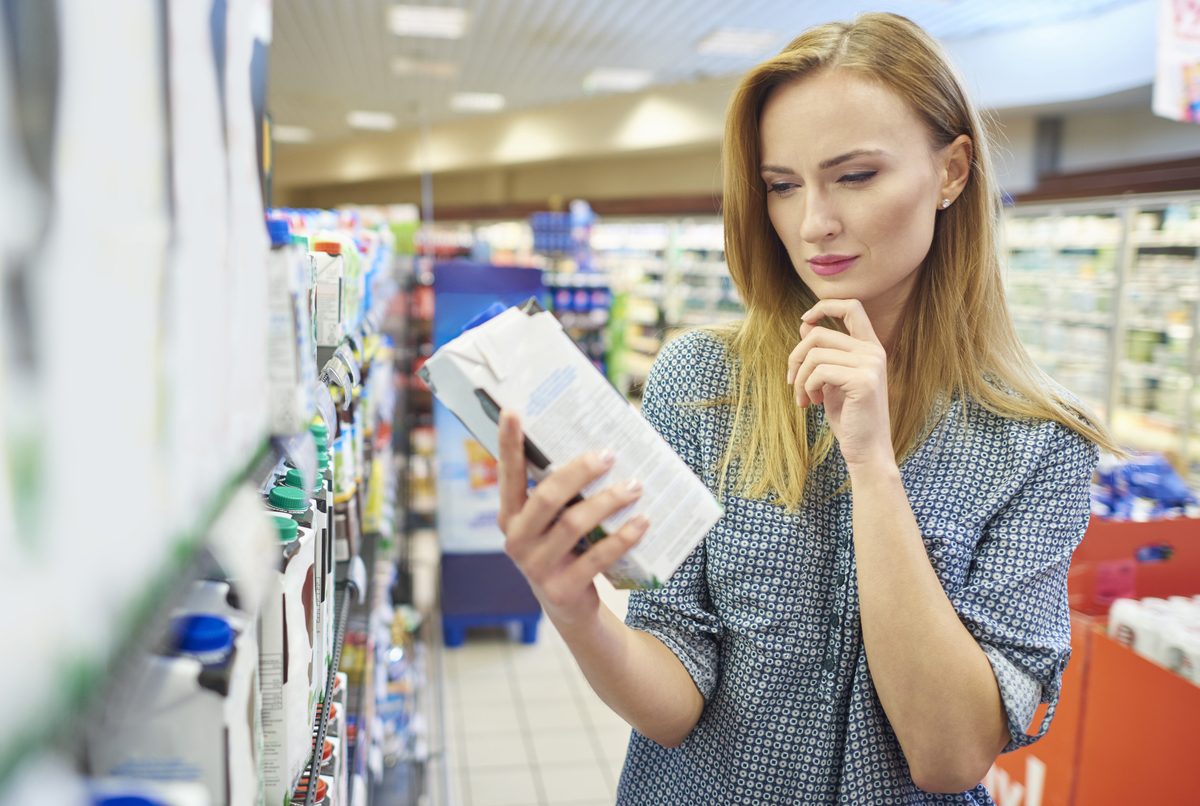
The nutrition declaration is a key tool for comparing products. It gives the energy value in kilocalories (kcal) and kilojoules (kJ), as well as the content of fat, carbohydrate, protein and salt. For example, two boxes of cereal may look similar, but their labels reveal major differences.
Take two examples: Weetabix (4.9 g of sugar per 100 g) vs. Coco Pops (17 g per 100 g). The « of which sugars » figure is crucial for avoiding blood sugar spikes. Likewise, keep an eye on saturated fat: a product with more than 10 g of fat per 100 g should be limited.
Nutri-Score, an optional system, summarises this data. A product with 15 g of sugar, 2 g of salt and 10 g of fat per 100 g will get an orange (D) or red (E) score, unlike an equivalent with 5 g of sugar and 3 g of fibre, which could show a green (B).
Using the per 100 g and per portion information
To compare two foods, always rely on the figures per 100 g or 100 ml. This standardised basis avoids the traps of variable portions. A box of cereal showing 10 g of sugar per 30 g portion actually hides 33 g of sugar per 100 g, a crucial detail for avoiding overconsumption.
- Energy value: A product at 400 kcal per 100 g provides a third of the daily needs of an active adult (1,200-2,000 kcal a day).
- Fat: A yoghurt with 3 g of fat per 100 g is balanced, but beware if saturated fat exceeds 4 g per 100 g.
- Carbohydrate: Favour cereals with less than 20 g of « of which sugars » to avoid cravings.
- Protein: A fromage frais with 10 g per 100 g is a good source of protein, compared with 2 g for a standard yoghurt.
- Salt: Rarely go above 1 g per 100 g to reduce cardiovascular risks.
Per-portion figures can be misleading: a manufacturer can define a portion of 25 g for a packet of pasta, when the average portion is 40 g. A spaghetti with 1.2 g of salt per 25 g looks healthy, but that works out at 4.8 g per 100 g, or 80% of the recommended daily intake.
Specific rules for non-pre-packed products and meat
Labelling of loose products or products sold by cut
Products sold loose or at the customer’s request, such as fruit, vegetables, bread or cheese cut to order, must display clear information on a notice or sign nearby. The product name is mandatory, as is a statement of the allergens present (e.g. gluten, lactose) and the physical state (« defrosted », « cooked »).
For certain regulated fruit and vegetables (apples, pears, strawberries, tomatoes, etc.), details of the class, variety or size are required. Since 2025, geographical origin is also mandatory for nuts, hazelnuts, almonds, saffron, dried fruit and « fresh-cut » products. This transparency lets consumers check quality and freshness, while avoiding the risks linked to cross-contamination, which are often underestimated.
Meat traceability: a transparency obligation
Labelling rules for meat are strict, guaranteeing full traceability. For beef, the origin must state the place of birth, rearing and slaughter. If these stages took place in the same country, the statement « Origin: [country] » is enough. Otherwise, the details are mandatory.
For pork, lamb, goat and poultry, the places of rearing and slaughter must be stated. This obligation extends to catering establishments since the decree of February 2025, strengthening consumer confidence. For example, a dish containing beef must say whether it comes from France or another country.
- Beef: Places of birth, rearing and slaughter are mandatory.
- Pork, lamb, goat and poultry: Places of rearing and slaughter are mandatory.
- Restaurants and takeaways: Obligation to display the origin of all these meats.
These rules, backed by fines of up to €3,000 for non-compliance, aim to promote local produce and to meet growing consumer demand for informed choices. Did you know that this transparency also helps to limit health risks linked to unsuitable farming methods?
Creating your own food labels: a guide for professionals and artisans
Technical requirements for compliant and safe labels
For professionals, the technical compliance of labels is as critical as the information they carry. The materials must withstand moisture, cold and grease, favouring materials such as plastic or vinyl, essential for products like artisan yoghurts kept in cold storage. Low-migration inks, such as the Novasens range, guarantee compliance and safety by preventing the transfer of chemical substances to food. These inks, validated by standards such as the Swiss Ordinance SR 817.023.21, limit health risks while ensuring optimal print quality on a variety of materials (kraft paper for organic products, synthetic films for metal packaging).
For a professional, choosing the right material and the right ink is as crucial as the legal details. A label must withstand its environment without contaminating the product.
Practical guide to creating your own labels (DIY)
For artisans, creating home-made labels requires accessible tools and suitable materials. Software such as Canva (intuitive design) or GIMP (technical precision) lets you lay out the mandatory details, such as allergen statements in bold for products made with eggs or nuts. Laser or thermal printers, such as the Brother RJ (portable) or Zebra ZD410 (high precision) models, are suited to small runs, with water- or grease-resistant labels, ideal for artisan olive oils or pastries.
- Design tools: Canva for intuitive design or GIMP for technical needs.
- Choice of printer: Laser or thermal models, such as the Brother RJ or Zebra ZD410 series, suited to small runs.
- Printing materials: Sheets of blank water- or grease-resistant labels, available from suppliers such as Brother or TSC.
- Compliance checking: Software such as Nutri Info (specialised in sweet products) or Food Label Maker (international regulations) to automatically include ingredients, allergens and nutritional values.
A compliance checklist is essential: check the mandatory details (ingredients, allergens in bold, DLC/DDM), legibility (minimum size 12 points) and the resistance of the materials. Solutions such as Novasens inks or Brother TD-2000 portable printers combine convenience and safety for artisan production. For example, a baker using labels printed in real time can avoid errors in the expiry date thanks to the automatic integration of data through certified software.
Towards more mindful shopping thanks to labels
The label, your best ally for informed choices
Food labels are essential tools for comparing products objectively. For example, spotting the « gluten-free » statement helps people with an intolerance avoid mistakes. Nutri-Score, although incomplete, helps you gauge nutritional quality at the point of purchase. By decoding the ingredients, you avoid « hidden sugars » such as corn syrup or « hydrogenated » fats. Did you know that claims such as « high in protein » require a minimum of 20% of energy to come from protein? These keys let you choose according to your specific needs, whether you follow a vegetarian diet or manage diabetes.
Beyond the obligations: labels and marketing claims
Official labels such as AOP (e.g. cheeses, the French equivalent of PDO) or AB (French organic) guarantee strict quality standards, with regular checks. On the other hand, claims like « natural » are not all equal. For example, a product can be « natural » if it contains no synthetic additives, but that does not necessarily mean better nutritional value. Companies must justify these claims through audits or certifications. Beware too of misleading flags on packaging: the origin of the product must be stated if it differs from that of its main ingredient. By using these markers, you maximise transparency at every checkout. Food labels, governed by strict standards, are your allies for informed choices. By decoding mandatory details, nutritional values and official labels, you avoid marketing traps and adopt healthy, responsible eating suited to your needs. Every purchase becomes a conscious act, guided by transparency and quality.
FAQ
How do you create a compliant food label?
To design a food label, start by respecting the mandatory details: product name, ingredients list (with allergens highlighted), net quantity, DLC (use-by) or DDM (best-before) date, and the manufacturer’s contact details. Use software such as Canva or Illustrator for the design, choose resistant materials (vinyl, recycled paper) and « low migration » inks for food safety. Print with a laser or thermal printer, and check compliance with the regulations (EU Regulation 1169/2011).
What are the main types of label?
Food labels come in several categories:
- Self-adhesive: versatile for food packaging (moisture-resistant).
- Sew-on: ideal for food textiles (cloth bags).
- Plastic (vinyl): durable for liquid products or outdoor use.
- Iron-on: practical for textiles, applied with an iron.
What is the 5/20 rule on nutrition labels?
The 5/20 rule recommends comparing nutritional values per 100 g:
- 5% or less of saturated fat, sugars or salt = a product to favour.
- 20% or more of these nutrients = consume in moderation.
It helps you quickly identify healthy products based on reference intakes (RI), notably through Nutri-Score (A to E scale).
What are the fundamental rules of food labelling?
Labels must be clear, accurate and fair under EU Regulation 1169/2011. They must avoid any misleading information about the composition, origin or quality of the product. Mandatory details include the product name, the ingredients list, allergens, net quantity, dates (DLC/DDM), origin for certain products, and storage advice where necessary.
How do you make your own food labels?
To create artisan labels:
- Use software such as Canva for the design.
- Choose laser or thermal printers for professional quality.
- Favour suitable materials (recycled paper, water-resistant vinyl).
- Check the legal details (ingredients, allergens, DLC) and the legibility of the text.
- Carry out test prints before mass production.
What are the 3 mandatory details on a food label?
The three essential details are:
- Product name: official name (e.g. « plain yoghurt »).
- Ingredients list: in descending order, with allergens highlighted.
- Expiry date: DLC (« use by… ») for perishable products or DDM (« best before… ») for the others.
Which device should you use to print labels?
To print labels, choose a label printer:
- Thermal: ideal for adhesive labels on a roll, fast and economical.
- Laser: precise for custom labels on sheets.
- Handheld labeller: manual, practical for small runs (e.g. price labels).
Complete the setup with a thermal label holder to keep your rolls organised.
How do you interpret food labels?
To decode a label, follow these steps:
- Read the name to identify the product.
- Check the ingredients list and spot the allergens.
- Check the nutrition declaration (calories, sugar, salt) by comparing values per 100 g.
- Look at the Nutri-Score (A to E) for a visual summary of nutritional quality.
- Check the use-by date (DLC) or the best-before date (DDM).
What are the three most common types of label?
The three main types are:
- Self-adhesive: the most widespread, for food packaging (water-resistant).
- Vinyl: durable for damp products or outdoor use (jars, cosmetics).
- Iron-on: used for food textiles (cotton bags).
Each type suits specific surfaces (glass, fabric, plastic).


