Psyllium before bed: good or bad idea?
The short answer
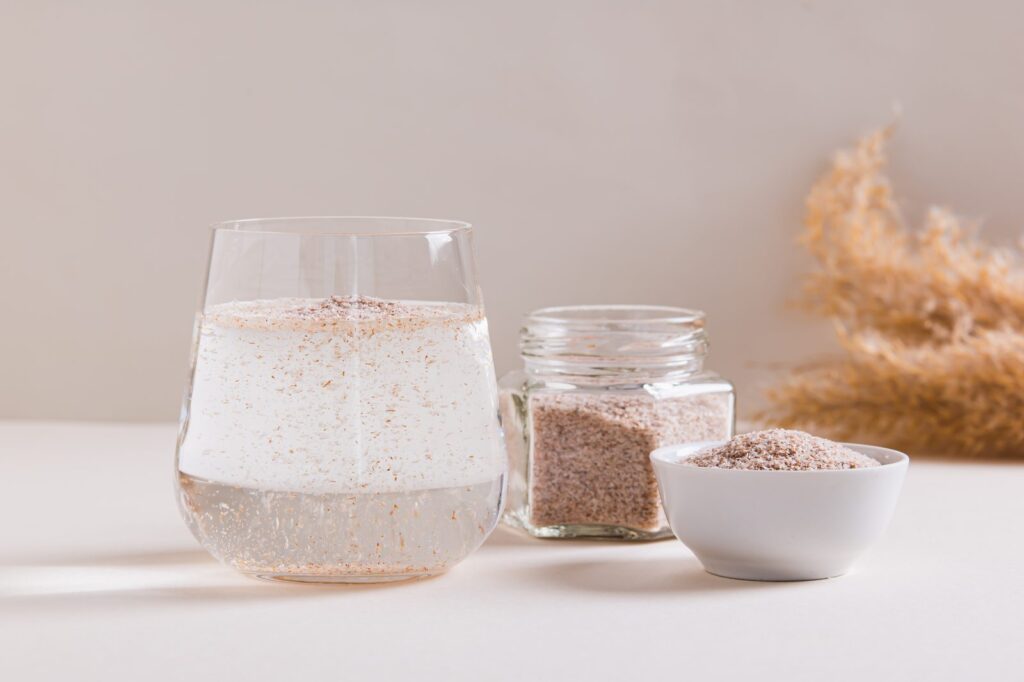
No, it is better not to take psyllium just before you go to bed. That comes from the European Medicines Agency: in its official monograph, psyllium husk should be taken “during the day”, “not immediately before going to bed”, and always with plenty of liquid, about 30 ml of water per gram. You can, however, take it in the late afternoon or with dinner, with a large glass of water. Its effect on bowel movements is not immediate anyway: it appears 12 to 24 hours after taking it.
This article gives information based on official data; it does not replace the advice of your doctor or pharmacist.
How does psyllium work?
Blond psyllium, or ispaghula, comes from a plant, Plantago ovata. The part mostly used is the husk, the seed coat, which is very rich in mucilage. According to the European Medicines Agency:
- it is made up of 85% water-soluble fibre;
- it can absorb up to 40 times its weight in water;
- as it swells, it increases the volume of the bowel contents, which triggers evacuation, and forms a gel that lubricates the passage of stools.
It is this swelling power that makes it effective, and it is also why you must drink enough.
Why not just before bed?
The European monograph does not give the reason for this instruction. It does, however, clearly describe the main risk of psyllium: taken with too little liquid, it can block the throat, the oesophagus or the bowel, with signs such as chest pain, vomiting, and difficulty swallowing or breathing. Bedtime is precisely a moment when you drink little and lie down straight afterwards.
| When to take it | Verdict | Why |
|---|---|---|
| In the morning or during the day, with a large glass of water | 🟢 recommended | this is the official instruction |
| At dinner or early in the evening, with enough water | 🟢 possible | you stay upright and can still drink afterwards |
| Just before lying down | 🔴 not advised | European Medicines Agency instruction |
| With only a sip of water, at any time of day | 🔴 avoid | risk of obstruction |
What dose for which goal?
| Goal | Daily adult dose | From age |
|---|---|---|
| Habitual constipation | 7 to 11 g, in 1 to 3 doses | 6 years (3 to 8 g from 6 to 12 years) |
| Soft stools wanted: anal fissure, haemorrhoids, after surgery | 7 to 11 g, in 1 to 3 doses | 6 years |
| Fibre intake: irritable bowel with constipation, adjunct to the diet in high cholesterol | 7 to 20 g, in 1 to 3 doses | 12 years |
The amount of water: at least 30 ml of liquid per gram of psyllium. For 10 g, that means at least 300 ml, or a large glass and a half. The water can be replaced by milk, fruit juice or another liquid. You then need to keep drinking well throughout the day.
The delay: the laxative effect usually appears 12 to 24 hours after taking it, sometimes only after 2 to 3 days.
To choose a product, see our comparison of fibre supplements: capsules often provide less than a gram, far from useful doses.
Whole seed or husk: two products, two doses
In shops, you find two forms of blond psyllium, each with its own European monograph. The husk, the seed coat alone, is a concentrate of mucilage. The whole seed, sold as ispaghula or psyllium seed, contains much less per gram: its doses are therefore much higher.
| Point | Psyllium husk | Whole seed |
|---|---|---|
| Adult dose, constipation | 7 to 11 g a day | 8 to 40 g a day, in 2 to 3 doses |
| Child aged 6 to 12 | 3 to 8 g a day | 4 to 25 g a day, in 2 to 3 doses |
| Water | at least 30 ml per gram | at least 30 ml per gram |
| Timing | during the day, not just before bed | during the day, not just before bed |
| Time to work | 12 to 24 hours | 12 to 24 hours |
The bedtime instruction and the rule of 30 ml of water per gram therefore apply to both forms. But watch the doses: with whole seed, 30 g a day already needs almost a litre of liquid just for the doses. Read the label carefully to know whether your product is husk or seed, and do not transfer the dose from one to the other.
Psyllium, bowel movements, cholesterol and blood sugar
- Bowel movements: this is its best-established use. If constipation lasts more than 3 days despite taking it, the EMA advises seeing a doctor or pharmacist.
- Cholesterol: in mild to moderate hypercholesterolaemia, a drop in LDL cholesterol of about 7% has been reported. There are no studies on cardiovascular events or mortality. This use requires medical supervision.
- Blood sugar: the EMA asks people with diabetes to take psyllium only under medical supervision, as their diabetes treatment may need adjusting.
What the studies show
Beyond the uses recognised by the EMA, several meta-analyses have measured the effect of psyllium:
| Goal | Result | Source |
|---|---|---|
| Chronic constipation | 77% of patients improved on fibre supplements, versus 44% on placebo; but more gas, and low-quality evidence | Christodoulides et al., 2016, 7 trials |
| Irritable bowel | risk of persistent symptoms reduced by about 22% with ispaghula | Ford et al., BMJ, 2008 |
| Cholesterol | LDL cholesterol lowered by 0.33 mmol/L on average, or about 0.13 g/L, with a median dose of about 10 g a day | Jovanovski et al., 2018, 28 trials, 1,924 people |
| Blood sugar, type 2 diabetes | fasting blood sugar lowered by 37 mg/dL and HbA1c by 0.97 points, with psyllium taken before meals; no effect in people with normal blood sugar | Gibb et al., 2015, 35 trials |
Two lessons. On cholesterol, the effect is real but modest: it complements a suitable diet and, if needed, treatment, without replacing them. On blood sugar, the effect is proportional to the imbalance: nil in a person without diabetes, clear in a person with treated diabetes. That is exactly why the EMA asks for medical supervision in diabetes: combined with a treatment, psyllium can lower blood sugar more than expected.
Irritable bowel and diarrhoea: what the EMA really says
Psyllium is often presented as a “regulator” of bowel movements, effective against both constipation and diarrhoea. The EMA examined both questions.
Irritable bowel. The strongest trial cited by the EMA was run in general practice in 275 patients, over 12 weeks: 10 g of psyllium, 10 g of wheat bran or a placebo, every day. Psyllium did better than placebo in the first month, when you needed to treat 4 people for one more to be relieved, and in the second month, but no longer in the third. Bran only did better than placebo in the third month, and it was stopped twice as often because of poor tolerance. Overall, 40% of participants left the trial before the end. The EMA concludes that the evidence is not sufficient for irritable bowel in general, but that a benefit exists in the form with constipation.
Diarrhoea. The available studies are small and of low quality. In an open crossover trial in 19 patients with chronic diarrhoea, husk combined with calcium halved the number of stools, as much as loperamide. In women treated with radiotherapy, it was less effective than codeine. The EMA judges these data insufficient to recognise a use against diarrhoea. Diarrhoea that lasts should be investigated by a doctor, not masked with fibre.
Psyllium and medicines
Psyllium can delay the absorption of other medicines taken at the same time. The EMA cites minerals, vitamins including B12, cardiac glycosides for the heart, coumarin anticoagulants, carbamazepine and lithium. The rule: leave at least half an hour to an hour between psyllium and any other medicine.
Two situations call for medical advice:
- thyroid hormones, whose dose may need adjusting;
- medicines that slow the bowel, such as opioids, because of the risk of obstruction.
Who should not take it?
| Situation | Verdict |
|---|---|
| Difficulty swallowing, throat or oesophagus problem | 🔴 contraindicated |
| Narrowing of the digestive tract, bowel obstruction or risk of obstruction | 🔴 contraindicated |
| Sudden change in bowel habit lasting more than 2 weeks | 🔴 see a doctor first |
| Unexplained rectal bleeding | 🔴 see a doctor first |
| Abdominal pain, nausea, vomiting, faecal impaction | 🔴 only on medical advice |
| Elderly or frail people | 🟠 under medical supervision |
| Diabetes, thyroid treatment | 🟠 under medical supervision |
| Pregnancy and breastfeeding | 🟠 possible if needed, when diet is not enough |
| Child under 6 | 🔴 not recommended |
Carers and care workers: the risk of allergy from the powder
This is a little-known risk, but well documented by the European authorities. In 2011, Spain reported 31 cases of allergy linked to psyllium powders, 25 of them in people who had breathed in the powder while preparing it for someone else. They were mostly care workers who had been preparing these sachets for elderly patients for years.
| Point | What the European assessment concluded |
|---|---|
| Care home staff repeatedly exposed | about 9% had an allergy confirmed by tests |
| Symptoms | mostly respiratory, rhinitis and asthma, sometimes severe; a few anaphylactic reactions with a drop in blood pressure |
| People most at risk | atopic people, already prone to allergies |
| General population | no significant risk demonstrated; few cases, mostly mild |
If you prepare psyllium every day for an elderly relative, get into the habit of preparing it without breathing in the powder, as leaflets have asked since 2011. A runny nose or breathing discomfort while preparing it should prompt you to see a doctor: in the case of a proven allergy, the only solution is to stop the exposure, including by mouth.
Side effects
- Gas: possible, and it usually fades as you continue.
- Bloating, and a risk of obstruction if psyllium is swallowed with too little liquid.
- Allergies: psyllium contains potent allergens. Rhinitis, conjunctivitis, bronchospasm and, more rarely, anaphylactic reaction have been described, mostly in people who often handle the powder and inhale it. Avoid breathing in the powder while preparing it.
If abdominal pain appears, stop psyllium and see a doctor.
Psyllium and constipation during pregnancy
Constipation is common during pregnancy. Ameli (the French national health insurance service) cites several reasons: reduced physical activity, especially late in pregnancy, changes in diet and iron supplementation. Its first pieces of advice concern diet:
- eat fibre, green vegetables, fresh fruit, and dried fruit such as prunes;
- drink water regularly, at least 1.5 litres a day;
- keep up suitable daily physical activity.
If that is not enough, Ameli states that the doctor or midwife can prescribe bulk-forming laxatives, including ispaghula and psyllium, or osmotic laxatives. It insists on one point: do not take any medicine for constipation without their advice. The EMA, for its part, states that data on psyllium during pregnancy are limited, fewer than 300 pregnancies followed, and that its use can be considered if necessary, when a change of diet is not enough.
During pregnancy, the water rule matters even more: 30 ml per gram of psyllium, on top of the day’s water. And since iron may be behind the constipation, talk to your midwife if it appeared with an iron supplement: psyllium can also delay the absorption of minerals, which is why it helps to leave at least half an hour to an hour between doses.
What about the pancreas?
This question comes up often online. The European monograph mentions neither a harmful effect nor a benefit of psyllium on the pancreas, and we have not found a solid study on the subject. If you have a pancreatic disease, ask your doctor before starting any course of fibre.
Psyllium, bran, chia, flax: what is the difference?
Psyllium is not the only concentrated source of fibre. But it stands out for the nature of its fibre:
| Per 10 g | Fibre | Type of fibre |
|---|---|---|
| Psyllium husk | about 8.5 g of soluble fibre | mostly soluble, forming a gel |
| Wheat bran | 4.3 g | mostly insoluble |
| Dried chia seeds | 3.4 g | mixed, also forms a gel |
| Flaxseed | 2.4 g | mixed |
| Oat bran | 1.7 g | rich in beta-glucans, soluble |
Soluble fibre forms a gel that slows digestion and helps reduce cholesterol absorption; insoluble fibre, like that in wheat bran, mainly speeds up transit. Psyllium is therefore both a regulator of bowel movements and a tool for cholesterol, whereas wheat bran acts mainly on constipation. In every case, the water rule applies to all these concentrated fibres. To choose a product, see our comparison of fibre supplements.
And in children?
Psyllium husk is not recommended before the age of 6, and the EMA report notes that there are no specific clinical data on its laxative effect in children. It does, however, cite a simple benchmark from a consensus conference on fibre: from age 2, aim for dietary fibre of age plus 5 g a day, that is 8 g at 3 years or 13 g at 8 years, from fruit, vegetables and cereals. In 20 children aged 5 to 17 with high LDL cholesterol, already on a suitable diet, cereals enriched with psyllium, 6 g a day for 4 to 5 weeks, brought no additional drop in cholesterol. In children, constipation should therefore first be discussed with the paediatrician, and the plate comes before the powder.
Psyllium does not replace the fibre on your plate
Anses recommends 30 g of fibre a day for an adult. Pulses, wholegrain cereals, fruit and vegetables remain the basis: see our guide to dietary fibre and our selection of high-fibre vegetables. The EMA itself points out that bulk-forming laxatives only come after a change of diet has failed.
Frequently asked questions
Can you take psyllium in the evening?
Yes, early in the evening, with a large glass of water. Just avoid taking it right before lying down, as the European Medicines Agency recommends.
How much water with psyllium?
At least 30 ml per gram, so 300 ml for 10 g, then drink well throughout the day.
What dose of psyllium a day?
For constipation, 7 to 11 g a day in adults, in 1 to 3 doses. Up to 20 g for fibre intake, for example as an adjunct to the diet in high cholesterol, under medical supervision.
How long does psyllium take to work?
Usually 12 to 24 hours, sometimes 2 to 3 days.
Should you leave a gap between psyllium and medicines?
Yes, at least half an hour to an hour before or after.
Can psyllium cause constipation?
Taken with too little water, it can on the contrary block the bowel, even cause an obstruction. Hence the importance of drinking well.
Does psyllium lower cholesterol?
Yes, modestly: about 0.33 mmol/L less LDL, or 0.13 g/L, with around ten grams a day, according to a meta-analysis of 28 trials.
Does psyllium lower blood sugar?
In people with type 2 diabetes, yes, especially when taken before meals. Without diabetes, the effect is nil. If you are on treatment, medical supervision is needed to avoid too large a drop.
Psyllium or wheat bran for constipation?
Both can help. Psyllium provides mostly soluble fibre that forms a gel; wheat bran, insoluble fibre. In both cases, you need to drink enough.
What is the difference between psyllium husk and psyllium seed?
The husk is the seed coat, highly concentrated in mucilage: 7 to 11 g a day is enough against constipation. The whole seed is dosed at 8 to 40 g a day. In both cases, 30 ml of water per gram and no dose just before bed.
Is psyllium effective against diarrhoea?
The EMA does not recognise this use: the studies are small and of low quality. Diarrhoea that lasts should be seen by a doctor.
Can you become allergic to psyllium by preparing it?
Yes: about 9% of care workers repeatedly exposed to the powder had a confirmed allergy, mostly respiratory. Avoid breathing in the powder while preparing it.
Our sources
- European Medicines Agency, Committee on Herbal Medicinal Products. Community herbal monograph on Plantago ovata Forssk., seminis tegumentum. EMA/HMPC/199774/2012, 14 May 2013.
- Anses, fibre intake benchmarks for adults.
- Christodoulides S et al. Systematic review with meta-analysis: effect of fibre supplementation on chronic idiopathic constipation in adults. Aliment Pharmacol Ther, 2016 (PMID 27170558).
- Jovanovski E et al. Effect of psyllium fiber on LDL cholesterol and alternative lipid targets: a systematic review and meta-analysis. Am J Clin Nutr, 2018 (PMID 30239559).
- Gibb RD et al. Psyllium fiber improves glycemic control proportional to loss of glycemic control: a meta-analysis. Am J Clin Nutr, 2015 (PMID 26561625).
- Ford AC et al. Effect of fibre, antispasmodics, and peppermint oil in the treatment of irritable bowel syndrome. BMJ, 2008 (PMID 19008265).
- Ciqual 2025 table (Anses): wheat bran, oat bran, chia seeds, flaxseed.
- Ameli, “Nausea, vomiting, acid reflux and constipation during pregnancy” (in French), updated 19 June 2026.
- EMA, HMPC. Community herbal monograph on Plantago ovata Forssk., semen, and assessment report on Plantago ovata Forssk., seminis tegumentum (EMA/HMPC/199775/2012).
- Bijkerk CJ et al. Soluble or insoluble fibre in irritable bowel syndrome in primary care? Randomised placebo controlled trial. BMJ, 2009 (PMID 19713235).
- Bernedo N et al. Allergy to laxative compound (Plantago ovata seed) among health care professionals. J Investig Allergol Clin Immunol, 2008 (PMID 18564629).