Stevia: safe or not? What EFSA says in 2024
The short answer
Stevia is not dangerous at usual doses. Its sweetening component, steviol glycosides (E960), is authorised in Europe with an acceptable daily intake of 4 mg per kilo of body weight, expressed as steviol. In 2024, EFSA refused to raise this limit, because the youngest children already exceed it among the heaviest consumers, mainly because of “diet” drinks. For an adult, a few products sweetened with stevia are not a problem; for toddlers, it is better to avoid sweetened drinks.
What is stevia?
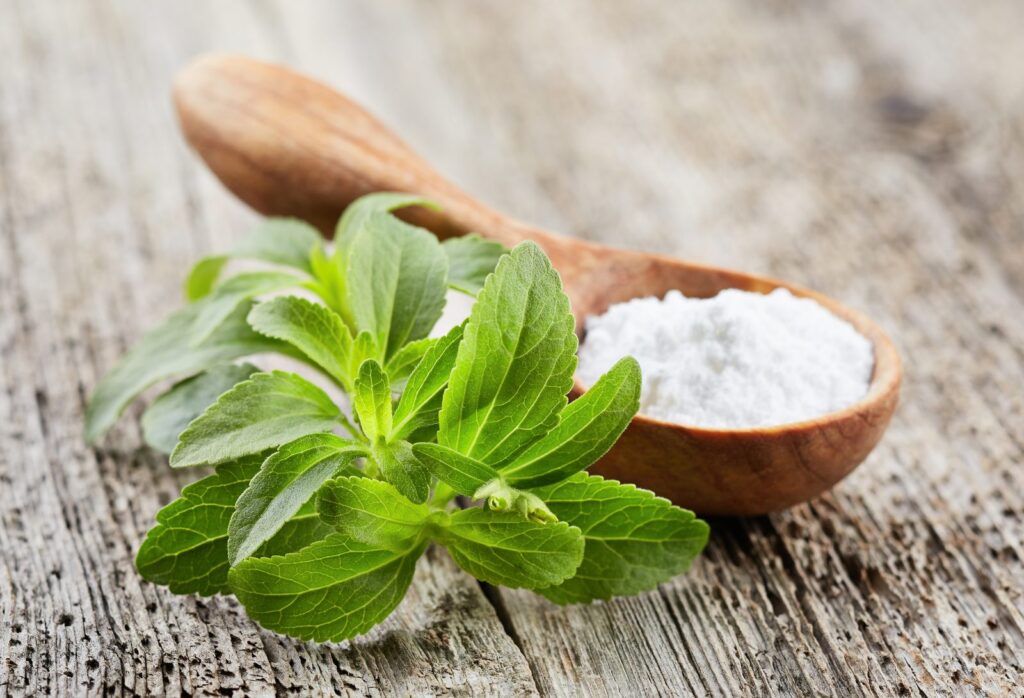
Stevia is a South American plant whose leaves taste very sweet. The authorised additive is not the whole leaf but a purified extract, steviol glycosides, coded E960 on labels. It is an intense sweetener: it sweetens a lot at a very low dose and provides practically no calories.
It is found in “zero” or “diet” drinks, yoghurts and desserts with reduced sugar, some chewing gums, sweets and cereals, and in tabletop sweeteners in powder or drops. On the label, look for “E960”, “steviol glycosides” or “stevia extract”.
What EFSA says
The European Food Safety Authority sets an acceptable daily intake of 4 mg per kilo of body weight, expressed as steviol equivalents. In 2024, an authorisation application proposed raising it to 6, or even 16 mg/kg, to allow more uses. EFSA replied that there was not enough justification and kept the limit.
| Weight | Acceptable daily intake (steviol equivalents) |
|---|---|
| 12 kg (young child) | 48 mg |
| 30 kg | 120 mg |
| 60 kg | 240 mg |
| 70 kg | 280 mg |
The point to watch: toddlers
When recalculating the exposure of the European population, EFSA found that the most exposed toddlers reach 4.8 mg per kilo per day, already above the acceptable intake, and that they would rise to 6.9 mg if the new uses requested were authorised. The main source involved: flavoured drinks with reduced sugar. Their low body weight explains why they reach the limit more quickly.
Should you avoid it?
For an adult, nothing indicates that you need to ban stevia. But replacing sugar with a sweetener does not train your taste: the goal is still to reduce the sweet taste in general. For young children, water remains the only essential drink, and it is the simplest way not to exceed the limit. Our guide how much sugar per day gives guidelines for cutting sugar without replacing it.
Frequently asked questions
Is stevia carcinogenic?
No, that is not the authorities’ conclusion: EFSA authorises steviol glycosides with an acceptable intake, which it confirmed in 2024.
Does stevia raise blood sugar?
Steviol glycosides provide practically no sugar. Beware, however, of tabletop sweeteners “with stevia” that contain other bulking ingredients: read the composition.
How much stevia per day?
At most 4 mg of steviol equivalents per kilo of body weight, or 280 mg for 70 kg. As the content is not stated on products, the practical guideline is not to pile up sweetened products.
Is stevia better than aspartame?
They are two authorised sweeteners, each with its own acceptable intake. Neither replaces a reduction in sweet taste.
Can you give it to children?
It is among toddlers that EFSA observes excesses. It is better to avoid giving them sweetened drinks.
The other additives in the series: E471 and monosodium glutamate.
Our sources
- EFSA, Scientific opinion on the extension of the authorisation of use of the food additive steviol glycosides (E 960a-d) and the modification of the acceptable daily intake (ADI) for steviol, EFSA Journal, 2024.