Group · Fish
Conger eel
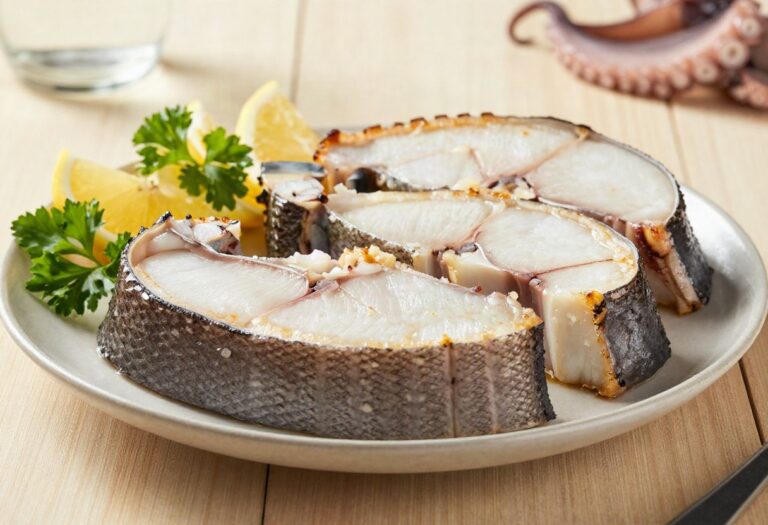
The conger eel is a large marine eel, caught in the Atlantic and the Mediterranean. Its front section, fleshy and boneless, is sold in steaks; its rear section, very bony, traditionally goes into fish soup.
In terms of nutrition facts, raw: 127 kcal per 100 g, with 18.3 g of protein and 4.6 g of fat. It provides 270 mg of phosphorus, 240 mg of potassium, 71 mg of calcium, 30 µg of iodine and 3 µg of vitamin B12 per 100 g, with 0.13 g of salt.
Macronutrient breakdown
Nutrition table per 100 g
| Calories | 127 kcal |
| Kilojoules | 535 kJ |
| Protein | 18,3 g |
| Carbohydrate | 3,2 g |
| Fat | 4,6 g |
Micronutrients per 100 g
All measured nutrients, ranked by share of the daily reference intake.
- Vitamin B123 µg120 %
- Phosphorus270 mg39 %
- Vitamin B34,3 mg27 %
- Iodine30 µg20 %
- Copper0,2 mg20 %
- Potassium240 mg12 %
- Iron1,3 mg9 %
- Zinc0,9 mg9 %
See the other 6 nutrients
- Calcium71 mg9 %
- Vitamin B10,06 mg5 %
- Magnesium20 mg5 %
- Vitamin B50,24 mg4 %
- Vitamin B20,04 mg3 %
- Manganese0,01 mg1 %
Anses Ciqual 2025. Source: Anses, 2025, Ciqual food composition table
Tips
3 µg of vitamin B12: one portion covers the day’s requirement. And more: 150 g provides 4.5 µg, against 2.5 µg recommended. Fish and meat are the main dietary sources of B12.
Ask for the front section, not the tail. This is the only buying tip that matters: the rear section is riddled with fine bones that cannot be removed. The fishmonger can tell the difference, you just need to ask.
Its gelatinous flesh holds up to slow cooking. It is rich in collagen, which makes it ideal in bouillabaisse, in matelote (a wine-based fish stew) or in curry. Grilled, on the other hand, it tends to dry out.
127 kcal: it is a medium-fat fish. Between lean white fish and oily fish, like sea bream. It therefore contributes in part to the weekly omega-3 intake.
It is cheap and underused. Little in demand at French fish counters, it costs a fraction of the price of bass or sea bream for comparable nutritional value.