Group · Fruit
Feijoa
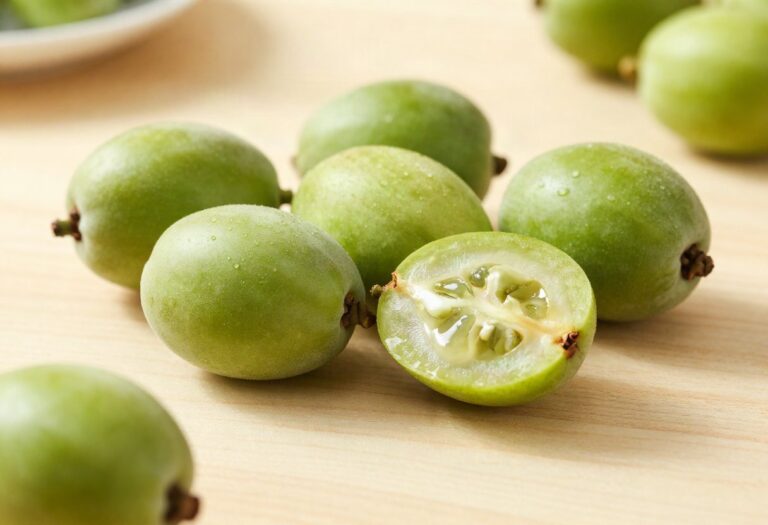
The feijoa, or pineapple guava, is an oval green fruit with fragrant, jelly-like flesh, somewhere between pineapple, guava and mint. Native to South America, it is now grown mainly in New Zealand.
In terms of nutrition facts, raw flesh provides 61 kcal per 100 g, with 6.4 g of fibre, a very high level for a fruit, 15.21 g of carbohydrate and 0.71 g of protein. It provides 32.9 mg of vitamin C, 172 mg of potassium and 17 mg of calcium per 100 g.
Macronutrient breakdown
Nutrition table per 100 g
| Calories | 61 kcal |
| Kilojoules | 254 kJ |
| Protein | 0,8 g |
| Carbohydrate | 15,3 g |
| Fat | 0,5 g |
| Fibre | 6,4 g |
Micronutrients per 100 g
All measured nutrients, ranked by share of the daily reference intake.
- Vitamin C32,9 mg41 %
- Vitamin B923 µg12 %
- Potassium172 mg9 %
- Vitamin B60,07 mg5 %
- Vitamin K13,5 µg5 %
- Manganese0,08 mg4 %
- Vitamin B50,23 mg4 %
- Copper0,04 mg4 %
See the other 11 nutrients
- Phosphorus19 mg3 %
- Magnesium9 mg2 %
- Calcium17 mg2 %
- Vitamin B30,3 mg2 %
- Omega-3 ALA0,03 g1 %
- Vitamin E0,16 mg1 %
- Vitamin B20,02 mg1 %
- Omega-6 LA0,11 g1 %
- Iron0,14 mg1 %
- Zinc0,06 mg1 %
- Vitamin B10,01 mg1 %
USDA FoodData Central (SR Legacy)
Tips
6.4 g of fibre per 100 g: only elderberry does better. That is three times as much as an apple. A 50 g portion provides 3.2 g.
32.9 mg of vitamin C: 41% of the reference intake. Two feijoas almost cover your daily need.
Eat it with a spoon. Cut in half, the flesh scoops out like a kiwi fruit. The skin is edible but distinctly bitter: most people leave it.
It ripens after picking and drops by itself. A feijoa picked up from the ground is ready; picked from the tree, it is still hard. It should give slightly under your thumb.
It browns very quickly once cut. A squeeze of lemon slows the oxidation, but it is best eaten within a minute.