Group · Fruit
Guava
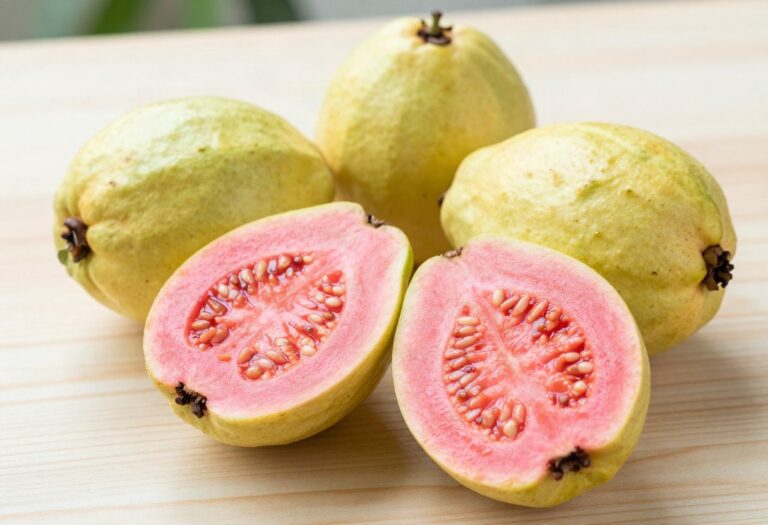
The guava is a tropical fruit with fragrant flesh, yellow, pink or red depending on the variety, tucked inside a green skin that turns yellow when ripe. Grown in warm climates, it is eaten fresh, as juice, in jam or as a paste (the famous guava in syrup or jelly). Nutritionally, it is a light and interesting fruit: around 68.3 kcal per 100 g, rich in fibre (5.4 g) and a notable source of vitamin C. With 2.55 g of protein and only 0.95 g of fat, guava slots easily into a balanced diet, whether you want more variety in your fruit, a refreshing touch or a tasty, low-calorie snack.
Macronutrient breakdown
Nutrition table per 100 g
| Calories | 68 kcal |
| Kilojoules | 286 kJ |
| Protein | 2,6 g |
| Carbohydrate | 9,1 g |
| Fat | 1 g |
| Fibre | 5,4 g |
Micronutrients per 100 g
All measured nutrients, ranked by share of the daily reference intake.
- Vitamin C228 mg285 %
- Copper0,23 mg23 %
- Potassium417 mg21 %
- Vitamin B60,11 mg8 %
- Manganese0,15 mg8 %
- Vitamin B50,45 mg8 %
- Vitamin B31,08 mg7 %
- Vitamin B10,07 mg6 %
- Vitamin B9dietary folate equivalents49 µg
See the other 13 nutrients
- Vitamin E0,73 mg6 %
- Magnesium22 mg6 %
- Phosphorus40 mg6 %
- Vitamin A31,2 µg4 %
- Vitamin K12,6 µg3 %
- Omega-3 ALA0,06 g3 %
- Vitamin B20,04 mg3 %
- Zinc0,23 mg2 %
- Calcium18 mg2 %
- Iron0,26 mg2 %
- Omega-6 LA0,15 g2 %
- Selenium0,5 µg1 %
- Iodine0,71 µg0 %
Anses Ciqual 2025. Source: Anses, 2025, Ciqual food composition table
Tips
The guava is best enjoyed fully ripe, when it gives slightly under your finger and releases its characteristic scent. You can bite into it as it is, skin included after washing, or cut it into wedges and add it to a fruit salad, a yoghurt or a smoothie. Its flesh also works in hot preparations: compotes, jellies, coulis and nectars. Keep it for a few days at room temperature to finish ripening, then put it in the fridge to slow the process.
In terms of nutritional values, guava stands out for its fibre, which helps with fullness and digestive comfort, and for its vitamin C. With a low-fat profile and moderate calories, it is an excellent ally if you are watching your weight, as long as you choose fresh fruit rather than the much sweeter syrup or candied versions. To compare its benefits with other exotic options, take a look at the mango or the papaya, just as fragrant.
- Recommended portion: one to two medium guavas, around 150 to 200 g, are enough for a filling snack.
- Smart pairings: squeezed lemon to lift its flavour, fromage blanc for a protein-rich snack, or fresh mint in a summer salad.
- Gentle cooking: as a compote with no added sugar, to preserve nutrients and limit sugar intake.
For active people, guava is a good source of natural carbohydrates and fibre: eat it as a snack a few hours before exercise rather than just before, to avoid any digestive discomfort. After training, pair it with a source of protein (Greek yoghurt, fromage blanc or a protein drink) to support recovery. Its water and minerals also contribute to good hydration. If you are looking for balanced snack ideas, our article on protein snacks may inspire you.
Guava fits naturally into a balanced diet, alongside a wide variety of fruit. To compare its calories with those of other foods, the calorie table remains a handy reference. Don’t hesitate to alternate varieties and colours through the seasons: it is the best way to enjoy the full range of flavours and nutrients that tropical fruits offer.