Group · Dairy
Grana Padano
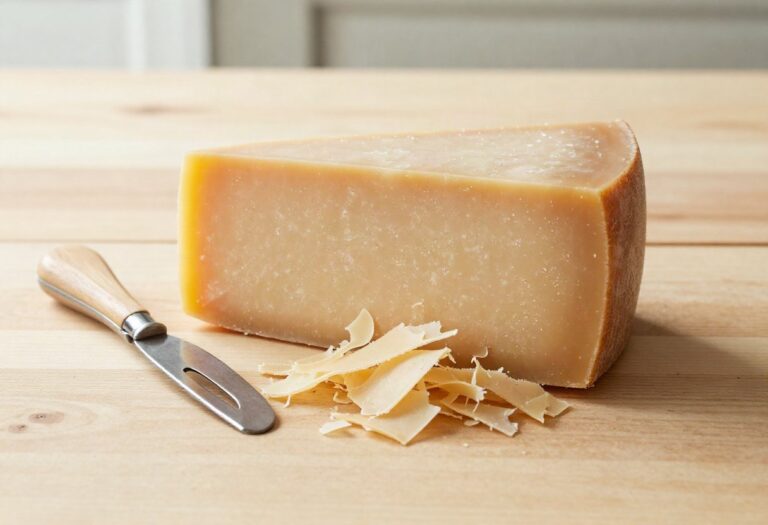
Grana Padano is a hard, grainy Italian cheese (grana means grain) produced in the Po plain since the 12th century by Cistercian monks. Aged for nine to twenty months, it is the less strict cousin of Parmesan: the same methods, but broader specifications.
On the nutrition side: 399 kcal per 100 g, with 33.2 g of protein, 28.5 g of fat and 1.17 g of carbohydrate. Two figures stand out: 1,050 mg of calcium and 695 mg of phosphorus per 100 g, or 131% and 99% of the reference intakes respectively. It also contains 1.35 g of salt.
Macronutrient breakdown
Nutrition table per 100 g
| Calories | 399 kcal |
| Kilojoules | 1660 kJ |
| Protein | 33,2 g |
| Carbohydrate | 1,2 g |
| Fat | 28,5 g |
Micronutrients per 100 g
All measured nutrients, ranked by share of the daily reference intake.
- Calcium1050 mg131 %
- Phosphorus695 mg99 %
- Copper0,56 mg56 %
- Zinc5,4 mg54 %
- Iodine80,9 µg54 %
- Selenium23,1 µg42 %
- Vitamin B120,96 µg38 %
- Vitamin A237 µg30 %
- Vitamin B9dietary folate equivalents0,85 µg
See the other 11 nutrients
- Vitamin B20,28 mg20 %
- Magnesium41 mg11 %
- Vitamin B60,11 mg8 %
- Omega-6 LA0,63 g6 %
- Omega-3 ALA0,11 g6 %
- Vitamin B50,3 mg5 %
- Vitamin E0,58 mg5 %
- Potassium93,4 mg5 %
- Vitamin K11,5 µg2 %
- Vitamin B10,02 mg2 %
- Manganese0,03 mg1 %
Anses Ciqual 2025. Source: Anses, 2025, Ciqual food composition table
Tips
33.2 g of protein: no French cheese comes close. The long ageing evaporates the water and concentrates everything. In a 30 g portion, that is 10 g of protein for 120 kcal, a ratio comparable to that of lean meat.
It is naturally lactose-free. The prolonged ageing breaks it down completely: hard cheeses aged more than twelve months are tolerated by almost everyone who is lactose intolerant. The same goes for Beaufort and pecorino.
Less salty than Parmesan, and far less than pecorino. 1.35 g of salt per 100 g, against 5.3 g for a pecorino. For a comparable amount of calcium, it is a much better everyday choice (see salt for the guidelines).
The rind is not waste. Scraped and dropped into a soup or a stock made with vegetables, it melts slowly and gives a depth that no stock cube can match. This is the traditional use in Italy, and it costs nothing.
Grate it to order. Grated in advance, it oxidises and loses most of its aroma within a few hours. The packet from the shop has little in common with the same cheese grated at the last moment.