Group · Starchy foods
Filo pastry
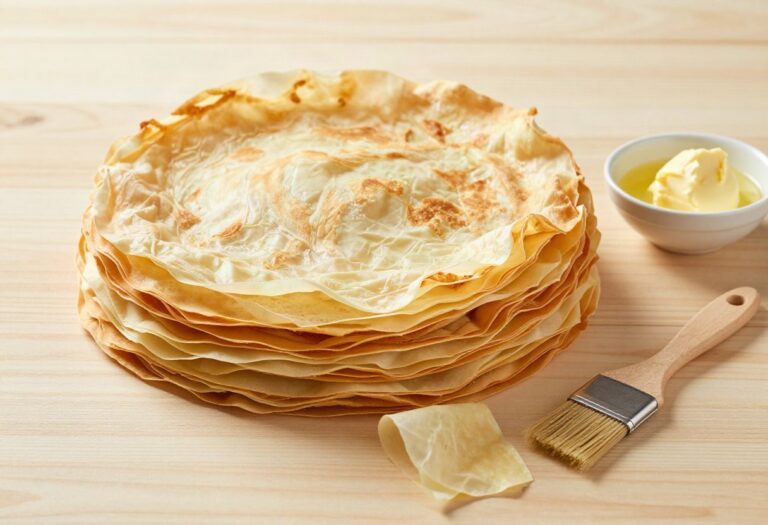
Filo pastry, also spelt phyllo, is a dough stretched into translucent sheets, the base of baklava, bourek and spanakopita. Unlike puff pastry, it contains almost no fat: it is the butter brushed between the sheets that makes the layers.
In terms of nutrition facts, raw: 289 kcal per 100 g, with 50.7 g of carbohydrates, 7.1 g of protein and only 6 g of fat. It provides 3.21 mg of iron and 4.07 mg of vitamin B3 per 100 g, and contains 1.21 g of salt.
Macronutrient breakdown
Nutrition table per 100 g
| Calories | 289 kcal |
| Kilojoules | 1220 kJ |
| Protein | 7,1 g |
| Carbohydrate | 50,7 g |
| Fat | 6 g |
| Fibre | 1,9 g |
Micronutrients per 100 g
All measured nutrients, ranked by share of the daily reference intake.
- Vitamin B10,54 mg49 %
- Vitamin B34,07 mg25 %
- Manganese0,48 mg24 %
- Iron3,21 mg23 %
- Phosphorus75 mg11 %
- Copper0,1 mg10 %
- Vitamin B918 µg9 %
- Vitamin B50,3 mg5 %
See the other 7 nutrients
- Zinc0,49 mg5 %
- Magnesium15 mg4 %
- Potassium74 mg4 %
- Vitamin K12,5 µg3 %
- Vitamin B60,03 mg2 %
- Calcium11 mg1 %
- Vitamin E0,08 mg1 %
Anses Ciqual 2025. Source: Anses, 2025, Ciqual food composition table
Tips
6 g of fat against more than 25 g for puff pastry. That is the decisive difference, and it makes filo the lightest pastry in the aisle, as long as you do not drown it in butter.
The butter between the sheets changes everything. The traditional recipe brushes each sheet with it: count 10 g of butter per sheet, or 75 kcal. A spray of olive oil is more than enough.
It dries out within a few minutes in the air. Keep the sheets under a damp tea towel while you work, and take them out one at a time. Once dry, it cracks and becomes unusable, the same pitfall as brick pastry.
1.21 g of salt per 100 g. A 50 g portion provides 0.6 g. Go easy on the salt in the filling accordingly.
It freezes very well. That is in fact how it is most often sold. Defrost it in the fridge overnight, never at room temperature: the sheets would stick together.