Group · Meat
Rillettes du Mans
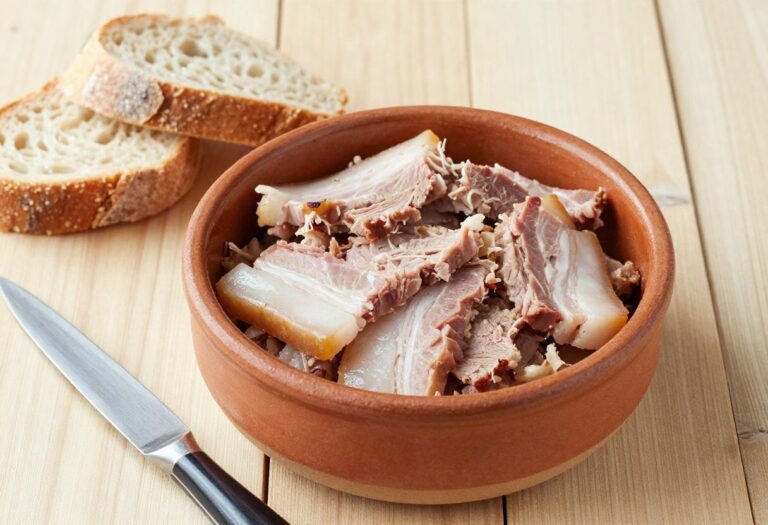
Rillettes du Mans are pork cooked for a very long time in its own fat then shredded into coarse strands, unlike the drier rillettes de Tours. The fat is not an addition: it is the cooking medium and the preservative of the product.
As for nutrition facts: 420 kcal per 100 g, with 37.6 g of fat including 14.8 g of saturated fat, and 15.6 g of protein. They contain 1.28 g of salt per 100 g, which is relatively moderate for a cold meat.
Macronutrient breakdown
Nutrition table per 100 g
| Calories | 420 kcal |
| Kilojoules | 1740 kJ |
| Protein | 15,6 g |
| Carbohydrate | 4,8 g |
| Fat | 37,6 g |
| Fibre | 0,3 g |
Micronutrients per 100 g
All measured nutrients, ranked by share of the daily reference intake.
- Omega-6 LA3,66 g37 %
- Omega-3 ALA0,3 g15 %
Anses Ciqual 2025. Source: Anses, 2025, Ciqual food composition table
Tips
37.6 g of fat: nearly four-tenths pure fat. A generous slice carries 30 g of rillettes, or 126 kcal. The calculation is done on the slice, not on the 100 g.
The bread doubles the bill. Two slices of bread and 30 g of rillettes make nearly 300 kcal for a starter. That is not a problem in itself, as long as you take it into account in the meal.
1.28 g of salt is low for this counter. Less than half that of a dry-cured sausage. Rillettes are preserved by fat, not by salt.
It counts towards the processed meat guideline. 150 g a week, all products combined, according to the Programme national nutrition santé.
The layer of fat on top keeps. It protects the rillettes from the air: do not scrape it off before you start the pot, and always close it again by smoothing the surface.