Group · Meat
Rillettes
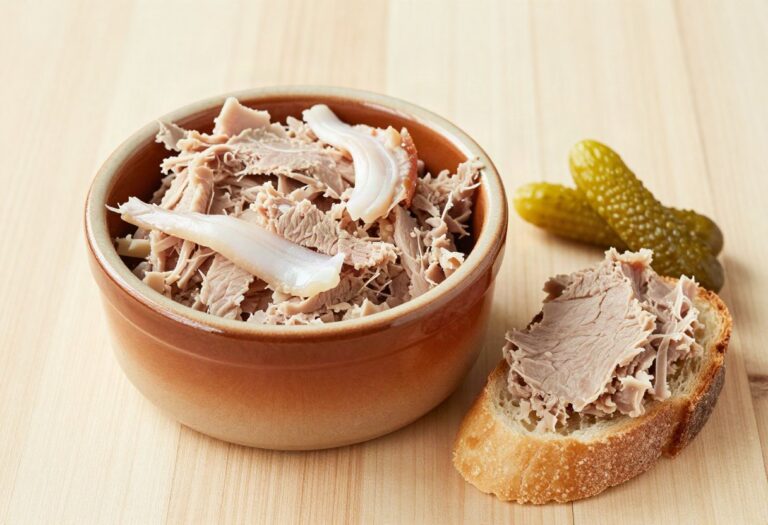
Rillettes are a traditional French charcuterie made by slow-cooking meat (most often pork, but also goose, duck or rabbit) in its own fat, then shredding it and storing it under a layer of fat. They are sold in pots, in jars or by weight at the deli counter, from the famous rillettes du Mans to rillettes de Tours. Rich and full of flavour, they are mostly eaten spread on bread. In terms of nutrition facts, rillettes provide around 413 kcal per 100 g, with nearly 38.3 g of fat: this is a fatty, high-calorie food, best enjoyed in small amounts as part of a balanced diet with room for pleasure.
Macronutrient breakdown
Nutrition table per 100 g
| Calories | 413 kcal |
| Kilojoules | 1710 kJ |
| Protein | 16,7 g |
| Carbohydrate | 0,2 g |
| Fat | 38,3 g |
| Fibre | 0,3 g |
Micronutrients per 100 g
All measured nutrients, ranked by share of the daily reference intake.
- Vitamin B121,06 µg42 %
- Omega-6 LA4,03 g40 %
- Zinc2,3 mg23 %
- Vitamin B33,32 mg21 %
- Phosphorus130 mg19 %
- Omega-3 ALA0,31 g16 %
- Total omega-30,34 g14 %
- Potassium240 mg12 %
See the other 15 nutrients
- Vitamin B50,59 mg10 %
- Vitamin D0,48 µg10 %
- Vitamin E1,13 mg9 %
- DHA0,02 g8 %
- Vitamin B914,3 µg7 %
- Iron0,91 mg7 %
- Vitamin B10,07 mg6 %
- Vitamin B60,09 mg6 %
- Copper0,06 mg6 %
- Magnesium15 mg4 %
- Vitamin A27,1 µg3 %
- Vitamin B20,05 mg3 %
- Manganese0,03 mg2 %
- Vitamin K10,99 µg1 %
- Calcium6,9 mg1 %
Anses Ciqual 2025. Source: Anses, 2025, Ciqual food composition table
Tips
Rillettes are above all a table treat to enjoy in moderation. Their calorie density is high (413 kcal per 100 g) and their fat content reaches 38.3 g, with a large share of saturated fat. A sensible portion is around 25 to 30 g, the equivalent of one or two spoonfuls spread on bread.
- How to eat them: as a starter or with drinks, spread on a slice of toasted country bread, served with gherkins and a green salad to add the fibre the product lacks.
- Smart pairings: go for raw vegetables, fresh herbs and wholemeal bread rather than extra butter, which is already very present in the recipe.
- Storage: once the pot is open, keep it in the fridge and eat it quickly; the layer of fat protects the meat as long as it stays intact.
- Time of day: preferably at lunch, to give you time to burn off this fatty intake over the course of the day.
Nutritionally, rillettes provide mainly energy in the form of fat, with very little carbohydrate and a negligible glycaemic index. However, they are low in usable protein and micronutrients compared with lean meat. If you are looking for a better protein intake, choose leaner options from the meat family, such as chicken breast or sliced ham, which are better choices for every day.
For active people: rillettes are not a suitable snack around exercise. Their high fat content slows digestion and they provide almost no protein for muscle recovery. Before or after training, choose more effective protein sources: lean meats, or have a look at our ideas for better-balanced protein snacks. Keep rillettes for the occasional treat meal.
Weight control: if you are trying to lose weight, their high fat content makes them a food to limit. That does not mean cutting them out: a small occasional portion fits easily into a balanced diet, as long as it is part of a well-balanced meal overall. To compare their calories with other charcuterie, check the food calorie table and adjust your quantities to suit your goals.
Pregnant? Raw cured meats and cooked charcuterie kept cold are not recommended during pregnancy; anything cooked and served hot is fine. See the list in our charcuterie in pregnancy guide.