Group · Dairy
Smooth plain yoghurt
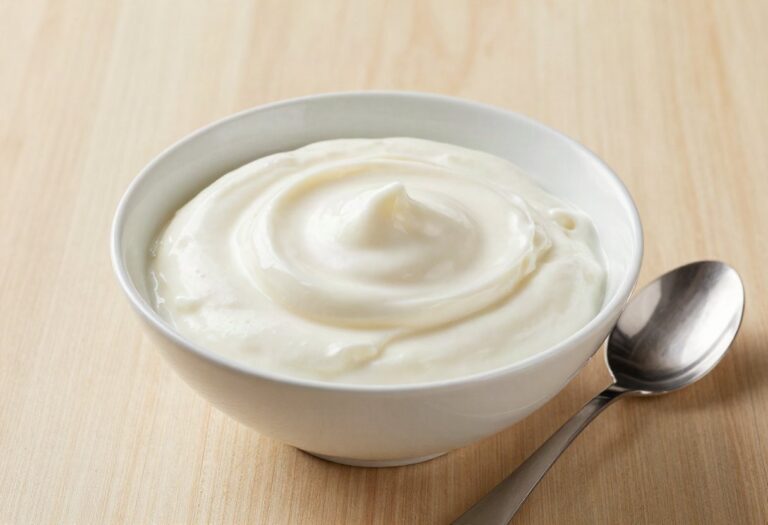
Smooth plain yoghurt (yaourt brassé) is a dairy product made by fermenting milk with lactic cultures, then stirring it to give it its smooth, creamy texture, which is richer than that of a set yoghurt. Unlike classic yoghurt, which is fermented directly in the pot, it is stirred after fermentation, which gives it its characteristic velvety feel. With only 62.3 kcal per 100 g, it has a good nutritional profile: around 3.85 g of protein, 5.85 g of carbohydrate and 2.3 g of fat. A source of calcium and live cultures, it easily finds a place in a balanced diet, at breakfast, as a snack or for dessert. Versatile, it can be eaten plain, sweetened, or used in many savoury and sweet recipes.
Macronutrient breakdown
Nutrition table per 100 g
| Calories | 62 kcal |
| Kilojoules | 262 kJ |
| Protein | 3,9 g |
| Carbohydrate | 5,9 g |
| Fat | 2,3 g |
| Fibre | 0,1 g |
Micronutrients per 100 g
All measured nutrients, ranked by share of the daily reference intake.
- Iodine32,1 µg21 %
- Calcium137 mg17 %
- Vitamin B20,21 mg15 %
- Phosphorus99,3 mg14 %
- Potassium167 mg8 %
- Vitamin B120,16 µg6 %
- Vitamin B50,37 mg6 %
- Selenium2,49 µg5 %
- Vitamin B9dietary folate equivalents7,85 µg
See the other 17 nutrients
- Zinc0,44 mg4 %
- EPA0,01 g3 %
- Vitamin D0,16 µg3 %
- Vitamin B60,04 mg3 %
- Magnesium11,7 mg3 %
- Vitamin A23,1 µg3 %
- Vitamin B10,03 mg2 %
- Total omega-30,04 g2 %
- Vitamin C0,99 mg1 %
- Copper0,01 mg1 %
- Iron0,13 mg1 %
- Omega-3 ALA0,02 g1 %
- Manganese0,01 mg1 %
- Vitamin E0,05 mg0 %
- Omega-6 LA0,04 g0 %
- Vitamin K10,27 µg0 %
- Vitamin B30,05 mg0 %
Anses Ciqual 2025. Source: Anses, 2025, Ciqual food composition table
Tips
Smooth plain yoghurt is an everyday ally, easy to include and low in calories. A standard portion is one 125 g pot, or around 85 kcal. You can have it at breakfast with oat flakes and fresh fruit, as an afternoon snack, or as a light dessert after a meal. Its smooth texture also makes it an ideal base for smoothies, fresh sauces (with cucumber, garlic and herbs), marinades or lighter baking, where it replaces some of the butter or cream.
In terms of nutrition facts, it provides good-quality protein, calcium and lactic cultures that contribute to digestive comfort. Its glycaemic index is moderate, especially when eaten plain. Beware of flavoured or sweetened versions, though: to limit added sugars, it is better to sweeten it yourself with a little honey, cinnamon or fruit. If you are watching your figure, smooth plain yoghurt remains an interesting option thanks to its low calorie density and filling effect.
- Storage: keep it in the fridge at between 4 and 6 °C and respect the use-by date.
- Clever pairings: red berries, chia seeds, muesli, or a touch of vanilla for variety.
- Cooking: avoid boiling it, as it may split; stir it in at the end of cooking.
For athletes, smooth plain yoghurt is an excellent source of protein to include in recovery. Paired with a banana or honey after exercise, it combines carbohydrate and protein to support muscle repair. It can also make up a balanced snack as part of a homemade protein snack. To optimise your intake, find out how to adjust your diet in our guide to fitness nutrition.
If you want a version that is even lower in fat, turn to low-fat plain yoghurt or fat-free fromage blanc, perfect for a weight-loss goal. You can explore all dairy products to compare their nutritional profiles and choose the one that best suits your needs. In short, smooth plain yoghurt combines pleasure, lightness and benefits, as long as you choose plain versions and go easy on sweet additions.