Group · Vegetables
Agar-agar
Agar-agar is a gelling agent extracted from red algae, used in Japan since the 17th century under the name kanten. It replaces animal gelatine and has one decisive difference: it sets at room temperature and withstands heat, whereas gelatine melts.
As for nutrition facts, this page is matched to the Ciqual entry “Agar (seaweed), fresh, raw”: 28.4 kcal per 100 g, with 6.25 g of carbohydrate, 85 µg of vitamin B9, 67 mg of magnesium and 1.86 mg of iron per 100 g. Please note: these are the values of the whole seaweed, not of the powder you buy, as explained below.

Macronutrient breakdown
Nutrition table per 100 g
| Calories | 28 kcal |
| Kilojoules | 121 kJ |
| Protein | 0,6 g |
| Carbohydrate | 6,3 g |
| Fat | 0,1 g |
| Fibre | 0,5 g |
Micronutrients per 100 g
All measured nutrients, ranked by share of the daily reference intake.
- Vitamin B985 µg43 %
- Manganese0,37 mg19 %
- Magnesium67 mg18 %
- Iron1,86 mg13 %
- Potassium226 mg11 %
- Vitamin E0,87 mg7 %
- Calcium54 mg7 %
- Copper0,06 mg6 %
See the other 10 nutrients
- Zinc0,58 mg6 %
- Vitamin B50,3 mg5 %
- EPA0,01 g3 %
- Vitamin K12,3 µg3 %
- Vitamin B60,03 mg2 %
- Vitamin B20,02 mg2 %
- Phosphorus5 mg1 %
- Vitamin B10,01 mg0 %
- Vitamin B30,06 mg0 %
- Total omega-30,01 g0 %
Anses Ciqual 2025. Source: Anses, 2025, Ciqual food composition table
Tips
These figures do not apply to how you use it. Agar-agar is used as a powder, at 2 g per litre of preparation: in other words, a negligible amount per portion. Neither the calories nor the magnesium on this page reach your plate, as it is a technical ingredient.
You must boil it, otherwise it will not set. This is mistake number one. Agar-agar must be dissolved cold and then brought to the boil for at least thirty seconds. If it is simply heated, it stays inactive and the preparation never gels.
Dosage is a matter of grams. 2 g per litre for a soft texture, 4 g for a firm set. Beyond that, the result becomes brittle and rubbery. Precision scales are more useful than a measuring spoon.
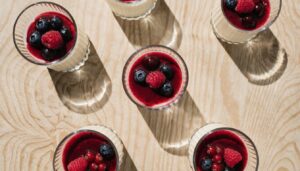
It allows much lighter desserts. A panna cotta set with agar-agar in milk rather than cream, a flan without egg or cream, a reduced-sugar jam that still holds: these are its most interesting uses.
Plant-based, unlike gelatine. For many people this is its whole purpose: gelatine is of animal origin, agar-agar is not. It suits vegetarian and vegan diets, as well as religious dietary restrictions.