Group · Vegetables
Kohlrabi
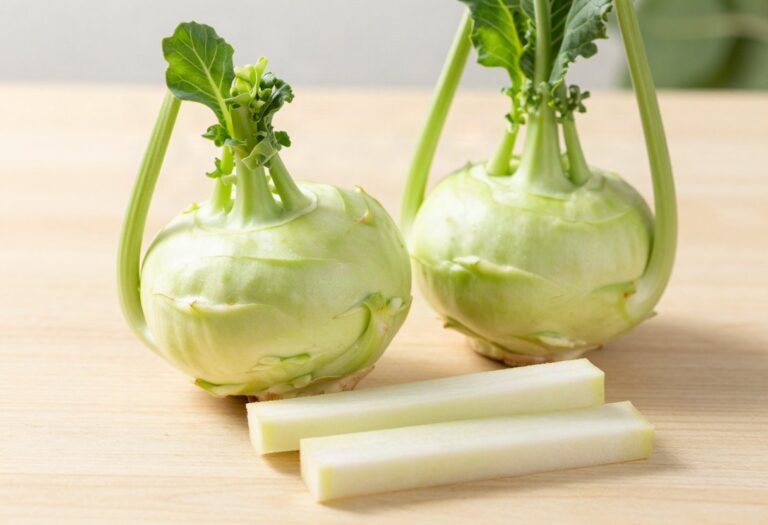
Kohlrabi is a vegetable from the brassica family of which the swollen stem is eaten, with crunchy flesh and a delicate taste somewhere between hazelnut and turnip. Pale green or purple depending on the variety, it can be eaten raw as well as cooked and fits easily into a balanced diet. At just 28 kcal per 100 g, kohlrabi is low in calories, rich in fibre (1.1 g) and low in fat. It provides moderate carbohydrate, a little plant protein, vitamin C and various minerals. Versatile and thirst-quenching, this often overlooked vegetable deserves a place in your basket, especially if you are watching your weight while looking for variety.
Macronutrient breakdown
Nutrition table per 100 g
| Calories | 28 kcal |
| Kilojoules | 118 kJ |
| Protein | 1,8 g |
| Carbohydrate | 4,4 g |
| Fat | 0,2 g |
| Fibre | 1,1 g |
Micronutrients per 100 g
All measured nutrients, ranked by share of the daily reference intake.
- Vitamin C54 mg68 %
- Potassium340 mg17 %
- Copper0,13 mg13 %
- Vitamin B60,15 mg11 %
- Manganese0,14 mg7 %
- Phosphorus45 mg6 %
- Magnesium19 mg5 %
- Vitamin E0,52 mg4 %
- Vitamin B9dietary folate equivalents12 µg
See the other 9 nutrients
- Vitamin B10,04 mg4 %
- Calcium25 mg3 %
- Zinc0,31 mg3 %
- Iron0,4 mg3 %
- Vitamin B50,16 mg3 %
- Vitamin B30,39 mg2 %
- Vitamin B20,02 mg1 %
- Vitamin A1,75 µg0 %
- Vitamin K10,1 µg0 %
Anses Ciqual 2025. Source: Anses, 2025, Ciqual food composition table
Tips
Kohlrabi lends itself to many culinary uses. Raw, grated or cut into thin sticks, it adds crunch to a salad, like celeriac or turnip. Cooked, it can be steamed, stir-fried in a wok, baked in a gratin, mashed or added to a soup. Favour gentle cooking to preserve vitamin C and texture: gentle cooking limits the loss of nutrients while keeping the flavours.
Nutrition facts and benefits: with 27 kcal and 1.1 g of fibre per 100 g, kohlrabi is an ally of light meals. Its fibre supports fullness and digestive comfort, while its vitamin C, potassium and brassica compounds make it an interesting vegetable to vary your diet. Its glycaemic index stays moderate and its 4.4 g of carbohydrate make it a reasonable option for weight control.
- Recommended portion: 150 to 200 g as a side, alongside a source of protein.
- Pairings: it goes with carrots, apples, fresh herbs, plain yoghurt or a drizzle of olive oil.
- Storage: in the fridge, in the vegetable drawer, for several days. Remove the leaves, which can be cooked like spinach.
- Seasonality: it is mostly found from spring to autumn, fresh and crunchy.
Tip for active people: kohlrabi is low in energy and hydrating, perfect as a complement to a meal after exercise. For recovery, combine it with a denser source of carbohydrate (wholegrain cereals, starchy foods) and good-quality protein. During a cutting or fat-loss phase, it helps fill the plate without weighing on the calorie balance. To go further on balancing meals around training, discover our advice on fitness nutrition.
On weight management, kohlrabi ticks many boxes: low energy density, filling fibre and great versatility. Stay alert to preparations: gratins rich in cheese or cream push up the calorie count. To compare its calories with other foods, consult our calorie table, and explore more ideas in the vegetable family to vary things day to day.