Group · Vegetables
Cabbage
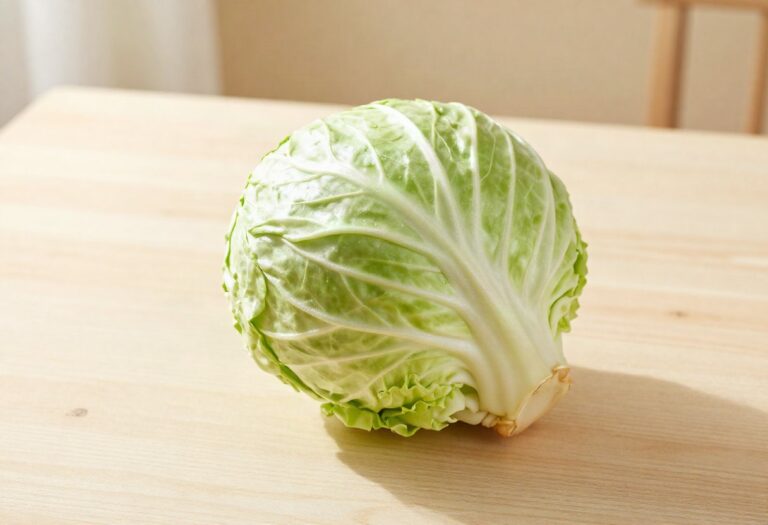
Cabbage is a vegetable from the large cruciferous family, grown in a great many forms: smooth or curly green cabbage, white cabbage, round-headed cabbage, not forgetting cousins such as red cabbage or cauliflower. Valued for its versatility and low price, it turns up raw in salads, braised, steamed or in soup. With only 31.8 kcal per 100 g, cabbage has light nutrition facts, little fat (0.14 g) and a good fibre content (2.9 g). Rich in water and a source of vitamin C and plant compounds, it is a great choice in a balanced diet, as a side or a main dish to fill up on volume.
Macronutrient breakdown
Nutrition table per 100 g
| Calories | 32 kcal |
| Kilojoules | 134 kJ |
| Protein | 1,3 g |
| Carbohydrate | 5,2 g |
| Fat | 0,2 g |
| Fibre | 2,9 g |
Micronutrients per 100 g
All measured nutrients, ranked by share of the daily reference intake.
- Vitamin C28,2 mg35 %
- Vitamin K112 µg16 %
- Potassium253 mg13 %
- Vitamin B60,14 mg10 %
- Manganese0,16 mg8 %
- Calcium46,5 mg6 %
- Iodine7,93 µg5 %
- Vitamin B10,05 mg5 %
- Vitamin B9dietary folate equivalents40,1 µg
See the other 11 nutrients
- Vitamin B50,28 mg5 %
- Phosphorus27,7 mg4 %
- Magnesium12,7 mg3 %
- Iron0,38 mg3 %
- Vitamin B20,04 mg3 %
- Copper0,02 mg2 %
- Vitamin B30,31 mg2 %
- Zinc0,15 mg2 %
- Total omega-30,03 g1 %
- Vitamin E0,06 mg0 %
- Vitamin A1,15 µg0 %
Anses Ciqual 2025. Source: Anses, 2025, Ciqual food composition table
Tips
Cabbage lends itself to countless preparations. Raw and finely sliced, it keeps all its vitamin C and its crunch: think of coleslaw with a squeeze of lemon and olive oil. Cooked, it reveals milder flavours: steamed, braised, stir-fried in a wok or simmered in a hotpot. Gentle cooking best preserves its nutrients and limits its strong sulphurous taste.
Practical tips for eating it:
- Allow a portion of about 150 to 200 g of cooked cabbage as a side.
- Pair it with a good-quality fat to improve the absorption of certain compounds.
- Keep it whole in the fridge, in the vegetable drawer, where it easily lasts one to two weeks.
- To reduce bloating, blanch it for a few minutes before the main cooking.
Varieties and seasonality: cabbage comes in many forms, from curly kale to Brussels sprouts, via red cabbage and Chinese cabbage. It is the quintessential autumn and winter vegetable, ideal for varying your plate during the cold season. You will find all its cruciferous cousins in the vegetable family.
Nutritional strengths: with its 31.8 kcal per 100 g, cabbage is low in calories and has a low glycaemic index. It provides fibre useful for digestion, vitamin C, vitamin K and various minerals, as well as plant compounds studied for their antioxidant properties. Its protein (1.26 g) and carbohydrate (5.13 g) remain modest, which makes it a perfect bulk vegetable for curbing appetite.
For active people: cabbage does not supply quick energy, but it is an ideal addition to a recovery meal, bringing volume, micronutrients and fibre without adding to the calorie intake. Pair it with a protein source (lean meat, fish, pulses) and starchy foods to build a balanced plate. For protein intake, rely instead on other foods or top up according to your needs, as explained in nutrition for fitness.
Weight control: thanks to its low calorie density and its richness in water and fibre, cabbage is an excellent ally for weight-loss plates. Do watch fatty preparations (gratins, cured meats, too much butter), which push up the calorie bill. Choose light cooking and simple seasoning to make the most of its benefits.