Group · Fruit
Gooseberry
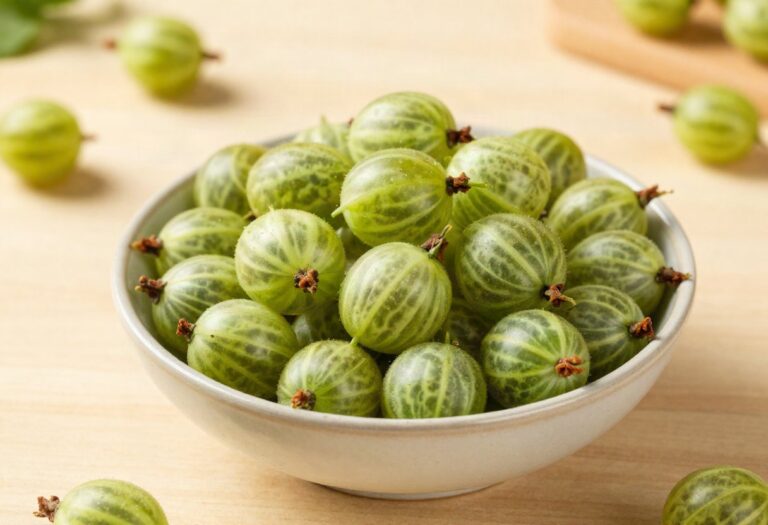
The gooseberry is a small, fleshy fruit, bigger than the redcurrant, whose translucent skin goes from sharp green to sweet pink depending on ripeness. Grown on thorny bushes, it is harvested mainly in early summer. Depending on the variety, its flavour ranges from very tart to milder, which makes it a versatile fruit in cooking as well as for eating plain. With only 39.4 kcal per 100 g, little fat and a good amount of fibre (4.3 g), it has its place in a balanced, varied diet. Rich in water, it brings freshness and lightness, perfect for those watching their weight without giving up pleasure.
Macronutrient breakdown
Nutrition table per 100 g
| Calories | 39 kcal |
| Kilojoules | 165 kJ |
| Protein | 0,9 g |
| Carbohydrate | 4,5 g |
| Fat | 0,6 g |
| Fibre | 4,3 g |
Micronutrients per 100 g
All measured nutrients, ranked by share of the daily reference intake.
- Vitamin C27,7 mg35 %
- Potassium198 mg10 %
- Copper0,07 mg7 %
- Manganese0,14 mg7 %
- Omega-3 ALA0,12 g6 %
- Vitamin B60,08 mg6 %
- Vitamin B50,29 mg5 %
- Phosphorus27 mg4 %
- Vitamin B9dietary folate equivalents6 µg
See the other 11 nutrients
- Vitamin B10,04 mg4 %
- Calcium25 mg3 %
- Vitamin E0,37 mg3 %
- Magnesium10 mg3 %
- Iron0,31 mg2 %
- Vitamin B20,03 mg2 %
- Vitamin B30,3 mg2 %
- Omega-6 LA0,17 g2 %
- Zinc0,12 mg1 %
- Iodine0,3 µg0 %
- Selenium0,07 µg0 %
Anses Ciqual 2025. Source: Anses, 2025, Ciqual food composition table
Tips
The gooseberry is enjoyed raw and fully ripe, or cooked in compote, jam, tart and coulis. Its hint of acidity also suits savoury dishes, notably oily fish (in French it is called “mackerel currant”, a nod to its traditional pairings). A portion of 100 to 150 g is more than enough to enjoy its benefits and its interesting nutrition facts.
- Calories and slimming: with 44 kcal and 4.45 g of carbohydrate per 100 g, this fruit has a low energy density. Its 4.3 g of fibre promotes fullness, an asset in a balanced diet.
- Key nutrients: it provides vitamin C, fibre and antioxidant compounds. To find out more, discover foods rich in antioxidants.
- Storage: keep it for a few days in the fridge, or freeze it to make coulis out of season.
In the kitchen, favour gentle cooking to preserve vitamin C and flavour. In sweet recipes, go easy on the sugar so as not to add to the calories: the gooseberry is naturally tart, but its glycaemic index stays moderate when eaten plain.
For active people: this light, hydrating fruit makes an excellent refreshing snack. Before exercise, its simple carbohydrates provide a burst of energy without heaviness. After training, add it to a yoghurt, fromage blanc or a smoothie to combine recovery and pleasure. For a more complete, higher-protein snack, take inspiration from these high-protein snack ideas, adding a handful of gooseberries.
You can vary your treats by pairing it with other small fruits of the same family such as the redcurrant or blackcurrant, or with sweeter berries such as blueberry. To compare its intake with that of other fruits, browse the fruit family.
In short, the gooseberry is a smart fruit: low in calories, rich in fibre and water, and versatile in the kitchen. Eat it fresh in season to get the most from its carbohydrates (and its small but present amount of protein) and its benefits, without too much added sugar.