Group · Condiments & sauces
Tamari
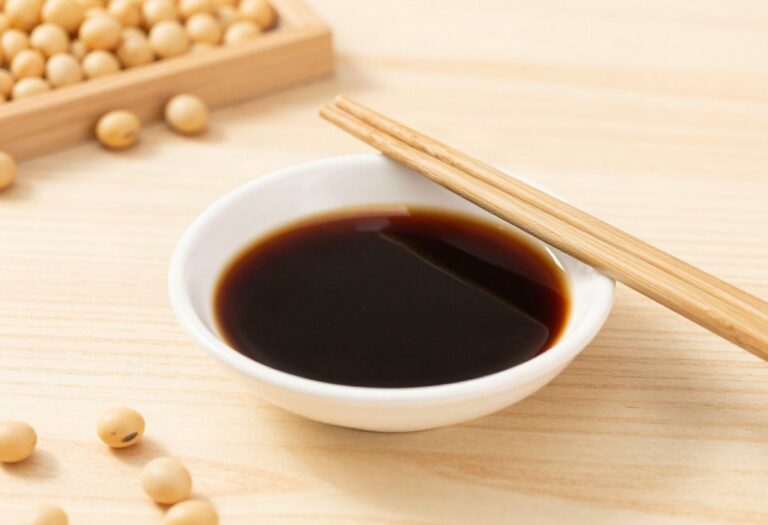
Tamari is a Japanese soy sauce brewed without wheat, or with only a tiny amount. It is the historic by-product of making miso: the liquid that runs off from the vats. Thicker, rounder and less sharp than ordinary soy sauce, it is also the only kind suited to gluten-free diets.
In terms of nutrition facts, it provides 39.9 kcal per 100 g, with 7.25 g of protein, 1.72 g of carbohydrate and 0.6 g of fat. The figure that matters is elsewhere: 13.1 g of salt per 100 g. The entry is matched to the Ciqual line « Sauce soja, préemballée » (pre-packed soy sauce), as the table does not distinguish tamari.
Macronutrient breakdown
Nutrition table per 100 g
| Calories | 40 kcal |
| Kilojoules | 170 kJ |
| Protein | 7,3 g |
| Carbohydrate | 1,8 g |
| Fat | 0,6 g |
| Fibre | 0,9 g |
Micronutrients per 100 g
All measured nutrients, ranked by share of the daily reference intake.
- Manganese0,86 mg43 %
- Phosphorus141 mg20 %
- Potassium375 mg19 %
- Magnesium60,9 mg16 %
- Iron2,1 mg15 %
- Iodine13,2 µg9 %
- Vitamin B60,11 mg8 %
- Zinc0,78 mg8 %
See the other 9 nutrients
- Vitamin B20,1 mg7 %
- Vitamin K15,3 µg7 %
- Selenium3,2 µg6 %
- Calcium28,9 mg4 %
- Vitamin C2,64 mg3 %
- Vitamin B10,03 mg3 %
- Vitamin B50,15 mg3 %
- Total omega-30,02 g1 %
- Vitamin A1,25 µg0 %
Anses Ciqual 2025. Source: Anses, 2025, Ciqual food composition table
Tips
13.1 g of salt, but a spoonful weighs 15 g. That is the real calculation: a tablespoon provides about 2 g of salt, spread across a dish for several people. Tamari is not dangerous, it is concentrated, and it should be measured like salt itself.
The golden rule: it replaces salt, it does not add to it. A dish seasoned with tamari does not need extra salt. Used this way, it adds flavour and umami without raising the total sodium of the meal.
Gluten-free: still check the label. Traditional tamari contains none, but some industrial versions add a little wheat. The « gluten-free » mention is the only reliable marker if you have coeliac disease.
It does not stand up to long cooking. Its aromas are volatile: added at the end of cooking or off the heat, it keeps all its depth. Simmered for twenty minutes, it leaves only saltiness.
It is useful well beyond Japanese cooking. A few drops in a vegetable soup, a vinaigrette or a dish of red lentils give depth to plant-based dishes that often lack it. The same logic applies as for miso.