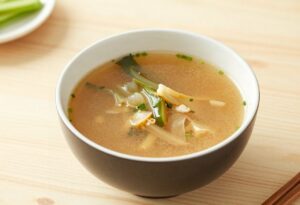
Group · Condiments & sauces
Miso (fermented soya bean paste)
Miso is a Japanese paste made by fermenting soya (sometimes with barley or rice). Salty and deeply umami, it flavours broths, marinades and sauces. As a fermented food, miso provides ferments that benefit the gut microbiota and lets you season dishes with real character; use it in small amounts.

Macronutrient breakdown
Nutrition table per 100 g
| Calories | 188 kcal |
| Kilojoules | 791 kJ |
| Protein | 12,8 g |
| Carbohydrate | 18,1 g |
| Fat | 6,1 g |
| Fibre | 5,4 g |
Micronutrients per 100 g
All measured nutrients, ranked by share of the daily reference intake.
- Manganese0,86 mg43 %
- Copper0,42 mg42 %
- Vitamin K129,3 µg39 %
- Zinc2,56 mg26 %
- Phosphorus159 mg23 %
- Iron2,49 mg18 %
- Vitamin B20,23 mg16 %
- Vitamin B60,2 mg14 %
See the other 10 nutrients
- Magnesium48 mg13 %
- Potassium210 mg11 %
- Vitamin B919 µg10 %
- Vitamin B10,1 mg9 %
- Calcium57 mg7 %
- Vitamin B30,91 mg6 %
- Vitamin B50,34 mg6 %
- Vitamin B120,08 µg3 %
- Vitamin A4,33 µg1 %
- Vitamin E0,01 mg0 %
Anses Ciqual 2025. Source: Anses, 2025, Ciqual food composition table
Tips
Miso is best known for miso soup, but it also elevates marinades, vinaigrettes and slow-cooked dishes. Golden rule: never boil it, as excessive heat destroys its ferments. Always dissolve it off the heat, at the end of cooking.
- Nutrition values: a source of plant protein and probiotics (unpasteurised miso); note that it is high in salt.
- Good to know: one teaspoon is enough to flavour a broth; reduce the added salt accordingly.
Like soy sauce, miso is a staple of Asian cooking. Keep it in the fridge, where it lasts a long time. Explore the Condiments & Sauces family for more ideas.
Sources
Average nutrition values per 100 g, given as a guide only (they may vary by brand and preparation).