Bee propolis: benefits, side effects, allergy and how to take it
The short answer
Bee propolis is a resin that honeybees collect from tree buds and bark, mostly poplar in Europe, to seal and protect the hive. It is rich in polyphenols such as flavonoids. Its best-studied benefits in people are local: a throat spray cleared mild sore throats two days sooner than placebo, a lip cream healed cold sores faster, and propolis may speed up mouth ulcer healing, though that evidence is weak. For propolis swallowed in capsules to prevent infections, the data are thin. Its main risk is allergy: propolis is a well-known contact allergen (eczema), and breathing reactions have been reported. Avoid it if you are allergic to bee products, and check with your doctor if you have asthma or are pregnant or breastfeeding.
This article is for information and does not replace medical advice. A sore throat that lasts, a high fever or trouble breathing need a doctor.
What is bee propolis?
Often called “bee glue”, propolis is plant resin that bees mix with wax and their own secretions. Its makeup therefore depends on the trees and the region. A review by de Groot (Dermatitis, 2013) covers its antibacterial, antifungal and antiviral activity in the lab, its uses (supplements, cosmetics, oral care) and its adverse effects.
| Type | Plant source | Good to know |
|---|---|---|
| Brown or poplar-type propolis | Poplar buds (Europe, China) | Most common in Europe; best studied for contact allergy |
| Green propolis | Brazilian Baccharis | Different chemistry; results do not transfer between types |
| Red or black propolis | Other regional plants | Little human data |
It comes as throat sprays, syrups, tinctures (alcohol extracts), lip creams, and purified propolis in capsules or powder. Studies do not all use the same form.
Propolis benefits: what the studies show
Sore throat and mild upper respiratory infections
In a double-blind randomised trial (Esposito et al., Phytomedicine, 2021), 122 adults with a mild throat infection used a poplar propolis oral spray standardised for polyphenols, or a placebo, three times a day for five days. After 3 days, 83% of the propolis group were symptom-free, while 72% of the placebo group still had at least one symptom. By day 5 everyone had recovered, so propolis saved about two days, with no related side effects. It was one single-centre trial of a specific spray (12 to 24 mg of polyphenols a day), applied directly to the throat.
Mouth ulcers: maybe faster healing, very weak evidence
A meta-analysis (Roberts et al., Dental Journal, 2024) of 10 trials and 825 adults with recurrent canker sores found propolis (mostly applied to the mouth, sometimes as tablets) may shorten healing and ease pain and redness. The authors rated the certainty of evidence very low. Side effects were few in short-term use.
Cold sores: a 0.5% lip cream
In a double-blind trial (Jautová et al., 2019) of 397 people at the blister stage, a 0.5% propolis extract cream led to crusting in a median of 3 days, versus 4 days with 5% aciclovir cream, with no allergic reactions reported in that trial.
Immune support: mostly lab data
Propolis inhibits microbes in a test tube, which does not prove a capsule prevents colds. Solid trials of swallowed propolis for preventing infections are lacking. See how to boost your immune system with food and our best immune support supplement comparison.
Propolis side effects and allergy
Contact allergy: the most common problem
Propolis is a recognised contact allergen that can trigger eczema on the skin or around the mouth, especially from creams, balms, sprays and oral care products. Among patients undergoing patch testing for dermatitis in North American clinics (DeKoven et al., 2026), positive reactions to poplar-type propolis ran at 2.2% to 3.7% depending on the year. That figure applies to people already being assessed for eczema, not the general population, but sensitisation is far from rare.
Breathing reactions and allergic people
Italy’s surveillance system for natural products (Menniti-Ippolito et al., 2008) received 18 reports linked to propolis over five years: 16 were allergic reactions, skin or respiratory, 6 needed hospital or emergency care and 2 were life-threatening. Seven people, four of them children, had a history of allergy. The authors warn that atopic and asthmatic people are at higher risk and advise against propolis in allergic people, especially those with pollen allergy.
- allergy to bee products (propolis, pollen, royal jelly, honey: avoid;
- asthma, atopic eczema, multiple allergies: ask your doctor first;
- pregnancy and breastfeeding: no proper safety data; ask your doctor or midwife and avoid alcohol tinctures. For honey, see can you eat honey when pregnant;
- children: not under 3 according to product labels, and with care after that;
- medication: ask your doctor or pharmacist.
Stop at once if you notice itching, redness or swollen lips, a rash, coughing, wheezing or trouble breathing. Breathing difficulty or a swollen face is an emergency.
How to take propolis
- For the throat: the clearest human data come from an oral spray, 2 to 4 sprays three times a day for 5 days.
- Capsules or powder: follow the label dose. No dose of swallowed propolis has been validated in trials.
- First time: start small and watch your skin and breathing, especially if you have allergies.
- Duration: short courses, when needed. The trials above lasted days.
- Propolis honey or syrup: mind the sugar if you watch your blood sugar; see honey and diabetes.
The powder mixes easily into a drink, smoothie or yoghurt; a little honey softens its resinous taste.
Nutrition•pro: organic poplar propolis, in capsules or powder
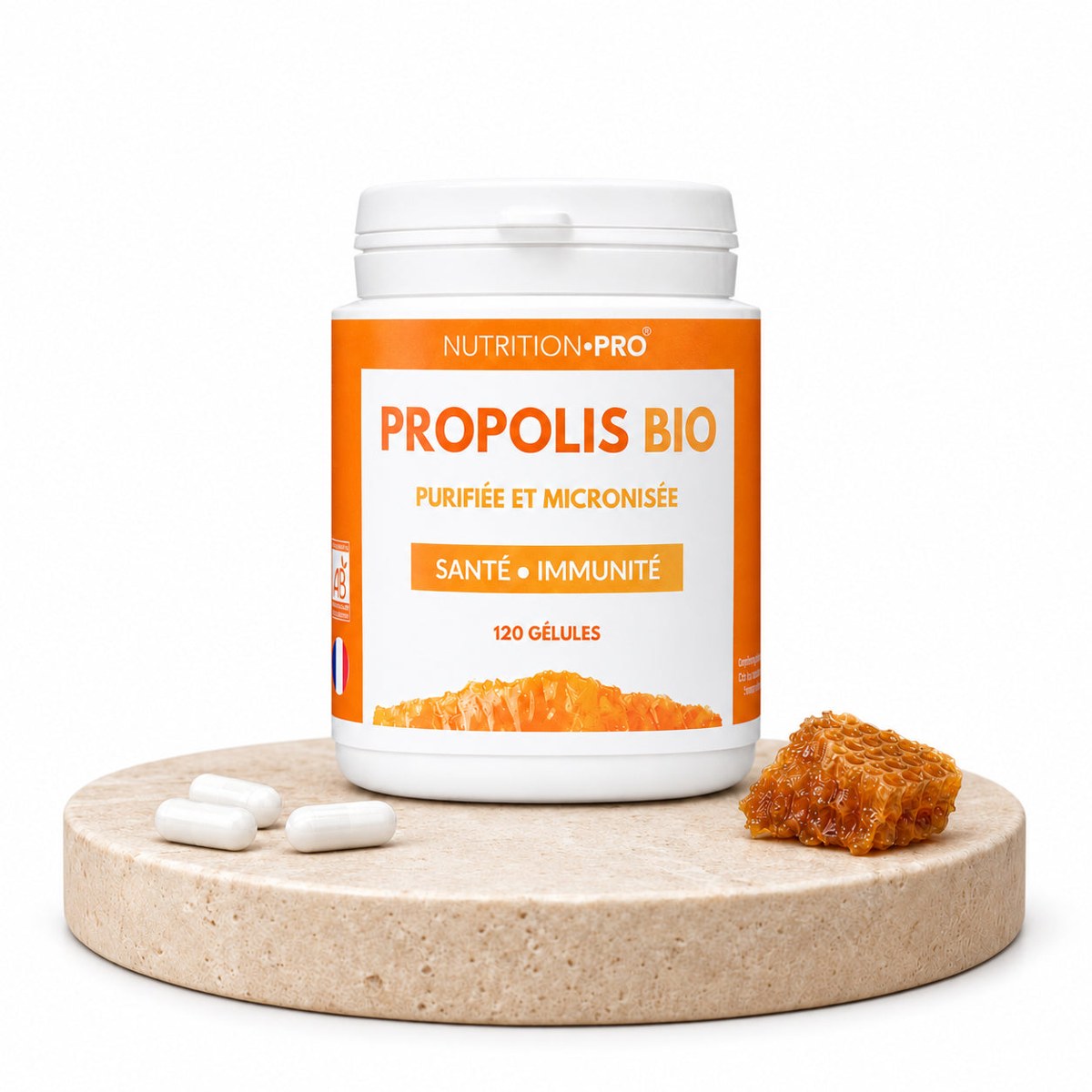
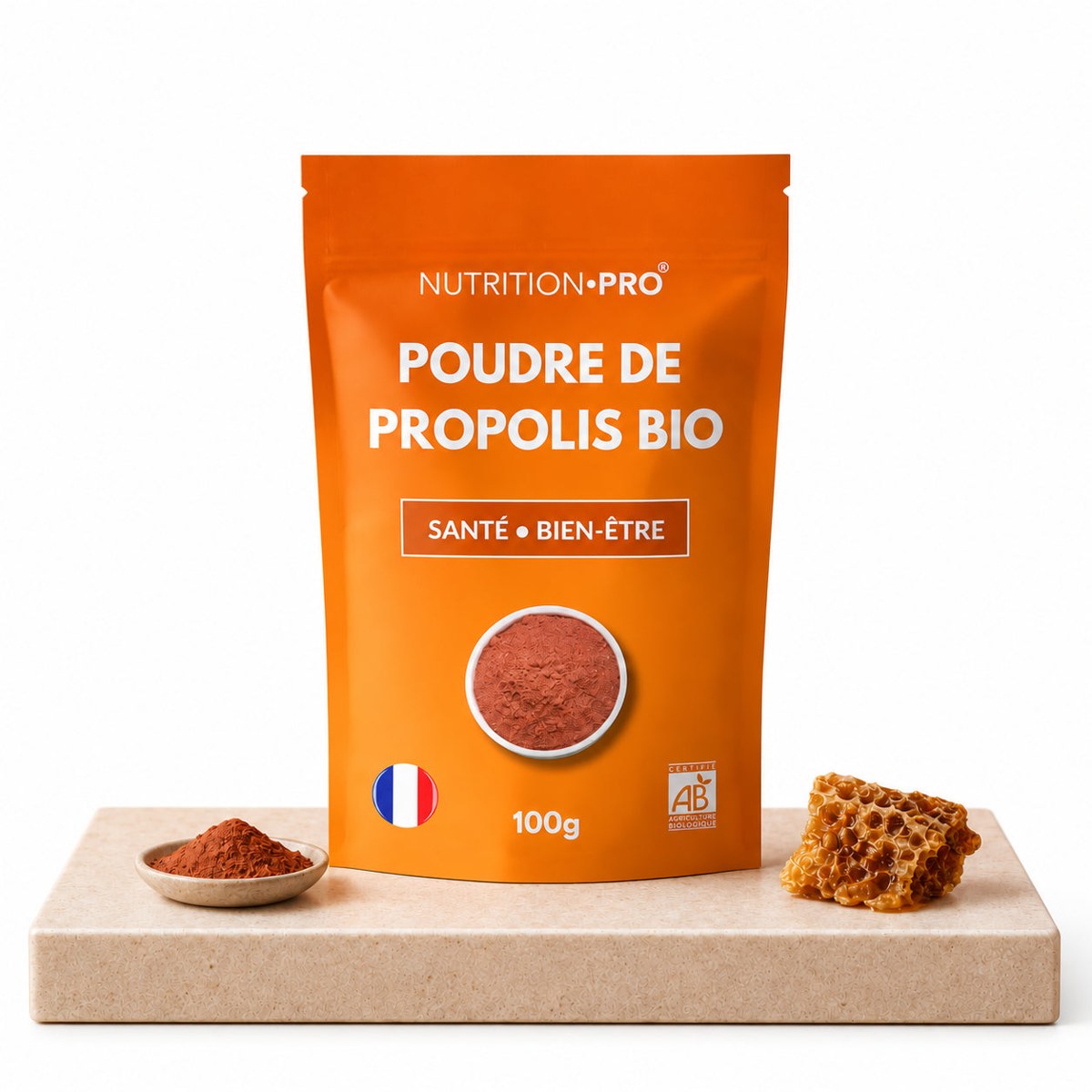
Nutrition•pro, a French brand based in Paris, offers certified organic propolis, purified and micronised, GMO-free, gluten-free and nanoparticle-free. The product page names its plant source: poplar bud resin (Populus), the most common type in Europe and the type used in the sore throat trial above. The page displays a “made in France” mention; it does not state the country where the propolis is harvested. It is a single-ingredient product.
| Organic propolis (capsules) | Organic propolis powder | |
|---|---|---|
| Ingredients | Organic poplar bud propolis; vegetable capsule (HPMC) | 100% purified, micronised organic propolis extract |
| Suggested use | 4 capsules a day, 1.4 g of propolis (350 mg per capsule) | 1 to 2 g a day (½ to 1 teaspoon) |
| Pack size | 120 capsules, 30 days | 100 g, 50 to 100 days (also 500 g) |
| Price (checked on 22/11/2026) | €29.99, about €1.00 a day | €34.99 per 100 g, €0.35 to €0.70 a day; €119.99 per 500 g |
With code SEOCONSULTINGSL |
€26.99, about €0.90 a day | €31.49 per 100 g; €107.99 per 500 g |
How does this compare with the research? The trials above used a throat spray, a mouth gel or a lip cream with standardised extracts, so their results do not transfer directly to swallowed capsules or powder. The appeal here is simplicity: organic propolis from a named plant source, no additives, a clearly stated dose. The powder is the most economical and flexible option; capsules avoid the resinous taste.
The brand’s own precautions match the evidence: not for people allergic to bee products, adults and children over 3 only, medical advice in pregnancy, breastfeeding or when on medication, and do not exceed the suggested dose.
Promo code: SEOCONSULTINGSL for 10% off your order (discounted prices as of 22/11/2026 in the table above).
See Nutrition•pro organic propolis capsules →
See Nutrition•pro organic propolis powder →
Partner link: we earn a commission if you order through this link, at no extra cost to you.
Frequently asked questions
What are the benefits of bee propolis?
In people, the clearest results are local: a spray shortened mild sore throats by two days, a cream sped up cold sore healing, and propolis may help mouth ulcers. Its antibacterial and antiviral effects are mainly shown in the lab.
Is propolis safe?
For most non-allergic adults in short courses, side effects are uncommon. The main risk is allergy, from contact eczema to rare serious breathing reactions.
Who should not take propolis?
Anyone allergic to bee products; people with asthma or many allergies without medical advice; and pregnant or breastfeeding women without their doctor’s agreement.
Is propolis anti-inflammatory?
It shows anti-inflammatory effects in the lab and reduced ulcer pain and redness in small trials, but it is not an anti-inflammatory drug.
Green, brown or red propolis: which is best?
Their chemistry differs with the plants bees visit, and study results only apply to the propolis studied. Poplar (brown) propolis is the most common in Europe and the best known.
Sources
- de Groot A.C. Propolis: a review of properties, applications, chemical composition, contact allergy, and other adverse effects. Dermatitis, 2013; 24(6): 263-82. PubMed 24201459
- DeKoven J.G. et al. Comparison Between Brazilian Propolis and Chinese Propolis: Results From the North American Contact Dermatitis Group 2019-2022. Dermatitis, 2026; 37(4): 589-595. PubMed 41346018
- Menniti-Ippolito F. et al. Surveillance of suspected adverse reactions to natural health products: the case of propolis. Drug Saf, 2008; 31(5): 419-23. PubMed 18422383
- Esposito C. et al. A standardized polyphenol mixture extracted from poplar-type propolis for remission of symptoms of uncomplicated upper respiratory tract infection (URTI). Phytomedicine, 2021; 80: 153368. PubMed 33091857
- Roberts T. et al. Efficacy and Safety of Propolis for Treating Recurrent Aphthous Stomatitis (RAS): A Systematic Review and Meta-Analysis. Dent J (Basel), 2024; 12(1): 13. PubMed 38248221
- Jautová J. et al. Lip creams with propolis special extract GH 2002 0.5% versus aciclovir 5.0% for herpes labialis (vesicular stage). Wien Med Wochenschr, 2019; 169(7-8): 193-201. PubMed 30406509