Honey in pregnancy: allowed, and the one precaution that matters
The short answer
Yes, you can eat honey during pregnancy. Honey is not among the foods to avoid in the official French recommendations for pregnant women. The precaution you may have heard about concerns babies under one year old: Anses, the French food safety agency, advises against giving them honey because of infant botulism. In adults, and therefore in pregnant women, a mature gut prevents this risk. The only limit is the same as for sugar: honey is a sugar, to be eaten in moderation, and watched closely if you have gestational diabetes.
These guidelines follow the official French recommendations. If in doubt, your midwife or doctor can answer your questions.
Why the question comes up: botulism
Honey can contain spores of Clostridium botulinum, the bacterium that causes botulism. In infants, whose gut flora is still immature, these spores can germinate in the intestine and produce a toxin: this is infant botulism, a rare but serious illness. This is why Anses recommends not giving honey to children under one year old.
In adults, gut flora stops these spores from germinating: eating honey does not cause botulism. Pregnancy does not change this mechanism. Honey does not appear on the Manger Bouger list, on the Ameli list, or on the 1000 premiers jours website of Santé publique France either.
Infant botulism in France: a rare illness
To put this risk in perspective, the data from Santé publique France is reassuring: infant botulism remains rare in France, with 6 cases identified between 2013 and 2016, and 9 between 2004 and 2012. The affected babies had a median age of 3 months, ranging from 1 to 6 months.
Honey is not the only possible source, either: Santé publique France states that while it has been implicated in some cases, notably in the United States and Italy, a contamination of environmental origin, through dust or soil containing spores, is most often suggested. The Anses recommendation stays simple and applies to all babies: no honey before the age of one, whether in bottles, on a dummy, or in home-made preparations.
For a pregnant woman, none of this applies: spores do not germinate in an adult gut.
The honey traffic light
| Product | Pregnant | Why |
|---|---|---|
| Shop-bought honey, all varieties | 🟢 allowed | not covered by precautionary recommendations |
| Artisan honey, from a beekeeper | 🟢 allowed | same rule |
| Honey in herbal tea, yoghurt or baking | 🟢 allowed | in moderation, like sugar |
| Honey with gestational diabetes | 🟠 conditional | it is a sugar: in a small amount, within the limits set by your care team |
| Royal jelly, propolis, pollen supplements | 🟠 conditional | supplements: discuss with your doctor or midwife |
| Mead, honey liqueurs | 🔴 avoid | alcohol, not recommended at all during pregnancy |
Royal jelly, propolis, pollen: the other hive products
While honey poses no particular problem during pregnancy, the other hive products, often sold as supplements, call for more caution. Anses was asked to investigate after three cases of severe allergy linked to supplements containing pollen or hive products, and it reminds us of several points:
- pollen can be present in royal jelly, propolis or even honey, without being stated explicitly on the label;
- hive products can cause reactions ranging from simple dermatitis to a life-threatening anaphylactic reaction;
- foods and supplements containing pollen or hive products are to be avoided if you have asthma or an allergy-prone background, and in particular a pollen allergy.
| Product | During pregnancy |
|---|---|
| Honey, as part of a normal diet | 🟢 allowed, in moderation |
| Royal jelly, propolis, pollen supplements | 🟠 discuss with your doctor or midwife, like any supplement |
| Hive products if you have asthma or a pollen allergy | 🔴 avoid, according to Anses |
During pregnancy, a severe allergic reaction is particularly important to avoid. If you are allergic to pollen or have asthma, it is therefore best to give up these supplements. And if a side effect occurs after taking a supplement, it can be reported to the Anses nutrivigilance scheme.
How much and how often
| For | Calories | Carbohydrate |
|---|---|---|
| One teaspoon, 7 g | 23 kcal | 5.7 g |
| One tablespoon, 21 g | 70 kcal | 17.2 g |
Honey is more than 80% sugars, fructose and glucose. The WHO classes it among the free sugars, along with sugar, syrups and fruit juices, and recommends limiting them to less than 10% of energy intake, ideally 5%, or about 25 g a day. One tablespoon of honey makes up two thirds of that. A teaspoon in a yoghurt or herbal tea is a reasonable guide.
And is honey a better choice than sugar? Not really: its average glycaemic index, 61, is close to that of sugar, 65, and a spoonful of honey provides more carbohydrate than a spoonful of sugar. The details are in our guide to honey and diabetes.
Honey or sugar: a spoon-for-spoon comparison
| One teaspoon | Weight | Calories | Sugars |
|---|---|---|---|
| Honey | 7 g | 23 kcal | 5.7 g |
| White granulated sugar | 4.2 g | 17 kcal | 4.2 g |
Per 100 g, honey is slightly lower in calories than sugar, 331 kcal against 399, because it contains 17% water. But a spoonful of honey, being denser, weighs almost twice as much as a spoonful of granulated sugar: by the spoonful, honey therefore provides more sugars. If you swap the sugar in your yoghurt for honey “because it is more natural”, you are actually eating a little more. As for blood sugar, their glycaemic indexes are close: 61 for honey, 65 for sugar, on average.
Honey, maple syrup, agave: sweeteners compared
During pregnancy, people sometimes look to replace sugar with something seen as more natural. Here is what the Ciqual table and the international glycaemic index tables say:
| 100 g of | Calories | Sugars | of which fructose | of which glucose | Glycaemic index |
|---|---|---|---|---|---|
| Honey | 331 kcal | 81.1 g | 40.4 g | 35.3 g | 61 on average |
| White sugar | 399 kcal | 99.7 g | sucrose | sucrose | 65 |
| Brown sugar | 393 kcal | 97.0 g | 1.1 g | 1.4 g | not measured |
| Maple syrup | 269 kcal | 60.2 g | 0.4 g | 1.1 g | 54, pure syrup |
| Agave syrup | not measured | 68.0 g | not measured | 9.6 g | 10 to 19 |
Maple syrup is the least sugary weight for weight, because it contains more water. Agave syrup shows a very low glycaemic index, but for a simple reason: it is mostly made of fructose, which raises blood sugar very little. All of them remain free sugars as defined by the WHO, to be limited in the same way. None of them is a “good sugar” during pregnancy.
Not all honeys have the same glycaemic index
The figure of 61 is an average. In Atkinson’s international tables, the 17 honeys tested range from a glycaemic index of 35 to 87. The differences partly follow their fructose content: among Australian honeys, yellow box, at 46% fructose, has an index of 35, against 72 for a commercial blend with 28% fructose. A Canadian honey, of unspecified type, reaches 87.
In practice, these differences cannot be used in the supermarket: the fructose content is not shown on the jars, and the honeys tested are mostly Australian and American. For a pregnant woman, and even more so with gestational diabetes, the rule remains about quantity: a teaspoon, at the end of a meal, rather than a tablespoon on an empty stomach.
With gestational diabetes
Gestational diabetes means limiting free sugars, honey included. It does not have to be banned entirely, but kept for small amounts, at the end of a meal rather than on an empty stomach, and within the advice of the team following your pregnancy. Honey does have one specific use if you are treated with insulin: a tablespoon is among the sugar boosts recommended for hypoglycaemia by the Fédération Française des Diabétiques. See also our guide to eating during pregnancy.
What honey provides during pregnancy
Honey mainly provides energy. Its vitamins and minerals are present in negligible amounts at the scale of a spoonful. It does not replace the foods that matter during pregnancy: dairy products for calcium, fish for omega-3 and iodine, green vegetables and pulses for folate. See our guides to foods high in calcium and foods high in iron.
Choosing your honey: fraud and labelling
The real quality issue with honey is not health-related but commercial. During a European Union coordinated operation in 2021-2022, called “From the Hives”, 147 of the 320 imported honeys checked at the Union’s borders, or 46%, were strongly suspected of having been cut with sugar, beet, rice or wheat syrups. In a comparable check in 2015, that rate was 14%.
A honey cut with syrup is not dangerous in itself, but you are paying honey prices for syrup. To limit this risk, labelling has changed: since 14 June 2026, under a 2024 European directive, honey blends must list their countries of origin in descending order, with the percentage of each to within 5%. Small jars under 30 g can use a two-letter code for each country.
- A honey from a single origin, French or otherwise, clearly stated, is easier to trace.
- A very low price for a blended honey should give you pause.
- During pregnancy as at any other time, all genuine honeys are equal as far as safety is concerned.
Jars labelled before 14 June 2026 can still be sold until stocks run out: so you will still find the old wording “blend of EU and non-EU honeys” for a while.
Gingerbread, nougat, cereals: hidden honey
Honey is also eaten without a spoon, in everyday sweet products. Pain d’épices (French spiced gingerbread) is the classic example. Of the 56 pains d’épices sold in France with a legible ingredients list on Open Food Facts:
- 36 state their honey content: from 5.8% to 56%, with a median value of around 21%;
- 9 contain no honey at all;
- 39 also contain glucose or invert sugar syrup.
In other words, a pain d’épices is often more of a sugar cake than a honey cake. According to Ciqual, 100 g of pain d’épices provides 318 kcal and 40.8 g of sugars; 100 g of soft nougat, 437 kcal and 60.8 g of sugars. These products are allowed during pregnancy, but they count towards the day’s sugars, like honey itself.
Ideas for using it
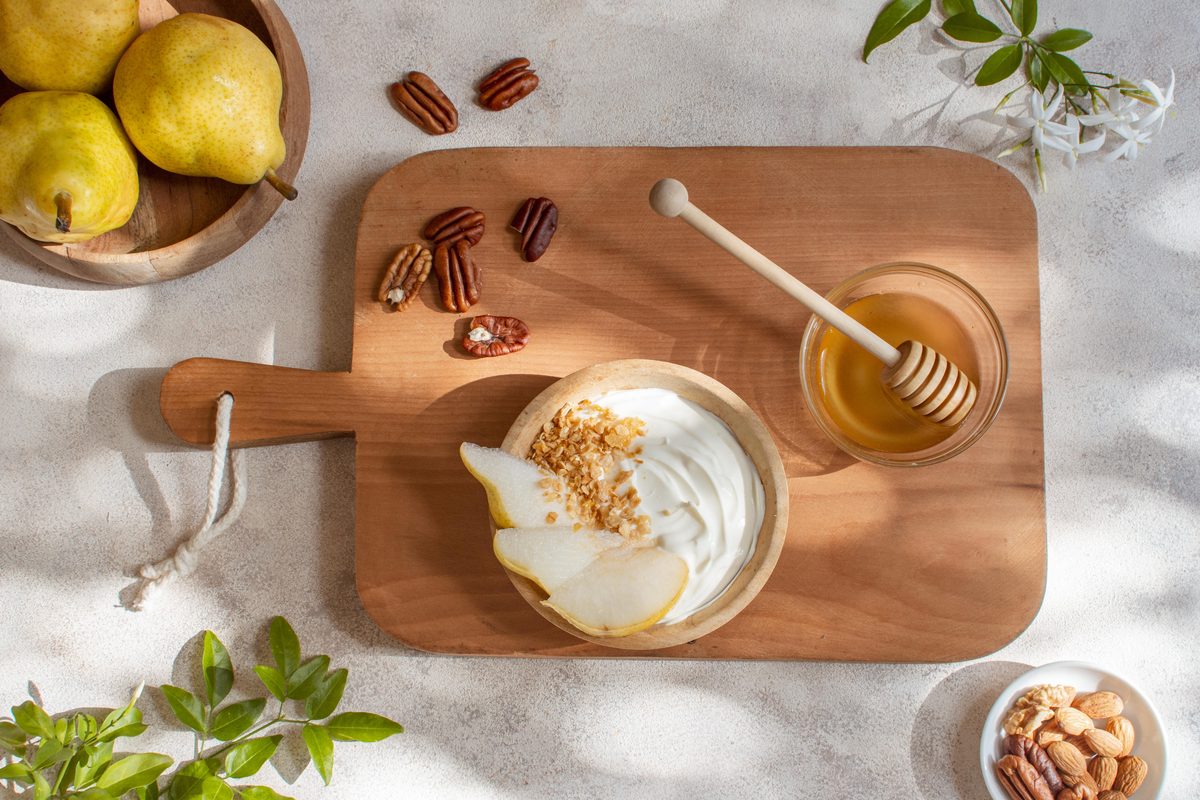
- A teaspoon in plain yoghurt, with washed fresh fruit.
- In a herbal tea such as camomile or verbena, in the evening.
- Porridge or overnight oats, with a drizzle of honey and cinnamon.
- Roast carrots with honey and cumin: honey in savoury cooking, in a small amount.
And while breastfeeding?
While breastfeeding, honey remains allowed for the mother: the authorities do not advise against it. However, you must not give it directly to the baby before the age of one, nor put it on a dummy. See our guide to eating while breastfeeding.
Frequently asked questions
Can you eat honey when pregnant?
Yes: honey is not one of the foods to avoid during pregnancy. Eat it in moderation, like sugar.
Is honey dangerous for the baby during pregnancy?
No. The risk of botulism concerns infants under one year old who eat honey themselves, not the foetus.
Is raw or artisan honey allowed when pregnant?
Yes, the official recommendations make no distinction for pregnant women.
Can you eat honey with gestational diabetes?
In a small amount, at the end of a meal and within the limits set by your care team. One tablespoon provides 17 g of carbohydrate.
Is royal jelly allowed when pregnant?
It is a food supplement: during pregnancy, any supplement should be discussed with your doctor or midwife.
How many cases of infant botulism are there in France?
Very few: 6 cases between 2013 and 2016, and 9 between 2004 and 2012, according to Santé publique France. The risk only concerns babies under one year old, not pregnant women.
Is honey healthier than sugar when pregnant?
Not really: by the spoonful, it actually provides slightly more sugars, 5.7 g against 4.2 g, and its glycaemic index is close. It should be eaten with the same moderation.
Is manuka honey recommended during pregnancy?
No official recommendation sets it apart from other honeys: it is allowed, with the same moderation, and does not replace any treatment.
How can I tell where my honey comes from?
Since 14 June 2026, blends must show their countries of origin in descending order, with their percentage.
Is pain d’épices allowed when pregnant?
Yes, it poses no safety problem. It is a sugary product: 40.8 g of sugars per 100 g according to Ciqual, and it often contains more glucose syrup than honey.
Is agave syrup better than honey during pregnancy?
No. Its glycaemic index is low because it is very rich in fructose, but it is a free sugar, to be limited like honey and sugar.
Do some honeys have a lower glycaemic index?
Yes, from 35 to 87 across the 17 honeys in Atkinson’s tables. But this information is not available on the jars: with gestational diabetes, quantity is what counts.
Can you eat it when pregnant? The series
Food by food, what is allowed, conditional or to avoid during pregnancy: cheesecake when pregnant, foie gras when pregnant, feta when pregnant, mozzarella when pregnant, raclette when pregnant, surimi when pregnant, cured meats when pregnant, smoked salmon when pregnant, tiramisu when pregnant, chorizo when pregnant, taramasalata when pregnant, camembert and brie when pregnant, prawns when pregnant, soft-boiled egg when pregnant, sushi when pregnant, cured ham when pregnant, hummus when pregnant, tinned tuna when pregnant.
Our sources
- Manger Bouger (Santé publique France), “Quels aliments éviter et quelles précautions prendre quand on est enceinte ?”, 2026 update.
- Santé publique France, 1000 premiers jours website; Ameli, foods to avoid during pregnancy.
- Anses: infant botulism, no honey before one year old.
- WHO, guideline on sugars intake, 2015; Fédération Française des Diabétiques: sugar boosts for hypoglycaemia.
- Ciqual 2025 table (Anses): honey; USDA FoodData Central, SR Legacy: weight of a spoonful of honey.
- Santé publique France, Bulletin épidémiologique hebdomadaire, “Le botulisme humain en France, 2013-2016”, 2018.
- European Commission, OLAF and Joint Research Centre: “From the Hives” operation against honey fraud, results published on 23 March 2023.
- Directive (EU) 2024/1438 of 14 May 2024, amending among others the honey directive: indication of countries of origin, applicable from 14 June 2026.
- Ciqual 2025 table (Anses): honey, white sugar; USDA, SR Legacy: spoon weights.
- Anses, opinion on three cases of allergy to food supplements containing pollen or hive products (referral 2017-SA-0215).
- Atkinson FS, Foster-Powell K, Brand-Miller JC. International Tables of Glycemic Index and Glycemic Load Values: 2008. Diabetes Care, 2008;31(12):2281-2283: honeys, maple syrup, agave nectars.
- Ciqual 2025 table (Anses): brown sugar, maple syrup, agave syrup, pre-packed pain d’épices, soft nougat.
- Open Food Facts, ingredient lists of 56 pains d’épices sold in France, data collected on 26 September 2026.